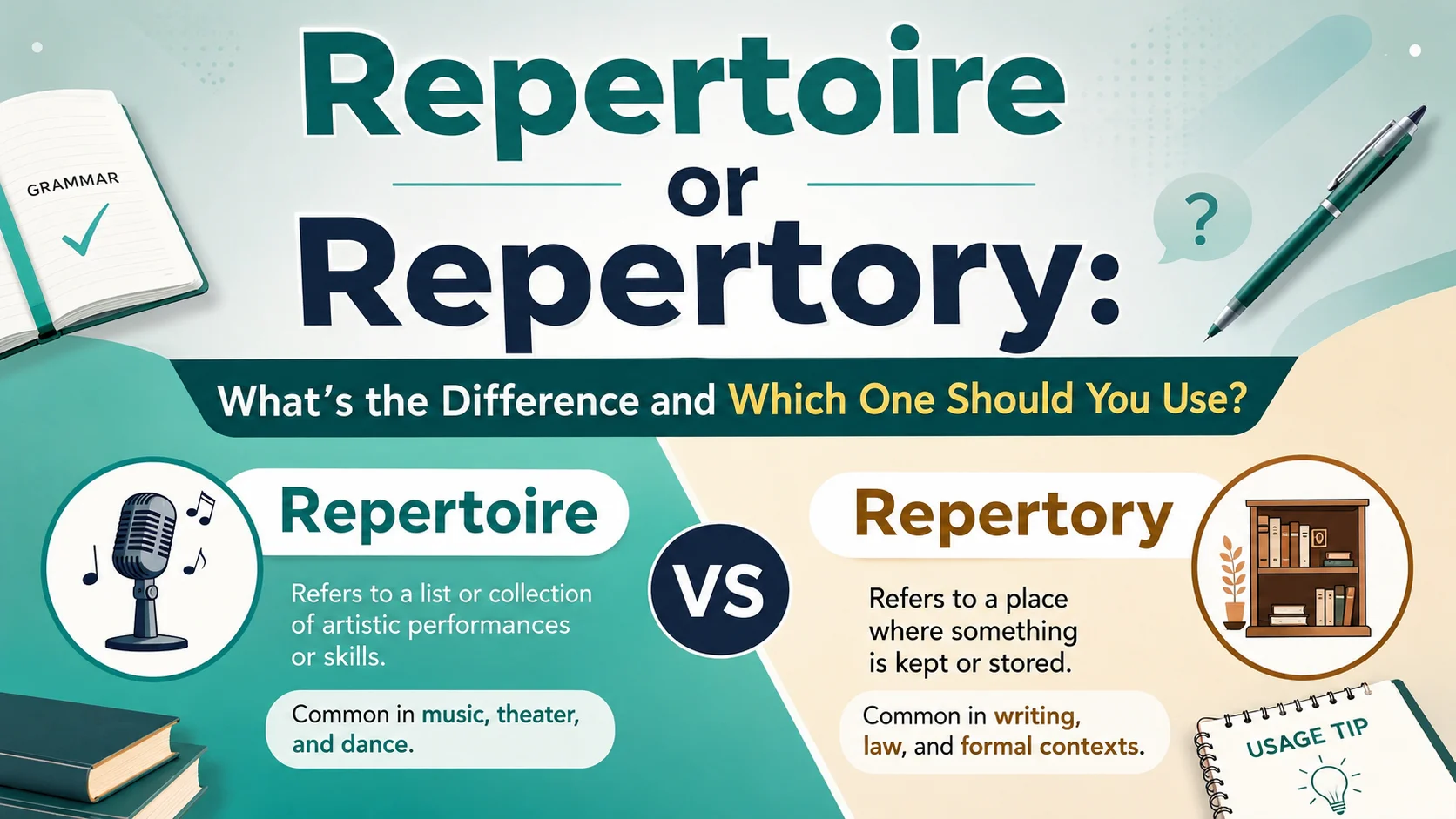
Repertoire or Repertory becomes clearer when you compare each word with the context, meaning, and purpose of the work being discussed in English. Both are legitimate words, but their usage isn’t identical. Repertoire usually describes a collection or range of things that a person or group can perform. A pianist can have a repertoire of songs and pieces, while a chef can develop a repertoire of cooking skills, methods, and techniques. The same idea can describe a pitcher’s available pitches, showing the person’s practical capabilities. In these examples, repertoire is the natural, established choice. Calling it repertory isn’t simply a harmless variation; in some contexts, it can create a misspelling or an incorrect assumption about the intended meaning. This distinction is an important detail because the two terms aren’t always interchangeable.
Repertory takes a more specialized path, especially in theater. A repertory company may prepare several plays and other works and present them on an alternating schedule during a season. Repertory theater commonly involves repertory companies, planned performances, a rotation of productions, and a particular system for presenting a body of works. The focus isn’t simply on what one person knows how to perform; instead, it often concerns the works selected for presentation and the way a company organizes those productions. This is where the difference between the terms becomes useful. Repertoire points toward someone’s available abilities or works they can perform, whereas repertory often relates to a collection of theatrical works and their presentation. Although the words are commonly confused, their distinct meanings become easier to recognize when you consider their pronunciation, spelling, and similar contexts.
The connection between the terms explains why this linguistic minutiae can cause confusion. Their historical meaning, related forms, and same root make them look closely connected, while real-world context determines the better choice. A musician may build a repertoire of pieces, but a theater company can maintain a repertory of productions. Dictionaries and encyclopedias can clarify these terms, while examples involving works, plays, songs, and performances show how usage changes according to context. Understanding how the terms originate also helps linguists and English enthusiasts explain why the words developed related but separate roles. In a sentence, choosing between them requires attention to these subtle differences rather than relying on spelling alone. Once you understand that distinction, the apparent linguistic showdown becomes much easier to navigate: you can rotate through different examples and identify which word fits the context without treating the two as automatically interchangeable.
Quick Answer: Repertoire vs. Repertory
Repertoire usually means a collection or range of works, skills, techniques, or capabilities that someone has available to use or perform.
Repertory can also mean a collection or range, but it has a more specific theatrical meaning. It can describe a system in which a company performs several different plays, operas, or other works during a particular period. It can also refer to the company or theater involved in that system.
| Word | Main meaning | Common use | Example |
| Repertoire | A range or collection of works, skills, or capabilities | Music, performance, cooking, sports, professional skills | “The pianist has an impressive repertoire.” |
| Repertory | A collection or range; also a theatrical performance system or company | Theater, opera, music, formal contexts | “She joined a repertory company.” |
A useful rule of thumb is:
Repertoire is usually the range of things someone can do or perform. Repertory can mean that range, but it also has a specialized theater meaning.
Neither spelling is automatically wrong. Context determines the better choice.
What Does Repertoire Mean?
Repertoire is a noun that refers to a collection or range of works that a person or group knows and can perform. It can also describe a range of skills, techniques, methods, or capabilities.
The word appears frequently in music and the performing arts. A singer might have a repertoire of songs. An orchestra might have a large repertoire of symphonies. A dancer might develop a repertoire of pieces over several years.
The meaning has also expanded well beyond performance.
A chef can have a repertoire of dishes. A baseball pitcher can have a repertoire of pitches. A negotiator can have a repertoire of strategies. In each case, the word describes a supply or range of things available to someone.
Repertoire as a Collection of Performable Works
The most familiar meaning involves performance.
Consider a pianist who has practiced 50 pieces. The pianist doesn’t necessarily perform all 50 at every concert. Instead, those pieces form part of the pianist’s repertoire.
For example:
- “The pianist expanded her repertoire this year.”
- “The band’s repertoire includes classic rock and contemporary songs.”
- “That concerto has become part of his repertoire.”
- “The choir has a surprisingly diverse repertoire.”
- “The orchestra’s repertoire ranges from Baroque works to contemporary compositions.”
Here, repertoire means the collection of works that the performer knows and can potentially present.
Repertoire as a Range of Skills
The word becomes especially interesting when you move beyond music.
Someone’s repertoire can include the skills and techniques they have developed. In this sense, the word works almost like a toolbox. A carpenter has tools. A skilled professional has methods, techniques, and solutions.
For example:
- “Public speaking is part of her professional repertoire.”
- “The pitcher has added a new slider to his repertoire.”
- “The chef has an impressive repertoire of vegetarian dishes.”
- “The teacher has several classroom techniques in her repertoire.”
- “The mechanic has a broad repertoire of diagnostic methods.”
Merriam-Webster specifically recognizes this broader sense, including a supply of skills, devices, solutions, and capabilities.
That makes repertoire useful in everyday writing. You don’t need to be discussing theater or music to use it correctly.
Repertoire in Everyday and Figurative English
You can also use repertoire figuratively when someone has developed a recognizable range of actions or responses.
Imagine a comedian who always uses three particular jokes when a conversation becomes awkward. Those jokes form part of the comedian’s conversational repertoire.
Likewise, a salesperson may have a repertoire of responses for common objections. A coach may have a repertoire of training drills. A writer may have a repertoire of storytelling techniques.
The basic idea remains the same:
Repertoire = the collection of things available within someone’s range.
What Does Repertory Mean?
Repertory is also a noun, and its meanings overlap with repertoire. However, repertory has a distinctive connection with theater.
Merriam-Webster defines repertory as repertoire in one sense. It also defines it as a company that presents several different plays, operas, or pieces, usually alternately during a season. It can additionally refer to a theater that houses such a company or to the practice of producing and presenting works in this way.
That theatrical meaning is the key distinction to remember.
Repertory as a Collection of Works
In some contexts, repertory simply means a collection or range of works.
For example:
- “The orchestra explored the modern symphonic repertory.”
- “The conductor has studied a difficult repertory.”
- “The festival featured an unusual repertory of early works.”
This usage is legitimate. Major dictionaries recognize repertory as a synonym of repertoire.
Still, that doesn’t mean the two words always feel equally natural.
In many general contexts, especially when talking about a person’s skills or musical works, repertoire is the more familiar choice for American readers.
Repertory as a Theater System
The specialized theatrical meaning is where repertory becomes much more distinctive.
A repertory theater presents several different works rather than concentrating exclusively on one production. A company may perform one play on one night and another play on a different night.
For instance, imagine a theater company with three productions:
- Hamlet
- The Importance of Being Earnest
- A Doll’s House
Instead of running Hamlet for an entire season and then replacing it, the company might rotate the productions. Hamlet could play on Friday. Another production could appear Saturday. Hamlet might return the following week.
That is the basic idea behind repertory theater.
Cambridge describes a repertory arrangement as one in which several plays are performed by the same company on different days.
Repertoire vs. Repertory: The Main Difference
The easiest way to understand repertoire vs. repertory is to focus on what the word is emphasizing.
Repertoire usually emphasizes the collection itself.
Repertory can emphasize the collection, but it can also emphasize the theatrical system or organization that presents the collection.
Think of it this way:
Repertoire is the toolbox. Repertory can be the toolbox plus the system for using it.
That isn’t a strict grammatical rule. It’s a practical memory aid.
Collection vs. Performance Organization
Compare these sentences:
“The singer expanded her repertoire.”
This sentence focuses on the songs the singer can perform.
Now consider:
“The actor joined a repertory company.”
This sentence isn’t simply describing the actor’s collection of plays. It identifies a particular type of theatrical company.
The difference becomes even clearer with the phrase in repertory.
“The play is currently in repertory.”
That means the play forms part of a rotating schedule of works performed by the company.
You wouldn’t normally replace repertory with repertoire in that established expression.
When Repertoire and Repertory Are Interchangeable
There are situations where the two words overlap.
Suppose you’re discussing a collection of musical works. Both of these sentences can be understood:
- “The orchestra’s repertoire is extensive.”
- “The orchestra’s repertory is extensive.”
The meanings are essentially the same in this context.
Dictionaries explicitly recognize this overlap. Oxford lists repertory as a formal synonym for repertoire, including the collection of plays, songs, and musical pieces a performer knows and can perform.
However, grammatical correctness isn’t the only concern when choosing a word. Natural usage matters too.
For general American English, repertoire often feels more familiar when describing someone’s range of works or abilities. Repertory becomes especially natural when the context involves theater, rotating productions, or established expressions such as repertory company.
When Repertoire and Repertory Are Not Interchangeable
Some expressions strongly favor one word.
Repertory Company
Repertory company is the established term for a theatrical company that presents several works.
Example:
“After graduating from drama school, she joined a repertory company.”
Calling it a repertoire company would sound unusual because repertory company is the established expression.
Repertory Theater
The standard phrase is:
repertory theater
A repertory theater typically has a company associated with multiple productions that may be performed in rotation. Collins defines American repertory theater as a theater in which a permanent company presents several plays or operas during a season, usually in alternating limited runs.
In Repertory
The phrase in repertory has a specific meaning.
If a play is “in repertory,” it means the production is one of several works being performed by the same company during a particular period.
For example:
“The production will remain in repertory throughout the summer.”
This wording describes a performance arrangement, not merely a list of available works.
Repertoire or Repertory in Music
Music is one of the areas where the distinction can become blurry.
Both words can refer to collections of musical works. However, repertoire is extremely common.
You might hear or read:
- classical repertoire
- piano repertoire
- vocal repertoire
- orchestral repertoire
- jazz repertoire
- contemporary repertoire
- choral repertoire
For example:
“The pianist specializes in twentieth-century piano repertoire.”
Here, repertoire refers to the body of music the pianist studies or performs.
Repertory can also occur in musical contexts, particularly in formal or specialized writing.
For example:
“The conductor has explored rarely performed orchestral repertory.”
That sentence is legitimate. The choice doesn’t automatically make the writer’s English incorrect.
The important point is that repertory is not merely a theatrical spelling of repertoire. It has a broader dictionary history, even though its theatrical meaning is particularly prominent.
Repertoire or Repertory in Theater
Theater provides the clearest distinction between the two words.
Consider these examples:
“The actress has a broad repertoire of dramatic roles.”
Here, repertoire describes the range of roles she can perform.
Now consider:
“The actress works in repertory.”
Here, repertory describes the type of theatrical work she is doing.
And:
“She joined a repertory company.”
Again, repertory identifies the theatrical organization.
This difference can be summarized like this:
| Sentence | What the word emphasizes |
| “She has a broad repertoire of roles.” | Her range of roles |
| “She works in repertory.” | The theatrical system |
| “She joined a repertory company.” | The type of theater company |
| “The theater has an impressive repertoire.” | Its collection of works |
| “The theater presents plays in repertory.” | Its rotating performance system |
The distinction becomes much easier once you look at what the sentence is actually describing.
Repertoire or Repertory for Skills and Abilities
When you’re describing someone’s skills, repertoire is generally the more natural choice.
Consider a basketball player. You might say:
“The guard has an impressive offensive repertoire.”
That could include different shots, drives, passes, and moves.
Similarly:
“The chef has developed a large repertoire of sauces.”
Or:
“The negotiator has a useful repertoire of strategies.”
In each example, repertoire means a collection of abilities or techniques available to someone.
Cambridge also recognizes repertory in the broader sense of the things someone can do or the methods someone can use, with repertoire listed as its synonym.
So repertory isn’t grammatically impossible in these sentences. It’s simply less likely to be the first choice for many American readers.
Natural Choices for Skills
| Context | More natural choice | Example |
| Cooking skills | Repertoire | “She has a broad culinary repertoire.” |
| Baseball pitches | Repertoire | “His pitching repertoire includes five pitches.” |
| Communication techniques | Repertoire | “The speaker has a useful repertoire of techniques.” |
| Professional methods | Repertoire | “The consultant has a wide repertoire of strategies.” |
| Theater company | Repertory | “He joined a repertory company.” |
| Rotating plays | Repertory | “The plays are being performed in repertory.” |
Repertoire vs. Repertory Example Sentences
Seeing the words in context is often more useful than memorizing definitions.
Music Examples
- “The violinist expanded her repertoire with several contemporary works.”
- “The choir’s repertoire includes traditional spirituals.”
- “The orchestra performed a rarely heard orchestral repertory.”
- “That composition has become part of his concert repertoire.”
- “The festival explored twentieth-century musical repertory.”
Theater Examples
- “The actor has a wide repertoire of comic roles.”
- “She joined a repertory company after college.”
- “The theater specializes in repertory theater.”
- “Several Shakespeare plays are currently in repertory.”
- “The company performs different productions throughout the season.”
Skills and Abilities Examples
- “Problem-solving is part of her professional repertoire.”
- “The chef has an extensive culinary repertoire.”
- “The pitcher added a changeup to his pitching repertoire.”
- “The teacher has developed a useful repertoire of classroom activities.”
- “The designer has a broad repertoire of visual techniques.”
Everyday Examples
- “Sarcasm seems to be part of his conversational repertoire.”
- “The dog has a surprisingly large repertoire of tricks.”
- “The technician has a reliable repertoire of troubleshooting methods.”
- “The restaurant has expanded its repertoire of vegetarian dishes.”
- “The coach added several drills to the team’s training repertoire.”
Common Mistakes With Repertoire and Repertory
This section highlights the most common errors people make when choosing between repertoire and repertory, including incorrect usage, spelling, and context.
Mistake: Treating Repertory as a Misspelling of Repertoire
This is the most basic misconception.
Repertory is a real word.
Major dictionaries define it independently and give it several meanings. Those meanings include repertoire, theatrical performance, repertory companies, and theaters associated with such companies.
So don’t “correct” repertory to repertoire automatically.
Mistake: Assuming Repertory Only Means Theater
Theater is an important meaning of repertory, but it isn’t the only one.
Dictionaries also recognize repertory as a synonym for repertoire.
Therefore, a sentence about musical or artistic repertory can be perfectly legitimate.
Mistake: Assuming Repertoire Only Applies to Music
Repertoire has moved far beyond music.
It can describe:
- skills
- techniques
- methods
- strategies
- abilities
- dishes
- sports techniques
- professional capabilities
- artistic works
Merriam-Webster specifically includes a broad sense covering skills, devices, solutions, and capabilities.
Mistake: Writing “Repertoire Company”
If you’re referring to the theatrical organization, use:
repertory company
Not:
repertoire company
The first is the established expression for a company presenting multiple productions in the repertory system.
Mistake: Assuming the Two Words Have Completely Separate Meanings
They don’t.
Their histories are closely connected. Their dictionary definitions overlap. The distinction is therefore more nuanced than a simple “Word A means this; Word B means that” rule.
That’s why context is so important.
Repertoire and Repertory: Word Origins
The connection between the words goes back to Late Latin repertorium, meaning an inventory or list. Merriam-Webster traces repertory directly to this Latin source and traces repertoire through French.
The original idea of a list or inventory makes perfect sense when you consider the modern meanings.
A musician’s repertoire is essentially a list of works available for performance.
A theater’s repertory is a collection of works that its company can present.
A chef’s repertoire is a collection of dishes the chef knows how to prepare.
The underlying concept is remarkably consistent: a stored range of available things.
The words later developed different patterns of use. Repertoire became strongly associated with the works and abilities available to a performer or individual. Repertory developed a particularly important theatrical meaning involving companies that perform multiple works.
How to Pronounce Repertoire and Repertory
The pronunciation difference is another reason these words can be confusing.
Repertoire Pronunciation
In US English, repertoire is commonly pronounced approximately:
REP-er-twar
The final sound resembles “twar” rather than the ending you might expect from the spelling.
The standard dictionary pronunciation is represented as approximately /ˈrepərˌtwär/.
Repertory Pronunciation
Repertory is commonly pronounced approximately:
REP-er-tor-ee
Its US pronunciation is represented as approximately /ˈrepərˌtȯrē/.
The endings therefore sound quite different:
- repertoire → REP-er-twar
- repertory → REP-er-tor-ee
Knowing the pronunciation can make the distinction easier to recognize in conversation.
Repertoire vs. Repertory: Side-by-Side Comparison
| Feature | Repertoire | Repertory |
| Part of speech | Noun | Noun |
| Refers to a collection | Yes | Yes |
| Refers to performable works | Yes | Yes |
| Refers to skills | Yes | Yes |
| Common in music | Very common | Also possible |
| Common in theater | Yes | Especially common |
| Refers to a theater company | No, not normally | Yes |
| Refers to a theater system | No, not normally | Yes |
| “In repertory” | No | Yes |
| “Repertory company” | No | Yes |
| “Repertory theater” | No | Yes |
| Plural | repertoires | repertories |
| Historical connection | From French, ultimately Late Latin | From Late Latin |
Which One Should You Use?
When you’re unsure about repertoire or repertory, don’t start by asking which spelling looks correct. Instead, ask what you mean.
Choose Repertoire When:
Use repertoire when you’re talking about:
- a person’s range of musical works
- a band’s collection of songs
- a performer’s available roles
- someone’s professional skills
- cooking abilities
- sports techniques
- problem-solving methods
- a broad range of capabilities
For example:
“The singer has expanded her repertoire.”
“Negotiation is part of his professional repertoire.”
“The chef has an impressive repertoire of regional dishes.”
These uses are straightforward and natural.
Choose Repertory When:
Use repertory when you’re talking about:
- a repertory company
- repertory theater
- plays performed in repertory
- a theatrical repertory system
- a collection of works in a more formal or specialized context where repertory is preferred
For example:
“She spent three years with a repertory company.”
“The theater is known for its repertory productions.”
“The play is currently in repertory.”
These expressions have established meanings that make repertory the natural choice.
A Simple Trick to Remember Repertoire vs. Repertory
Here’s a practical memory trick:
Repertoire usually tells you what someone has. Repertory can tell you how a theater presents it.
Think about a musician.
The musician’s repertoire is the collection of pieces the musician can perform.
Now think about a theater.
Its repertory can describe the system through which several productions are performed by the same company.
This isn’t an absolute rule because repertory can also mean repertoire. However, it gives you a reliable starting point.
When you see company, theater, or in, repertory deserves your attention:
- repertory company
- repertory theater
- in repertory
When you’re describing a person’s range of abilities, repertoire will usually be the natural choice.
Repertoire vs. Repertory in American English
In American English, both words are established. The important difference lies in their common patterns of use rather than basic grammatical correctness.
Repertoire has broad applications. It appears naturally in discussions of music, performance, sports, cooking, professional skills, and other areas where someone has a range of available abilities or works.
Repertory has an especially strong connection with theater. The terms repertory company, repertory theater, and in repertory are well-established expressions.
Oxford also identifies repertory as a formal synonym for repertoire, while listing the theatrical meaning separately.
So American English doesn’t force a rigid either-or distinction. Instead, usage gives each word its own center of gravity.
A Practical Case Study: Choosing the Right Word
Imagine you’re writing about an actor named Jordan.
Jordan has performed Shakespeare, modern drama, comedy, and musical theater.
You could write:
“Jordan has an impressive repertoire of dramatic roles.”
That’s natural because you’re describing the range of roles Jordan can perform.
Now suppose Jordan joins a theater company that performs five productions throughout the year.
You could write:
“Jordan joined a repertory company.”
Here, you’re describing the type of company Jordan joined.
Finally, suppose the company performs Hamlet on Friday and The Tempest on Saturday.
You could write:
“Both productions are currently in repertory.”
Each sentence uses the word that best matches the intended meaning.
The vocabulary isn’t complicated. The context does the heavy lifting.
Quick Rules You Can Remember
If you want a fast reference, keep these rules nearby:
- Repertoire means a range or collection of works, skills, techniques, or capabilities.
- Repertory can mean repertoire too.
- Repertory also has a specialized theatrical meaning.
- Use repertory company for the theatrical organization.
- Use repertory theater for the theater or performance system.
- Use in repertory when several productions rotate through a performance schedule.
- Repertoire is usually the more natural choice for someone’s skills or abilities.
- Don’t assume repertory is a misspelling of repertoire.
- Don’t assume repertoire belongs only to music.
- When both words could work, choose the one that best matches the context and sounds natural for your audience.
Conclusion
Understanding Repertoire or Repertory becomes much easier when you focus on context. Repertoire usually describes the collection of skills, techniques, songs, pieces, or works that a person or group can perform or use. Repertory, on the other hand, is more closely associated with theater, especially a repertory company that presents different plays or productions during a season. Although the two words share a related history and can appear in similar contexts, they aren’t always interchangeable. Choosing the right word makes your writing more precise and helps prevent common confusion.
FAQs
Q1. What is the main difference between repertoire and repertory?
Repertoire generally refers to the collection or range of things someone can perform or use, such as songs, skills, techniques, or pieces. Repertory usually refers to a collection of works, especially plays performed by a theater company.
Q2. Is repertoire the correct word for a musician?
Yes. Repertoire is the natural choice for a musician. For example, you can say, “The pianist has a wide repertoire of classical pieces.”
Q3. What does repertory mean in theater?
In theater, repertory refers to a collection of plays or other productions that a repertory company performs, often by alternating different works throughout a season.
Q4. Can repertoire and repertory be used interchangeably?
Not always. Although they have related meanings and origins, their typical usage differs. Repertoire focuses more on what a person or group can perform or do, while repertory is especially common for theatrical works and performances.
Q5. Is repertory a misspelling of repertoire?
No. Repertory is a legitimate English word, just like repertoire. The important point is choosing the word that matches your intended meaning and context.
About the Author