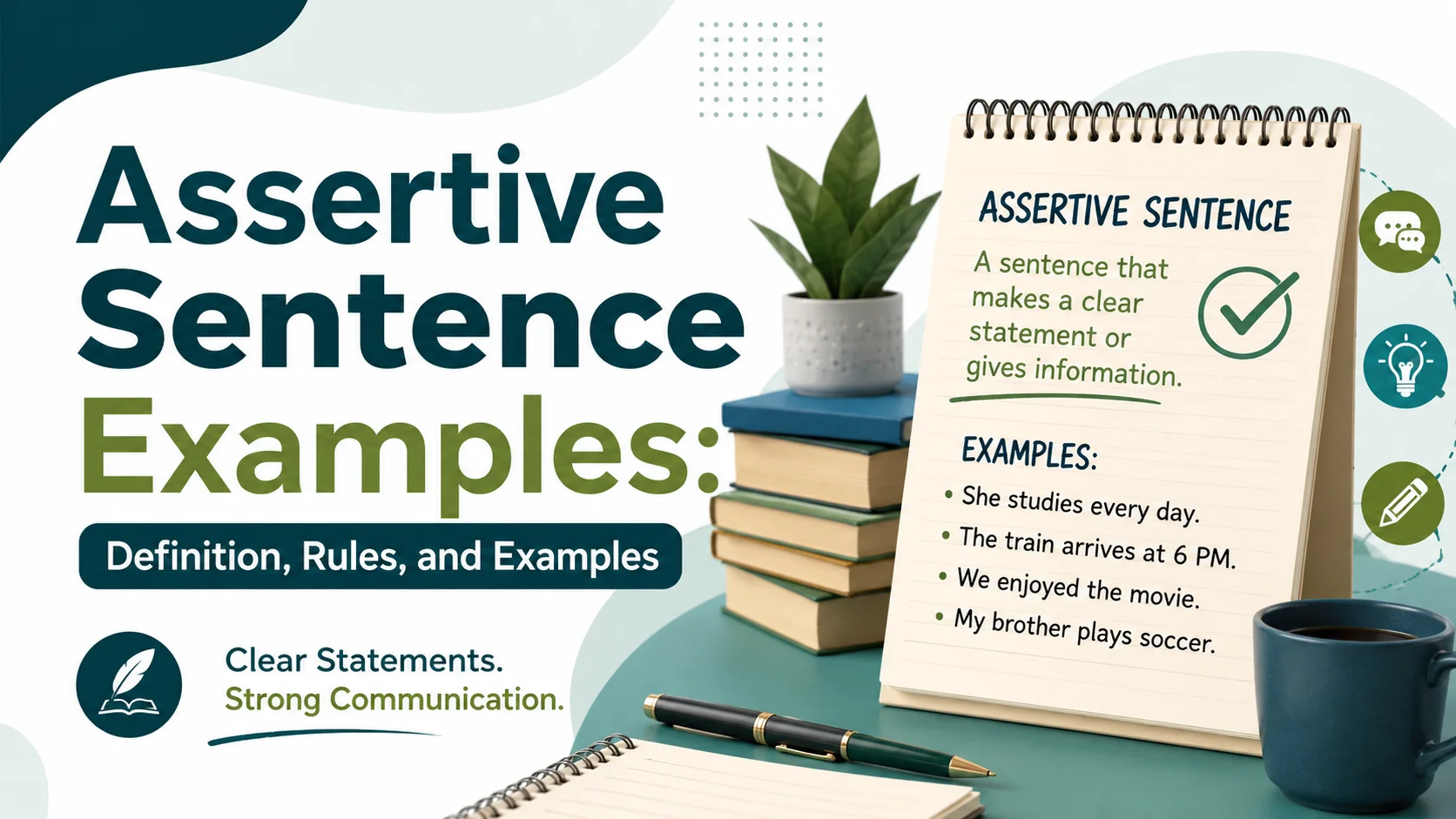
Assertive Sentence Examples show how a statement can give information, an opinion, or a fact in a straightforward way. In modern English grammar, an assertive sentence is also known as a declarative sentence, a technical term for a sentence that makes a statement or states a fact. You can use this sentence type to tell someone what happened, describe a situation, share an opinion, explain what you believe, or provide information. For example, “The train arrives at six” states a fact, while “I believe this is the right decision” gives an opinion. Cambridge Dictionary treats the declarative sentence as a grammatical category that differs from interrogatives, imperatives, and exclamatives. These sentences can be positive or negative, and their length, vocabulary, and grammar can change without changing their basic purpose. A short sentence such as “The sky is blue” is simple, while a long or complicated sentence can still be assertive when it clearly presents ideas or facts. A useful negative example is “I do not like ice cream,” which expresses an opinion negatively. When mastering assertive sentences, focus on clarity, confidence, and the sentence’s purpose rather than complicated rules. This approach makes English learning easier because you can recognize the common type of sentence by what it does: it makes statements rather than asks questions or gives commands.
Assertive sentences also become more useful when you understand how wording affects meaning. A sentence can describe a situation, state an opinion, or present facts while remaining clear and direct. For instance, “The train arrives at six” sounds more certain than “The train may possibly arrive at six.” This small difference shows how confidence and clarity influence the way people understand a statement. A strong assertive sentence doesn’t need to be long or sophisticated. Its power comes from choosing suitable vocabulary, arranging clear sentences, and making the intended point easy to follow. Even a sentence about a person who knows how to craft language can demonstrate how carefully selected words improve communication. The straightforward expressions used in assertive writing can strengthen arguments because they tell readers exactly what the writer means. Stating facts directly also reduces confusion, while carefully presenting an opinion helps readers understand whether you’re describing something certain or simply explaining what you think. In practical English grammar, the best examples are those that communicate an idea without unnecessary complexity. As Marcus Froland noted on February 24, 2026, the power of clear language can change the way people receive a message. That’s why learning to craft effective assertive sentences can give your writing more punch without making it difficult to understand.
The main distinction is simple: an assertive sentence communicates something as a statement, whether that message involves a fact, information, an opinion, or a decision. Its purpose determines its role, while its wording determines how clearly the reader understands it. The sentence normally ends with a period, although its structure and length may vary considerably. You don’t need a special secret to create one. Start with a clear idea, choose appropriate vocabulary, and avoid wording that hides your meaning. When you tell someone what happened, explain what you believe, or share information, you’re often using an assertive structure. The same principle applies when saying something in everyday conversation or presenting evidence in formal writing. Terms such as pack, punch, kicker, change, way, and talking can describe the effect of strong language, but the grammar itself remains simple. Whether the sentence is positive, negative, short, long, or complicated, it can still function as a declarative sentence when it communicates a statement clearly. This is what makes assertive sentence examples useful for students: they connect grammar rules with ordinary communication and show how clear sentences can express ideas, facts, and opinions naturally.
Quick Answer
An assertive sentence is a sentence that states something. It can communicate a fact, opinion, belief, feeling, description, event, or piece of information.
Assertive sentences are also commonly called declarative sentences. They can be affirmative or negative and can appear in simple, compound, or complex structures.
Examples of assertive sentences
- The sun rises in the east.
- Maria works at a local hospital.
- I enjoy reading historical novels.
- They aren’t ready yet.
- We finished the project yesterday.
- He will call you tomorrow.
- I don’t think that’s a good idea.
- The children are playing outside.
A quick test works well: if the sentence primarily makes a statement rather than asking a question, giving an instruction, or expressing an exclamation, it is likely declarative or assertive.
What Is an Assertive Sentence?
An assertive sentence makes a statement about something. That statement might describe reality, report an event, express an opinion, communicate a feeling, or present an idea.
The word assertive can cause confusion because it has another common meaning. In everyday English, assertive describes someone who communicates confidently and directly. Cambridge Dictionary defines the adjective as behaving confidently and expressing what you want or believe without fear.
Grammar uses the idea differently.
In grammar, an assertive sentence is essentially a statement. It doesn’t have to sound forceful, confident, argumentative, or aggressive.
Consider these two examples:
The flowers are beautiful.
I don’t like spicy food.
Neither sentence sounds aggressive. Yet both make statements.
That’s the key.
Assertive in grammar does not mean aggressive in personality.
The term declarative sentence is often preferred in modern English grammar because it clearly identifies the sentence type. Cambridge’s grammar reference lists declaratives as statements and distinguishes them from interrogatives, imperatives, and exclamatives.
Key Characteristics of Assertive Sentences
Once you know what to look for, assertive sentence examples become easy to recognize.
An assertive sentence generally:
- Makes a statement
- Gives information
- States a fact or belief
- Expresses an opinion
- Describes something
- Reports an event or action
- Can be affirmative or negative
- Can use any major verb tense
- Can contain one clause or several clauses
- Usually ends with a period in ordinary writing
For example:
The store is closed.
This sentence states a condition.
The store isn’t closed.
This sentence also states a condition, but it uses negation.
The meaning changed. The sentence function didn’t.
Assertive sentence formula
There isn’t one single formula for every assertive sentence. However, a common pattern is:
Subject + Verb + Complement/Object
Examples:
- James reads books.
- The dog chased the ball.
- My sister is tired.
- We completed the assignment.
English declaratives commonly use subject-before-verb order, although actual structures can become much more varied as sentences grow more complex.
Assertive Sentence Structure
One common mistake is assuming that every assertive sentence follows Subject + Verb + Object.
That’s only one possibility.
Subject + Verb
Some verbs don’t need a direct object.
Examples:
- The baby slept.
- Birds migrate.
- She smiled.
- The audience laughed.
Each sentence makes a statement.
Subject + Verb + Object
This pattern appears frequently in everyday English.
Examples:
- Liam opened the window.
- Sarah bought a notebook.
- We watched the movie.
- The students completed the exercise.
Here, the verb acts on an object.
Subject + Linking Verb + Complement
A linking verb connects the subject with information that describes or identifies it.
Examples:
- The soup is hot.
- Michael became a doctor.
- The plan seems reasonable.
- Her answer was correct.
These are still assertive sentences because they make statements.
Assertive sentences with dependent clauses
Assertive sentences can also become much more detailed.
For example:
I stayed home because I wasn’t feeling well.
The sentence contains a main clause and a dependent clause. Yet its overall function remains declarative.
Cambridge Grammar notes three major structural patterns: simple, compound, and complex sentences. Declarative sentences can occur within all of these structures.
Types of Assertive Sentences
The two most useful categories are affirmative and negative assertive sentences.
Affirmative Assertive Sentences
An affirmative assertive sentence states something without making it negative.
Examples:
- She likes classical music.
- The meeting starts at nine.
- They live in Texas.
- My brother plays tennis.
- The children finished their homework.
- We will visit them next weekend.
The statement doesn’t need to express a positive emotion. Affirmative simply means the sentence isn’t grammatically negative.
For instance:
I dislike crowded places.
This is grammatically affirmative because it doesn’t contain a negative construction such as not or never. Semantically, however, it expresses an unfavorable opinion.
That distinction matters.
Negative Assertive Sentences
A negative assertive sentence states that something isn’t true, doesn’t happen, didn’t happen, or doesn’t exist.
Examples:
- She doesn’t like coffee.
- They aren’t ready.
- I didn’t call him yesterday.
- We won’t attend the meeting.
- Nobody answered the phone.
- He never complains.
- There is nothing in the box.
Declarative clauses can be either affirmative or negative. They can therefore make statements about how things are and how they are not.
Common words used to form negative assertive sentences
- not
- never
- nobody
- nothing
- nowhere
- no
- don’t
- doesn’t
- didn’t
- isn’t
- aren’t
- wasn’t
- weren’t
- won’t
- can’t
Compare:
| Affirmative | Negative |
| She likes tea. | She doesn’t like tea. |
| They are ready. | They aren’t ready. |
| He finished the work. | He didn’t finish the work. |
| We have enough time. | We don’t have enough time. |
| Everyone attended. | Nobody attended. |
Both columns contain assertive sentence examples.
50+ Assertive Sentence Examples
A large example bank helps because sentence function becomes much clearer when you see it in different contexts.
Assertive Sentence Examples About Facts
- The Earth revolves around the Sun.
- Water freezes at 32°F under standard atmospheric pressure.
- The Pacific Ocean is the largest ocean on Earth.
- A week has seven days.
- Plants need water to grow.
- The human heart pumps blood throughout the body.
- Winter follows autumn in the Northern Hemisphere.
- The moon orbits Earth.
- Most birds have feathers.
- The library closes at five o’clock.
These sentences present information as statements.
Assertive Sentence Examples About Opinions
- I think this restaurant is excellent.
- She believes the plan will succeed.
- This book is more interesting than the first one.
- I prefer tea to coffee.
- He considers the proposal unrealistic.
- That movie was surprisingly entertaining.
- We think the blue design looks better.
- In my opinion, the second option is clearer.
- She feels that the decision was unfair.
- This approach seems more practical.
An assertive sentence doesn’t have to contain an objective fact. Opinions can also appear in declarative statements.
Assertive Sentence Examples About Daily Life
- I wake up early every morning.
- My sister works from home.
- The children are playing outside.
- Dinner is almost ready.
- My phone needs charging.
- We usually eat breakfast at seven.
- The bus arrives at eight.
- He keeps his keys on the table.
- Our neighbors have a new car.
- I need some quiet time.
These examples show why assertive sentences are so common. Everyday conversation relies heavily on statements.
Negative Assertive Sentence Examples
- I don’t understand the question.
- She isn’t at home.
- They aren’t coming tonight.
- He didn’t finish his homework.
- We don’t have enough chairs.
- The store isn’t open yet.
- Nobody knows the answer.
- She never misses a deadline.
- There is nothing wrong with the computer.
- They won’t arrive before noon.
Notice that every example still communicates information.
Assertive Sentence Examples About Feelings
- I feel nervous about the interview.
- She is excited about the trip.
- He was disappointed by the result.
- They are happy with the decision.
- I feel tired after the long journey.
- She seems worried about her brother.
- We are grateful for your help.
- He isn’t comfortable with the arrangement.
Feelings don’t prevent a sentence from being assertive. The sentence simply states the emotional condition.
Assertive Sentence Examples in Different Tenses
An assertive sentence can appear in almost any tense.
| Tense | Assertive sentence example |
| Simple present | She teaches English. |
| Present continuous | She is teaching English. |
| Present perfect | She has taught English for five years. |
| Simple past | She taught English yesterday. |
| Past continuous | She was teaching when I arrived. |
| Past perfect | She had taught there before moving. |
| Simple future | She will teach tomorrow. |
| Future continuous | She will be teaching at noon. |
The important point is that tense doesn’t determine sentence type.
The sentence’s communicative purpose does.
For example:
She teaches English.
Did she teach English?
The first sentence makes a statement. The second asks a question.
The verb teach appears in both. The sentence functions differ.
Simple, Compound, and Complex Assertive Sentences
It explains how simple, compound, and complex assertive sentences are structured and how each type states a fact, opinion, or idea.
Simple Assertive Sentences
A simple sentence contains one independent clause.
Examples:
- The baby is sleeping.
- Maria loves music.
- The train arrived.
- We finished dinner.
Simple doesn’t mean incomplete. A simple sentence can contain several words and phrases while still having one independent clause.
Compound Assertive Sentences
A compound sentence joins two independent clauses.
Examples:
- I finished the report, and Maya sent the email.
- The weather was cold, but we went hiking.
- He called me, but I didn’t answer.
Each independent clause can stand as a sentence by itself.
Complex Assertive Sentences
A complex sentence contains an independent clause and at least one dependent clause.
Examples:
- I stayed home because I wasn’t feeling well.
- When the meeting ended, everyone left.
- She smiled after she heard the news.
- Although the road was crowded, we arrived on time.
The sentence can become longer without losing its declarative function.
Compound-complex Assertive Sentences
You can combine multiple clauses as well.
For example:
I finished the report after lunch, and my manager reviewed it before the meeting began.
It looks complicated at first. Still, it primarily makes a statement.
That’s an important lesson: sentence length and sentence type aren’t the same thing.
Assertive Sentence Examples in Different Situations
An assertive sentence clearly expresses a fact, opinion, or statement in a confident and direct way across everyday and formal situations.
At School
- The class begins at eight.
- I completed my assignment.
- Our teacher explained the rule clearly.
- The exam is next Monday.
- She doesn’t understand the formula.
At Work
- The report is ready.
- We need more time to finish the project.
- The manager approved the proposal.
- The meeting starts at ten.
- I won’t be available this afternoon.
At Home
- Dinner is ready.
- My brother is in the kitchen.
- The washing machine needs repair.
- We don’t have any milk.
- The children are asleep.
In Casual Conversation
- I agree with you.
- I don’t understand the problem.
- That sounds like a good idea.
- I’m tired today.
- She knows the answer.
In Formal Writing
- The results support the original hypothesis.
- This section explains the primary difference.
- The evidence suggests another conclusion.
- The findings require further analysis.
- The report identifies several important limitations.
Assertive vs. Other Types of Sentences
English grammar commonly distinguishes four major sentence or clause types: declarative, interrogative, imperative, and exclamative. Declaratives make statements, interrogatives ask questions, imperatives give orders or instructions, and exclamatives express strong emotion or surprise.
| Type | Main purpose | Example |
| Assertive/Declarative | Makes a statement | She is at home. |
| Interrogative | Asks a question | Is she at home? |
| Imperative | Gives an instruction | Go home. |
| Exclamative | Expresses strong emotion | What a beautiful home! |
The easiest way to remember the difference is to focus on purpose.
Assertive vs. interrogative
You are coming tomorrow.
This tells someone something.
Are you coming tomorrow?
This asks for information.
The first is assertive. The second is interrogative.
Assertive vs. imperative
You need to close the window.
This makes a statement.
Close the window.
This gives an instruction.
The second sentence may sound direct, but grammatical directness doesn’t turn a statement into an imperative.
Assertive vs. exclamatory
The view is beautiful.
This makes a statement.
What a beautiful view!
This expresses strong emotion.
The difference becomes especially interesting when punctuation changes. Cambridge notes that a declarative can sometimes end with an exclamation mark and still remain declarative depending on its grammatical function.
Assertive Sentence vs. Declarative Sentence
Are assertive sentence and declarative sentence the same thing?
In most educational contexts, yes.
Both terms describe sentences that make statements. However, declarative sentence is the more standard grammatical label in many modern English resources. Cambridge explicitly defines a declarative sentence as one that makes a statement or states a fact.
The term assertive sentence appears frequently in grammar teaching materials, particularly in contexts where sentence types are classified as assertive, interrogative, imperative, and exclamatory.
So if a teacher asks for an assertive sentence, an ordinary declarative statement is generally what they want.
Quick memory trick:
Assertive = states something.
Interrogative = asks something.
Imperative = tells someone to do something.
Exclamatory = expresses strong emotion.
How to Identify an Assertive Sentence
When you’re unsure, use this simple process.
Look for the sentence’s purpose
Ask:
“Is this sentence telling me something?”
If the answer is yes, you’re probably looking at an assertive or declarative sentence.
Check whether it makes a statement
For example:
The car is outside.
It gives information.
Don’t rely only on punctuation
A period often appears at the end of a declarative sentence. However, punctuation alone doesn’t determine the grammatical category.
For example:
I can’t believe this happened!
The exclamation mark shows strong emotion, but the sentence still has declarative structure. Cambridge specifically notes that a declarative can remain declarative even when an exclamation point appears.
Compare it with the other sentence types
If it asks for information, it’s likely interrogative.
If it gives an instruction, it’s likely imperative.
If it primarily expresses an exclamation, it’s likely exclamative.
Otherwise, if it makes a statement, assertive/declarative is the likely answer.
Common Mistakes With Assertive Sentences
Common mistakes with assertive sentences often include confusing statements with questions or commands, using incorrect punctuation, and expressing ideas unclearly or too indirectly.
Mistake: Thinking assertive means aggressive
This confusion comes from everyday use of the word assertive.
Someone can communicate assertively without being hostile. In fact, Cambridge distinguishes assertiveness from aggression and hostility.
In grammar, the issue is even simpler: an assertive sentence makes a statement.
Mistake: Thinking assertive sentences must be affirmative
They don’t.
She likes coffee.
is affirmative.
She doesn’t like coffee.
is negative.
Both make statements.
Mistake: Thinking assertive sentences must be short
A sentence can contain several clauses and still function as a declarative.
Although the weather was unpleasant, we continued the journey because we had already planned the trip.
That’s long, but it still primarily makes a statement.
Mistake: Thinking every assertive sentence follows SVO
English allows many structures.
The room is quiet.
This uses a linking verb.
The baby slept.
There is no direct object.
When the rain stopped, the children went outside.
This contains multiple clauses.
All three can function as declarative statements.
Mistake: Thinking punctuation determines everything
A period is common, but punctuation isn’t the complete test.
Start with meaning and grammatical function. Then use punctuation as supporting evidence.
How to Change Other Sentence Types Into Assertive Sentences
Changing sentence type can help you understand how grammatical function works.
Interrogative to Assertive
Interrogative:
Isn’t the movie interesting?
Assertive:
The movie is interesting.
The first asks a question. The second makes a statement.
Imperative to Assertive
Imperative:
Close the door.
Assertive:
You need to close the door.
The first gives an instruction. The second states what someone needs to do.
Exclamative to Assertive
Exclamative:
What a beautiful sunset!
Assertive:
The sunset is beautiful.
The meaning stays similar, but the communicative purpose changes.
This exercise is useful because it shows that sentence type depends on function and structure rather than vocabulary alone.
Assertive Sentence Examples: A Practical Comparison
Consider this small conversation:
Alex: The meeting starts at three.
Jordan: Does the meeting start at three?
Alex: Yes. We need to arrive early.
Here, the first and third sentences are assertive. Jordan’s question is interrogative.
Now consider:
Alex: Please arrive before three.
That sentence is imperative because it gives an instruction.
One situation can therefore contain several sentence types. The context doesn’t automatically determine the grammatical category. The individual sentence does.
Case Study: Finding Assertive Sentences in a Paragraph
Consider this short paragraph:
The school library opens at seven each morning. Students can use the computers before class begins. The library doesn’t open on Sundays. Please return borrowed books on time. What time does the library close?
Now classify each sentence:
| Sentence | Type | Why |
| The school library opens at seven each morning. | Assertive | It states information. |
| Students can use the computers before class begins. | Assertive | It states what students can do. |
| The library doesn’t open on Sundays. | Assertive | It makes a negative statement. |
| Please return borrowed books on time. | Imperative | It gives instructions. |
| What time does the library close? | Interrogative | It asks a question. |
This example shows why context alone isn’t enough. You need to examine what each sentence actually does.
Quick Rules to Remember Assertive Sentences
Keep these rules handy:
- Assertive sentences make statements.
- Declarative sentence is the common modern grammar term for this sentence type.
- An assertive sentence can state a fact, opinion, feeling, belief, event, or description.
- It can be affirmative or negative.
- It can use present, past, or future tense.
- It can be simple, compound, or complex.
- It commonly ends with a period.
- Don’t confuse grammatical assertive with personally aggressiveness.
- Sentence purpose matters more than sentence length.
- A negative statement is still an assertive sentence.
Practice: Identify the Assertive Sentences
Try identifying the assertive sentences before checking the answers.
- The children are outside.
- Where are the children?
- Please bring the chairs inside.
- The weather is unusually warm today.
- What a beautiful garden!
- I don’t need any help.
- Did you finish the assignment?
- She finished the assignment yesterday.
- Turn off the lights.
- The lights aren’t working.
Answers
| Number | Answer | Explanation |
| 1 | Assertive | It states where the children are. |
| 2 | Interrogative | It asks a question. |
| 3 | Imperative | It gives a request or instruction. |
| 4 | Assertive | It states information about the weather. |
| 5 | Exclamative | It expresses strong emotion. |
| 6 | Assertive | It makes a negative statement. |
| 7 | Interrogative | It asks whether an action occurred. |
| 8 | Assertive | It states that the action occurred. |
| 9 | Imperative | It gives a command. |
| 10 | Assertive | It makes a negative statement about the lights. |
Conclusion
Assertive sentences make communication clear, direct, and easy to understand. They can state a fact, express an opinion, provide information, or explain a decision without asking a question or giving an order. Whether you use a short sentence like “The sky is blue” or a more detailed statement, the main goal is clarity. Understanding assertive sentence examples also helps you recognize declarative sentences and use them confidently in everyday writing and conversation.
FAQs
Q1. What is an assertive sentence?
An assertive sentence is a sentence that makes a statement. It can express a fact, opinion, idea, or piece of information and usually ends with a period.
Q2. Is an assertive sentence the same as a declarative sentence?
Yes. Assertive sentence and declarative sentence are commonly used to describe sentences that make statements or present information.
Q3. What are some examples of assertive sentences?
Examples include “The sky is blue,” “She likes reading,” “The train arrives at six,” and “I do not like ice cream.” These sentences give information or express opinions.
Q4. Can an assertive sentence be negative?
Yes. An assertive sentence can be positive or negative. For example, “I do not like ice cream” is a negative assertive sentence because it expresses an opinion negatively.
Q5. How can I identify an assertive sentence?
Ask whether the sentence makes a statement or provides information. If it states a fact, gives an opinion, describes something, or communicates an idea rather than asking or commanding, it’s likely an assertive sentence.
About the Author