Kiss of Death can describe a single decision that turns a promising situation into failure, ruin, or the complete end of success for someone.John, the best baker in a small town, was famous for his fresh cakes, and his beloved bakery welcomed customers every morning. Then one decision became his biggest mistake. A promising opportunity and a deal with a big supermarket chain appeared likely to bring more people and help John’s business grow. Instead, the faulty deal created a chain of events that hurt the bakery, leaving the town whispering about a possible kiss of death.
The phrase carries a deeper meaning than affection or romance, despite containing the word kiss. It can refer to an action, event, decision, choice, or circumstance with a fatal impact that may seriously damage something and cause its final downfall. The kiss of death idiom fits many situations, including a company losing an important customer, a politician facing a major scandal, or an athlete making a costly mistake that destroys their chances of success.
Its historical connection adds to its strong, dramatic meaning. Judas, by betraying Jesus with a kiss, contributed to Jesus’ arrest and eventual crucifixion, creating a powerful link with disaster and betrayal. In conversations and everyday use, the expression remains popular because it communicates a serious idea in a short, memorable way. Whether accepting a bad agreement, making a poor choice, or facing business failure, one particular action can make someone fail, become unsuccessful, face complete failure, and reach the end of success—“It could be the kiss of death.”
Quick Answer: What Does “Kiss of Death” Mean?
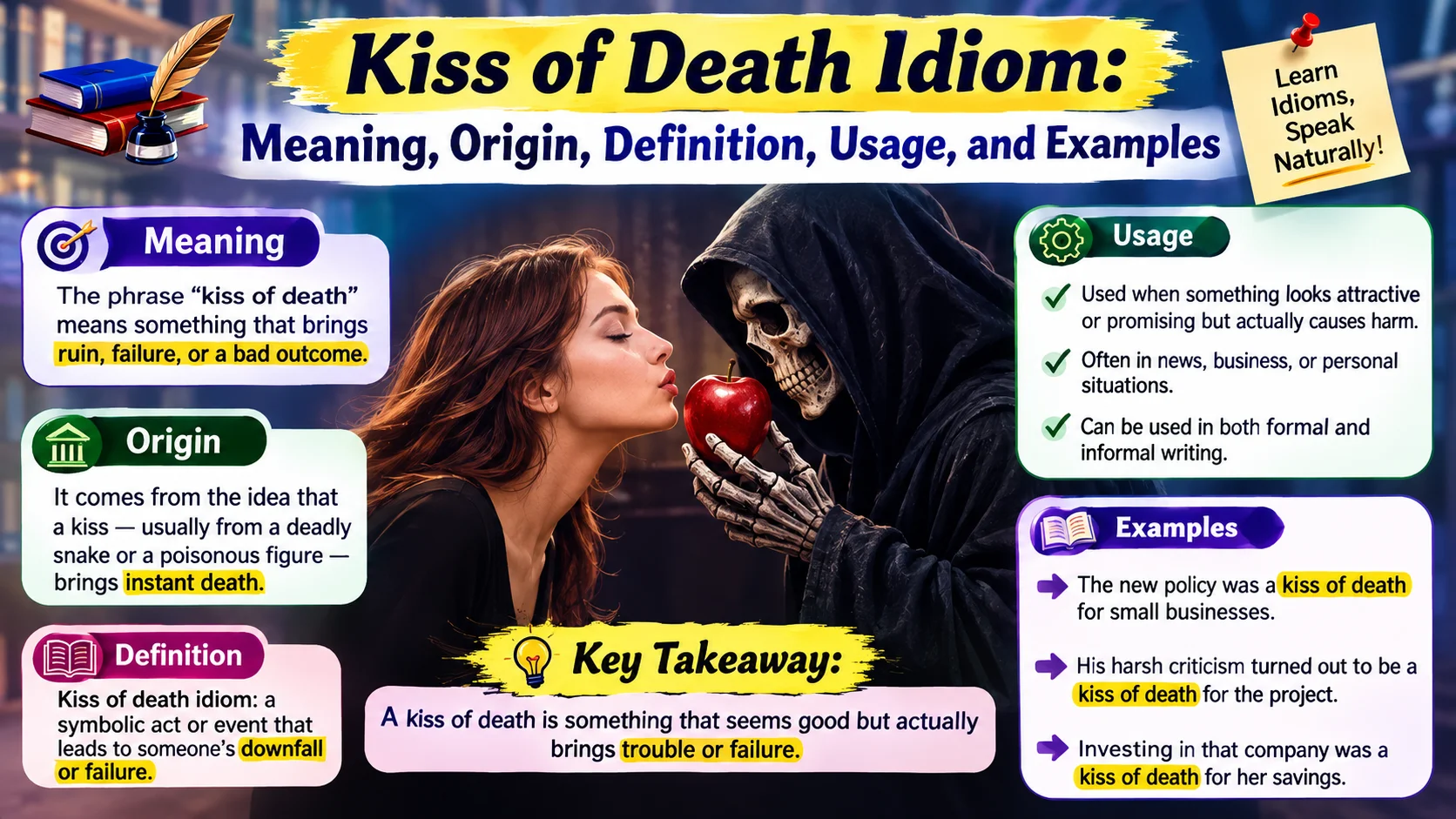
“Kiss of death” means something that causes or is likely to cause failure, ruin, or the end of something.
It usually describes a serious and decisive setback, not a small or temporary problem.
For example:
“Losing their biggest client was the kiss of death for the company.”
In this sentence, losing the client caused such serious damage that the company could no longer succeed or survive.
| Feature | Details |
| Idiom | Kiss of death |
| Meaning | A cause of failure or ruin |
| Type | Idiomatic noun phrase |
| Tone | Negative and dramatic |
| Common use | The kiss of death for something |
| Contexts | Business, careers, politics, sports, and everyday life |
Kiss of Death Idiom Definition
The kiss of death idiom means an act, event, decision, or circumstance that causes complete failure or seriously threatens the future of something.
The expression often suggests that a situation has reached a critical point. Problems may have existed before, but one particular event makes recovery difficult or impossible.
For example:
- “The scandal was the kiss of death for his career.”
- “The failed investment became the kiss of death for the business.”
- “Missing the deadline could be the kiss of death for the project.”
- “That final mistake was the kiss of death for their chances of winning.”
The idiom does not always mean that failure happens immediately. Sometimes it means that an event has made failure almost unavoidable.
What Does “Kiss of Death” Mean in Context?
The meaning of kiss of death becomes clearer when you look at the situation surrounding it. The phrase generally works in three main ways.
A Direct Cause of Failure
Sometimes the event directly causes something to end.
“The company’s loss of funding was the kiss of death for the project.”
Without funding, the project could not continue.
A Strong Sign of Future Failure
The idiom can also describe something that makes future success highly unlikely.
“Ignoring customer complaints could be the kiss of death for the brand.”
The company may still exist, but continuing to ignore customers could eventually destroy its reputation.
Origin of the “Kiss of Death” Idiom
The origin of the kiss of death is strongly connected with the symbolic relationship between a kiss, betrayal, and destruction.
A kiss normally represents love, friendship, respect, or loyalty. However, one of the best-known historical and religious examples connected a kiss with betrayal. This powerful contrast helped create the symbolic meaning behind the modern expression.
The modern idiom is commonly associated with Judas Iscariot’s betrayal of Jesus. A kiss was used as a sign to identify Jesus to those who came to arrest him. Because of this story, a kiss could symbolize an act that appears friendly but leads to a terrible outcome.
The modern phrase later developed into a broader expression for anything that causes ruin, failure, or destruction.
The Biblical Association: Judas’s Kiss
The story of Judas’s kiss gave the image a powerful connection with betrayal.
A kiss is normally an expression of closeness. In this situation, however, it became connected with an act of betrayal that led to serious consequences. The image therefore became memorable as a symbol of harm hidden behind an apparently harmless or friendly action.
This connection helps explain the emotional strength of the modern kiss of death idiom.
However, the modern expression should not be treated as if it originally appeared as an established idiom in the biblical text. The biblical story created the important symbolic association, while the phrase later developed into modern English usage.
Is “Kiss of Death” an Idiom?
Yes, “kiss of death” is an idiom.
The literal words describe a kiss connected with death. However, that is not the meaning people usually intend when they use the phrase.
For example:
“The bad publicity was the kiss of death for the new product.”
No physical kiss happened. Bad publicity damaged the product so badly that it failed or had little chance of succeeding.
That figurative meaning makes the phrase an idiomatic expression.
How to Use “Kiss of Death” in a Sentence
The most common sentence pattern is:
The kiss of death for + something
Examples:
- “The scandal was the kiss of death for his career.”
- “Poor reviews were the kiss of death for the movie.”
- “The missed deadline could be the kiss of death for the deal.”
- “Losing customer trust became the kiss of death for the company.”
You can also use the idiom with words that show possibility:
- could be the kiss of death
- might be the kiss of death
- may prove to be the kiss of death
- turned out to be the kiss of death
These patterns help you describe both actual failure and a situation where failure is still expected.
“The Kiss of Death for…”
This construction clearly identifies the thing that suffered because of a particular event.
“The budget cuts were the kiss of death for the program.”
The budget cuts caused the program to fail.
“One more injury could be the kiss of death for the team’s season.”
The team has not necessarily failed yet, but another injury could end its chances.
“A Kiss of Death” vs. “The Kiss of Death”
“The kiss of death” is more common because it often refers to one specific event that caused failure.
“That decision was the kiss of death for the company.”
You can use “a kiss of death” when speaking generally.
“A mistake like that can be a kiss of death for a new business.”
Both forms are possible, but “the kiss of death” is the more familiar expression.
Kiss of Death Examples in Everyday English
The idiom can describe many real-life situations.
Business and Careers
Businesses often face one major event that destroys their ability to recover.
“Losing its largest customer was the kiss of death for the small company.”
“The security breach became the kiss of death for customer trust.”
“His repeated mistakes were the kiss of death for his promotion chances.”
In career situations, the phrase often describes serious reputational damage or a major mistake.
Politics and Public Life
Political careers can change quickly after a damaging event.
“The corruption scandal was the kiss of death for the campaign.”
“That unpopular decision could be the kiss of death for her political future.”
The idiom works well here because public support can disappear after one serious mistake or controversy.
Sports and Competition
Sports commentators often use the kiss of death for a decisive error.
“The red card was the kiss of death for the team.”
“That late penalty proved to be the kiss of death for their comeback.”
The phrase suggests that the mistake changed the situation so severely that winning became impossible or highly unlikely.
Everyday Life
You can also use the idiom in ordinary conversations.
“Forgetting the interview was the kiss of death for his job application.”
“Lying again could be the kiss of death for their relationship.”
“Arriving extremely late may be the kiss of death for your first impression.”
These examples show that the phrase can apply to any situation involving a major threat to future success.
Kiss of Death Meaning in Different Contexts
The central meaning remains the same, but the result can vary.
| Context | Possible “Kiss of Death” |
| Business | Loss of major funding |
| Career | Serious reputation damage |
| Politics | A major scandal |
| Sports | A decisive mistake |
| Relationship | Serious betrayal |
| Technology | Loss of customer trust |
| Project | Missing a critical deadline |
The phrase works best when the event has major consequences.
For example, a small delay is not normally the kiss of death. However, missing a deadline that permanently cancels a major project could be.
Tone and Connotation of the Kiss of Death Idiom
The expression has a clearly negative and dramatic tone.
It can suggest:
- Failure
- Ruin
- Downfall
- Serious damage
- A decisive setback
- The end of success
Compare these two sentences:
“The company lost an important customer and faced serious difficulties.”
“Losing that customer was the kiss of death for the company.”
The second sentence is much stronger. It suggests that the company may not recover.
For this reason, the idiom is useful in storytelling, journalism, commentary, business discussions, and casual conversation.
Common Synonyms and Similar Expressions
Several expressions have meanings related to kiss of death.
Nail in the Coffin
A nail in the coffin is something that contributes to the eventual end or failure of something.
“The loss of another client was another nail in the coffin.”
It often suggests that several problems already exist.
Final Blow
A final blow is the last major event that ends something.
“The court decision was the final blow to the project.”
Death Knell
A death knell often refers to something that signals the end of something.
“The announcement was the death knell for the old system.”
Fatal Blow
A fatal blow is a decisive event that causes irreversible damage.
“The loss of funding dealt a fatal blow to the company.”
Last Straw
The last straw refers to the final problem that makes someone lose patience or decide to stop tolerating a situation.
“The broken promise was the last straw.”
It does not always mean failure, so it is not an exact replacement for kiss of death.
“Kiss of Death” vs. “Nail in the Coffin”
These phrases are similar, but they emphasize different ideas.
| Expression | Main Meaning |
| Kiss of death | A decisive cause of failure |
| Nail in the coffin | A damaging factor contributing to the end |
| Final nail in the coffin | The last event that finishes something |
For example:
“The scandal was the kiss of death for the company.”
This means the scandal caused its downfall.
“The scandal was the final nail in the coffin for the company.”
This suggests that the company already had problems, and the scandal finally ended its chances.
Using It for Small Problems
The idiom is dramatic. Avoid using it for minor inconveniences unless you are clearly joking.
A small delay is usually not a kiss of death. A major event that destroys future chances might be.
Confusing It with a Temporary Setback
A kiss of death suggests severe consequences. The situation may be difficult to recover from.
A temporary problem that can easily be fixed does not usually fit the expression.
Taking the Phrase Literally
The modern meaning is almost always figurative.
“The bad review was the kiss of death for the restaurant.”
The sentence means the review seriously damaged the restaurant’s success.
Can “Kiss of Death” Be Used Positively?
No, not in its normal meaning.
The expression is naturally negative because it refers to destruction, failure, or ruin.
However, people sometimes use it humorously.
“My cooking was the kiss of death for everyone’s appetite.”
This exaggerates the situation for comic effect. Even then, the basic meaning still suggests that something has destroyed another thing’s chances.
Is “Kiss of Death” Still Common Today?
Yes. The kiss of death idiom remains widely understood in modern English.
It is especially common in discussions about:
- Business
- Politics
- Sports
- Careers
- Entertainment
- Public reputation
The phrase remains useful because it is short and expressive.
Instead of saying:
“This event may seriously damage future success and lead to failure.”
You can say:
“This could be the kiss of death.”
That makes the meaning more memorable and direct.
Grammar and Capitalization of “Kiss of Death”
In an ordinary sentence, write the idiom in lowercase:
“The decision was the kiss of death for the project.”
Capitalize it when it appears in a title:
Kiss of Death: Meaning, Origin, and Examples
You do not normally need quotation marks when simply using the phrase in a sentence.
Quick Summary of the Kiss of Death Idiom
Here are the key points:
- Kiss of death is a common English idiom.
- It means something that causes or strongly leads to failure or ruin.
- It is usually used figuratively.
- Its symbolism is closely connected with betrayal and disastrous consequences.
- The phrase is useful for describing a decisive setback.
- It commonly appears in discussions about business, careers, politics, sports, and everyday life.
- It has a strongly negative and dramatic tone.
- Similar expressions include nail in the coffin, fatal blow, and death knell.
- It should describe a serious problem rather than a small inconvenience.
Conclusion
The Kiss of Death is a powerful English idiom that describes something likely to cause failure, ruin, or the end of success. A bad decision, costly mistake, faulty deal, or harmful event can become the final blow to a person, business, or opportunity. Its connection with Judas betraying Jesus with a kiss also gives the phrase a strong historical meaning. Today, you can use “kiss of death” to describe an action or situation with a potentially fatal impact.
FAQs
Q1. What does “kiss of death” mean?
The kiss of death means an action, event, or decision that causes failure or leads to the final downfall of something.
Q2. Is “kiss of death” an idiom?
Yes, kiss of death is a common English idiom. Its meaning is figurative and does not refer to a romantic or affectionate kiss.
Q3. Where did the phrase “kiss of death” come from?
The phrase is commonly connected with Judas betraying Jesus with a kiss, which led to Jesus’ arrest and later crucifixion.
Q4. Can “kiss of death” be used in business?
Yes. A bad deal, major financial loss, or loss of an important customer can be described as the kiss of death for a business.
Q5. Can a person’s decision be called the “kiss of death”?
Yes. If a decision seriously damages someone’s chances of success and leads to failure, it can be called the kiss of death.
Q6. Is “kiss of death” always negative?
Yes. The expression has a strongly negative meaning because it refers to ruin, failure, destruction, or final downfall.
Q7. How do you use “kiss of death” in a sentence?
You could say: “Losing their biggest customer was the kiss of death for the company.”
About the Author