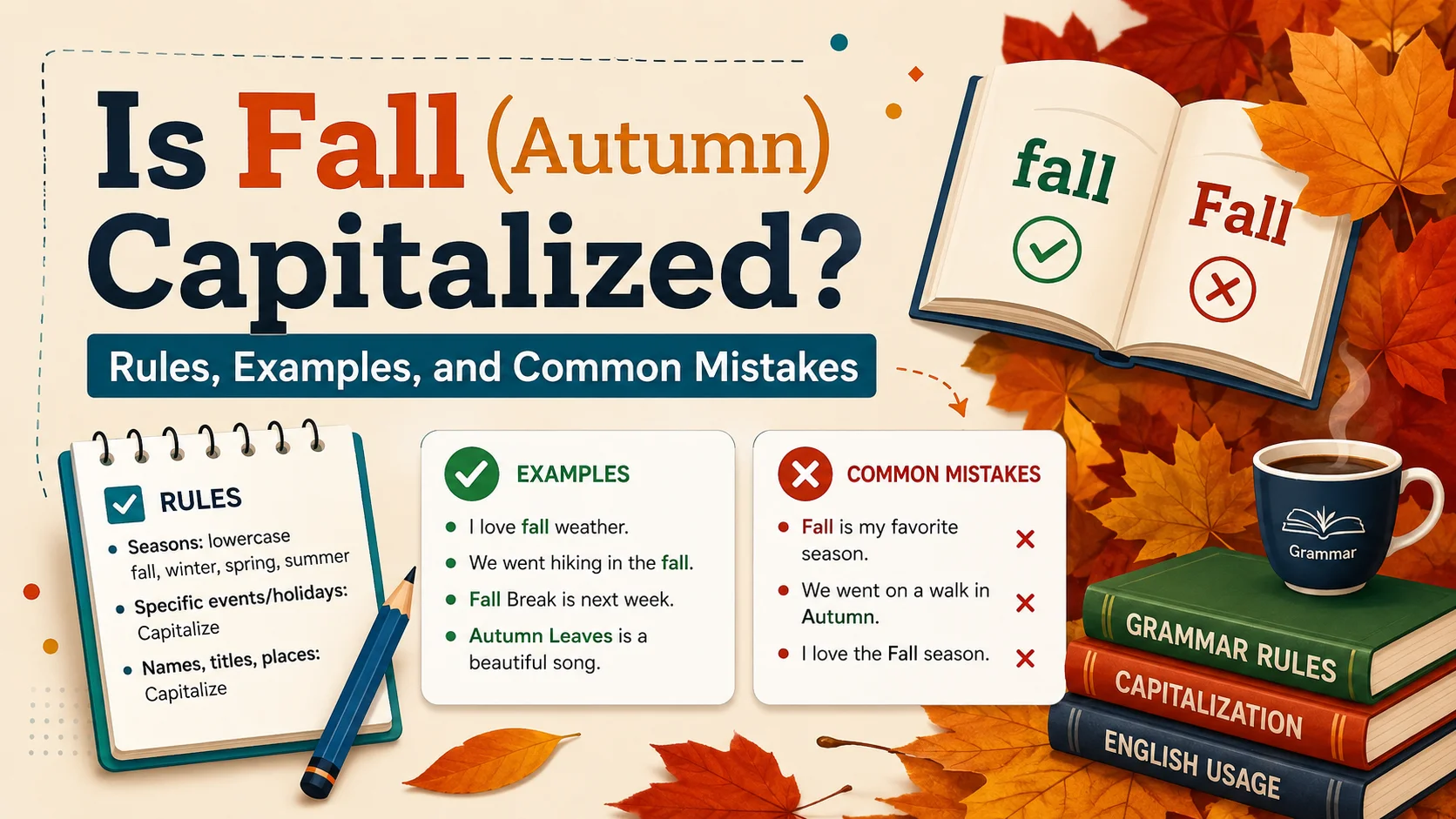
The short answer to Is Fall (Autumn) Capitalized? is simple: fall and autumn are usually written in lowercase because they are common nouns, not a proper name. In everyday writing, you might mention colorful leaves, cooler weather, or the changing season without capitalizing either word. The same basic rule applies when discussing fall 2026 or an autumn break, so the correct choice usually depends on how the word appears in the sentence.
There are important exceptions to the rules of capitalization. You capitalize the word at the beginning of a sentence, in certain titles, or when Fall appears as part of a proper name, such as Fall Semester or Fall Semester 2023 on an academic calendar. School terms, an academic term, and other phrases can vary based on context, so writers should check the relevant guidelines. In general writing, fall semester often stays lowercase, while a formal title may use a capital letter.
A quick-reference table, useful examples, and practical tips can help prevent common mistakes and unnecessary confusion. Think of writing as avoiding a minefield: one wrong step with a capitalized word may create an unintended change in meaning. Knowing your ABCs is helpful, but understanding proper nouns, proper noun usage, use, specific time period, and the seasons is the real guide. When you reach a grammatical crossroads, follow the right path and let context lead you toward grammatical salvation.
Quick Answer: Is Fall (Autumn) Capitalized?
No, fall and autumn are not normally capitalized.
Use lowercase when you’re simply referring to the season:
- I love fall weather.
- The trees look beautiful in autumn.
- We traveled to Vermont last fall.
- Her favorite season is autumn.
- Classes begin in fall 2026.
Capitalize Fall or Autumn only when a separate rule requires it:
| Situation | Correct Form | Example |
| General reference to the season | lowercase | I enjoy fall. |
| Beginning of a sentence | capitalized | Autumn arrives with cooler weather. |
| Title or heading | often capitalized under title style | Fall Travel Tips |
| Proper or official name | capitalized | Arab Spring |
| Personification | may be capitalized | Autumn painted the hills gold. |
Here’s the easiest rule to remember: If fall or autumn simply names the season, use lowercase.
Is Fall (Autumn) Capitalized in Normal Writing?
In ordinary sentences, fall and autumn remain lowercase.
That rule applies whether the word acts as a noun or modifies another noun.
Examples of Correct Lowercase Usage
- We go hiking every fall.
- The autumn air felt cool and crisp.
- She bought a new fall jacket.
- The fall colors were spectacular.
- They planned an autumn wedding.
- The school opens again in fall 2026.
These words may refer to a specific part of the year, but that doesn’t automatically make them proper nouns.
That distinction matters.
January, for example, is a proper noun. Monday is also a proper noun. English capitalizes both. In contrast, fall and autumn are common nouns, so they normally begin with lowercase letters.
Why Aren’t Fall and Autumn Capitalized?
The answer comes down to the difference between common nouns and proper nouns.
A common noun refers to a general person, place, thing, or idea. A proper noun identifies a specific name.
For example:
| Common Noun | Proper Noun |
| city | Chicago |
| month | January |
| day | Monday |
| season | fall |
| season | autumn |
Fall and autumn name general seasons. They don’t identify one unique season with a formal name.
Think of it this way: English treats the season like a category rather than a personal name.
You can say:
We moved there in fall.
You wouldn’t normally write:
We moved there in Fall.
The capital letter would suggest that another rule applies.
Is Fall or Autumn Capitalized? The Main Rule
The main rule couldn’t be much simpler:
Lowercase fall and autumn when they refer generally to the season.
For example:
- fall arrives after summer.
- Many people enjoy autumn because of the changing leaves.
- We usually travel during fall.
- The autumn weather was unusually warm.
- I prefer fall mornings to summer afternoons.
This same rule applies to the other seasons:
- spring
- summer
- fall
- autumn
- winter
Normally, they all remain lowercase.
Quick Comparison
Correct:
We visited the mountains in fall.
Incorrect in ordinary prose:
We visited the mountains in Fall.
The word doesn’t become a proper noun simply because it refers to a season.
When Should You Capitalize Fall or Autumn?
Although lowercase is the default, several situations require or allow capitalization.
These exceptions are worth learning because they explain nearly every correct use of Fall or Autumn with a capital letter.
Capitalize Fall or Autumn at the Beginning of a Sentence
Every sentence begins with a capital letter. That rule applies to season names just like any other word.
Correct examples:
- Fall is my favorite season.
- Autumn brings shorter days and cooler nights.
- Fall often feels like a fresh start.
- Autumn can arrive quickly in northern regions.
The important point is this: Fall and Autumn are capitalized because they begin the sentence.
They aren’t capitalized because season names always require capital letters.
Move the same words into the middle of a sentence:
- My favorite season is fall.
- Many people love autumn.
Now lowercase is correct.
Capitalize Fall or Autumn in Titles and Headings
Titles follow their own capitalization rules.
For example:
- Fall Travel Guide
- The Best Autumn Recipes
- Preparing Your Garden for Fall
- How to Enjoy the Beauty of Autumn
In headline-style titles, major words are often capitalized. That can make Fall or Autumn uppercase even though the same word would be lowercase in normal prose.
Compare these examples:
Heading:
Fall Gardening Tips for Beginners
Sentence:
These fall gardening tips can help beginners.
The first example follows a title style. The second follows normal sentence capitalization.
So, don’t assume that a capitalized season word in an article title means it should also be capitalized throughout the article.
Is “Fall 2026” Capitalized?
This question creates plenty of confusion.
In ordinary running text, the default form is:
fall 2026
For example:
- The program begins in fall 2026.
- We expect to launch the website in fall 2026.
- Applications open before fall 2026.
However, an organization may use Fall 2026 as a formal label or heading.
For example:
Fall 2026 Course Schedule
Here, the phrase functions as a heading.
The safest approach is simple:
- Running text: fall 2026
- Heading or title: Fall 2026 may be correct
- Official house style: follow the required style
Case Study: A University Course Schedule
Imagine a university website.
In a paragraph, it might say:
Registration for fall 2026 begins in April.
On the course catalog page, however, the heading may read:
Fall 2026 Course Schedule
Both forms can be correct because the first is ordinary prose while the second is a title or label.
Is “the Fall of 2026” Capitalized?
Usually, no.
Write:
- We moved there in the fall of 2026.
- The project began during the autumn of 2026.
- They met in the fall of 1998.
Adding a year doesn’t transform the season into a proper noun.
The phrase the fall of 2026 simply identifies a particular time period. The capitalization rule remains the same.
So this is the standard form:
The company expanded in the fall of 2026.
Not:
The company expanded in the Fall of 2026.
Unless, of course, the phrase appears in a title or follows a specific organization’s style convention.
Is Fall Semester Capitalized?
Usually, fall semester is lowercase in ordinary writing.
Correct examples:
- Students return for the fall semester next month.
- Registration for the fall semester is now open.
- She completed the course during the fall semester.
The same pattern applies to similar academic terms:
- spring semester
- summer semester
- fall semester
- winter term
When Can “Fall Semester” Be Capitalized?
An institution may capitalize the phrase when it appears as an official heading or formal label.
For example:
Fall Semester 2026 Academic Calendar
That formatting makes sense as a title.
In regular prose, however:
The fall semester begins on August 24.
Lowercase remains the usual choice.
This distinction helps prevent a common mistake: capitalizing ordinary academic terms simply because they sound official.
Is Fall Break Capitalized?
Normally, write fall break in lowercase.
Examples:
- Students return after fall break.
- Our school closes for fall break in October.
- We plan to travel during autumn break.
Like fall semester, these phrases generally describe a period rather than name a unique official entity.
Capitalization may appear in a title:
Fall Break Travel Information
Or as part of an official event name:
Fall Break Adventure Camp
The key question is whether you’re using a general description or an official name.
General Description
The students have fall break next week.
Official Name
Students can register for the Fall Break Adventure Camp.
The first phrase stays lowercase. The second forms part of a formal name.
Are Fall Colors and Fall Foliage Capitalized?
No, not in ordinary writing.
Write:
- The fall colors were beautiful.
- We drove north to see the fall foliage.
- The park is known for its autumn leaves.
- The photographer captured the best autumn colors.
These are descriptive phrases.
Fall and autumn simply modify another noun, so they remain lowercase.
Correct Examples
- fall weather
- fall festival
- fall foliage
- fall colors
- autumn leaves
- autumn harvest
- autumn fashion
- autumn weather
Unless the phrase forms part of an official name or appears in a title, lowercase is the right choice.
Fall and Autumn as Adjectives: Are They Capitalized?
No. The rule doesn’t change when fall or autumn modifies another word.
Consider these examples:
- fall clothing
- fall sale
- fall menu
- fall festival
- autumn landscape
- autumn fashion
- autumn harvest
All normally use lowercase.
For example:
The store introduced its new fall collection.
Not:
The store introduced its new Fall collection.
However, a brand or organization might officially name a collection Fall Collection 2026. In that situation, the capitalization may follow the company’s naming style.
Again, context rules the day.
When Fall or Autumn Is Part of a Proper Name
A season name should be capitalized when it belongs to a proper name.
This is one of the most important exceptions.
For example:
- Arab Spring
- Summer Olympics
- Spring Fling
In these cases, the season word belongs to a recognized name or title.
Compare:
The spring was unusually warm.
with:
The Arab Spring changed political history across several countries.
The first spring refers generally to a season. The second belongs to a specific historical name.
A Useful Test
Ask yourself:
Am I naming the season, or am I naming something?
If you’re simply naming the season:
We traveled during fall.
Use lowercase.
If the word forms part of a recognized name:
The school hosted its annual Spring Fling.
Capitalize according to the name.
Can You Capitalize Fall or Autumn When Personifying the Season?
Yes. Creative writing can treat a season like a person, character, or living being.
This technique is called personification.
For example:
Autumn painted the valley in shades of gold.
Here, autumn performs a human-like action. The writer presents the season almost as a character.
Another example:
Fall knocked on the door with crisp air and swirling leaves.
You may also see:
Autumn spread her golden cloak across the hills.
Capitalization works naturally in this kind of literary style.
Important Note
You don’t need to capitalize every creative use of a season.
This sentence can still use lowercase:
The autumn wind whispered through the trees.
The word becomes more strongly personified when the season itself takes on the role of a character.
Fall vs. Autumn: Does the Word Choice Affect Capitalization?
No. Fall and autumn follow the same capitalization rules.
Both usually remain lowercase:
- We traveled in fall.
- We traveled in autumn.
Both are capitalized at the beginning of a sentence:
- Fall is almost here.
- Autumn is almost here.
Both can be capitalized in titles:
- Fall Fashion Trends
- Autumn Fashion Trends
The main difference involves usage and style, not capitalization.
Fall occurs more often in American English, while autumn often sounds more formal and is more common in British English.
Since this article uses US English, fall may sound more natural in everyday conversation.
For example:
I love fall because the weather finally cools down.
Autumn remains completely correct, though it can create a slightly more formal or literary tone:
The beauty of autumn attracts visitors from around the world.
Neither word changes the capitalization rule.
Are All Seasons Capitalized?
No. The same basic rule applies to every season.
| Season | Normal Form | Capitalized at Sentence Start | Example in Normal Prose |
| spring | spring | Spring | We travel in spring. |
| summer | summer | Summer | School ends in summer. |
| fall | fall | Fall | Leaves change in fall. |
| autumn | autumn | Autumn | The air cools in autumn. |
| winter | winter | Winter | Snow falls in winter. |
The general rule is:
Lowercase seasons unless another capitalization rule requires a capital letter.
Fall and Autumn Capitalization Rules at a Glance
Use this table when you need a fast answer.
| Usage | Capitalize? | Example |
| General season | No | I love fall. |
| Beginning of a sentence | Yes | Fall is beautiful here. |
| Middle of a sentence | No | We love autumn weather. |
| Before a year in normal prose | No | Classes start in fall 2026. |
| Academic term in normal prose | Usually no | The fall semester begins soon. |
| General phrase | No | We enjoyed the fall foliage. |
| Title or heading | Often yes | Fall Gardening Guide |
| Proper name | Yes | Arab Spring |
| Personification | Often yes | Autumn smiled on the valley. |
Common Mistakes When Capitalizing Fall and Autumn
In most writing, fall and autumn are lowercase when they refer to the season. Capitalize them only when they appear in a proper name, title, or official term.
Capitalizing Fall Because Months Are Capitalized
Many writers see this pattern:
- January
- February
- March
- April
Then assume:
- Spring
- Summer
- Fall
- Winter
should follow the same rule.
They don’t.
Months are proper nouns in English. Seasons are generally common nouns.
Incorrect:
I start my new job in Fall.
Correct:
I start my new job in fall.
Capitalizing a Season Before a Year
Adding a year doesn’t normally change the rule.
Incorrect by default in ordinary prose:
The course starts in Fall 2026.
Preferred in ordinary prose:
The course starts in fall 2026.
Use Fall 2026 when the phrase functions as a heading or when a required style guide says to capitalize it.
Capitalizing Fall in Every Compound Phrase
Writers sometimes capitalize phrases such as:
- Fall weather
- Fall colors
- Fall break
- Fall semester
That isn’t normally necessary.
Use:
- fall weather
- fall colors
- fall break
- fall semester
A capital letter becomes appropriate when another rule applies.
Forgetting About Proper Names
The opposite mistake also happens.
Some writers lowercase a season even when it belongs to an official name.
For example:
Incorrect:
The school hosted its annual spring fling.
Correct:
The school hosted its annual Spring Fling.
The phrase functions as an event name, so capitalization applies.
A Simple Trick to Remember When to Capitalize Fall
Here’s an easy memory trick:
A season is not automatically a name.
Compare these sentences:
- We left in the morning.
- We left in the fall.
Both words refer to periods of time. Neither automatically requires capitalization.
Now compare:
- We left on Monday.
- We arrived in January.
Those words are proper nouns in English, so they take capital letters.
When you’re unsure about fall or autumn, ask one quick question:
Am I simply referring to the season?
If the answer is yes, use lowercase.
That’s the rule in a nutshell.
A Practical Editing Checklist for Fall and Autumn
Before publishing or submitting your writing, check each use of fall or autumn.
Ask these questions:
- Is the word simply referring to the season?
- Does it begin a sentence?
- Does it appear in a title or heading?
- Is it part of an official or proper name?
- Is the season being personified?
- Does a required style guide use a different convention?
- Have you used capitalization consistently?
If the word simply names the season, lowercase is almost always the correct choice.
Quick Editing Examples
Sentence:
We will travel in Fall.
Question: Is fall simply naming the season?
Yes.
Correction:
We will travel in fall.
Sentence:
Fall is our busiest season.
Question: Does the word begin the sentence?
Yes.
Correct form:
Fall is our busiest season.
Phrase:
Fall 2026 Registration Guide
Question: Is this a heading?
Yes.
Capitalized form can be appropriate:
Fall 2026 Registration Guide
The context changes the capitalization.
Does a Style Guide Change the Rule for Capitalizing Fall?
Major style guidance generally supports lowercase season names in ordinary prose.
However, writing styles can differ in specialized situations. An academic institution, publisher, journal, business, or organization may have a house style for headings, calendars, catalogs, or formal labels.
For example, an institution may consistently write:
Fall 2026
on its official registration pages.
That doesn’t necessarily mean every sentence should use a capital letter.
A page could correctly contain both:
Fall 2026 Registration
and:
Registration for the fall 2026 term begins in April.
The first works as a heading. The second is ordinary prose.
Consistency matters. Once you follow a required style for a document or publication, apply it throughout.
Conclusion
In most cases, fall and autumn stay lowercase because they are common nouns. However, you should capitalize them at the beginning of a sentence, in titles, or when they are part of a proper name, such as Fall Semester. The easiest way to make the correct choice is to check the context and understand how the word functions in your sentence.
FAQs
Q1. Is fall capitalized?
No, fall is usually written in lowercase when referring to the season. For example: “I love fall because of the colorful leaves.”
Q2. Is autumn capitalized?
No, autumn is generally not capitalized because it is a common noun. Write it as: “Autumn begins with cooler weather” only when it starts a sentence.
Q3. Should Fall Semester be capitalized?
Fall Semester may be capitalized when it is used as an official or specific academic term. In general references, fall semester can remain lowercase.
Q4. Is fall 2026 capitalized?
Usually, write fall 2026 in lowercase when simply referring to the season and year. Capitalize Fall only if it appears in a formal title or official name.
Q5. Are all seasons capitalized?
No, names of seasons such as spring, summer, fall, and winter are usually written in lowercase.
Q6. When should I capitalize fall or autumn?
Capitalize Fall or Autumn when the word begins a sentence, appears in a title, or forms part of a proper name.
Q7. Does personification change capitalization?
Sometimes. If you personify a season and treat it like a character with a name, you may capitalize it depending on the style and context.
About the Author