The first word of a sentence can cause confusion because the English language has many tricky rules and exceptions. Can You Start A Sentence With “For” is a common grammar question, and the answer is yes when you use this three-letter word correctly. Many people grow up hearing the same grammar warning: never start a sentence with for. These hard-and-fast, almost sacred rules from school may seem straightforward, but the truth is that English isn’t quite that simple. You need to understand the method, meaning, and proper usage before deciding whether it is allowed.
For example, “He couldn’t go to school today. For he was feeling ill.” Here, For acts as a conjunction that can connect two ideas and provide a reason for the first sentence. This usage is correct, particularly in formal writing, essays, and other formal texts, though it is less common in casual conversation. You may also see for example, for this reason, for years, and for now at the beginning of sentences every day. The real question is not whether for can appear first, but how it functions and which role it plays.
For can work as a preposition or a coordinating conjunction, and these two roles follow different patterns. In “For years, she practiced the piano,” it has a different function from “She practiced the piano, for she loved music.” Modern guidance confirms that starting with a conjunction is not automatically ungrammatical because the complete sentence, context, and intended style matter far more than the first word alone. Once you peel back the layers, the confusion becomes clear, helping many people write with confident attention, understand the reasons, find the right place for For, emphasize an important point, and use it correctly in their writing.
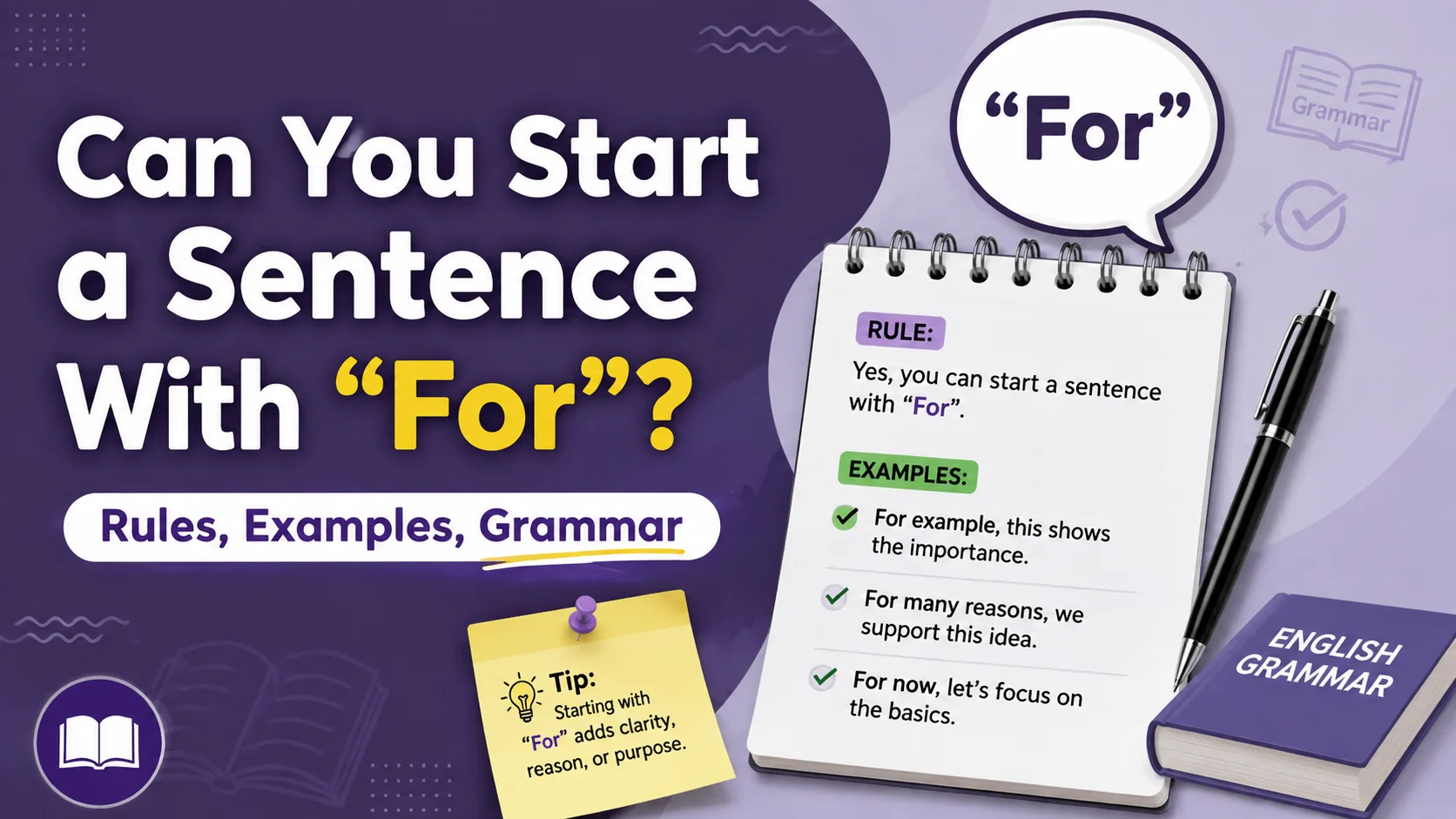
Quick Answer: Can You Start a Sentence With “For”?
Yes, you can start a sentence with “for.”
There is no general English grammar rule that prohibits for from appearing at the beginning of a sentence. The sentence simply needs to have a correct and complete structure.
Here are several correct examples:
- For example, you could practice this rule every day.
- For years, the old house remained empty.
- For this reason, the committee rejected the proposal.
- For now, let’s focus on the basic rule.
- For the first time, she felt completely prepared.
Each example begins with for, yet each one is grammatically correct.
The key is simple:
Don’t judge “for” by where it appears. Judge it by the job it performs in the complete sentence.
Most sentences beginning with for use it as a preposition or as part of a familiar introductory phrase. Its use as a coordinating conjunction meaning is also recognized, although that style often sounds more formal or literary today.
Understanding the Different Roles of “For”
The biggest source of confusion comes from the fact that for doesn’t have only one grammatical role.
Depending on the sentence, for can function in different ways. For this topic, two uses matter most:
- For as a preposition
- For as a coordinating conjunction
Think of the word as a multitool. The tool remains the same, but its job changes according to the situation.
“For” as a Preposition
In everyday English, for commonly works as a preposition.
A preposition helps show a relationship involving ideas such as:
- Purpose
- Time or duration
- Reason
- Benefit
- Recipient
- Reference
For example:
For three hours, we waited outside.
Here, for introduces the time period.
For your safety, keep the gate closed.
In this sentence, the phrase introduces the purpose or benefit.
For many people, learning grammar takes practice.
Here, the phrase identifies the group being discussed.
Starting a sentence with a prepositional phrase is completely normal in English. A sentence can begin with a preposition when the structure that follows forms a complete and meaningful sentence.
“For” as a Coordinating Conjunction
For also belongs to the traditional group of coordinating conjunctions remembered by the acronym FANBOYS:
- For
- And
- Nor
- But
- Or
- Yet
- So
In this role, for often means something close to because. It introduces a reason or explanation.
For example:
She stayed home, for she wasn’t feeling well.
The second clause explains the reason for the first clause.
You could rewrite the sentence as:
She stayed home because she wasn’t feeling well.
The meaning remains similar.
However, there is an important style difference. Using for as a conjunction in this way often sounds formal, literary, traditional, or slightly old-fashioned in modern everyday English. Many writers would naturally choose because instead.
When Is It Correct to Start a Sentence With “For”?
You can correctly start a sentence with for when the complete structure makes grammatical sense.
The most common patterns are easy to recognize.
Starting a Sentence With “For Example”
For example is one of the most common sentence openings in English.
It introduces an example that supports or explains the previous point.
For example, a single comma can change how a reader understands a sentence.
This use is natural in:
- Essays
- Blog posts
- Articles
- Reports
- Academic writing
- Everyday explanations
Usually, place a comma after for example when it introduces the rest of the sentence.
Correct: For example, you can use a shorter sentence for emphasis.
Incorrect: For example you can use a shorter sentence for emphasis.
The phrase works like a signpost. It tells your reader, “Here comes an example.”
Starting a Sentence With “For Instance”
For instance works much like for example.
For instance, you might use “because” instead of “for” in casual writing.
Both phrases introduce examples. However, writers often alternate between them to avoid repeating the same transition.
Here’s a quick comparison:
| Phrase | Main Purpose | Example |
| For example | Introduces an example | For example, try reading it aloud. |
| For instance | Introduces a specific case | For instance, this sentence uses “for” correctly. |
Both are correct at the beginning of a sentence.
Starting a Sentence With “For This Reason”
For this reason introduces a conclusion based on information that came before it.
For example:
The evidence didn’t support the claim. For this reason, the editor removed it.
The phrase creates a clear logical connection.
You can also use:
- For that reason
- For this purpose
- For this matter
- For that matter
The key is context. Your reader should clearly understand what this or that refers to.
Starting a Sentence With “For Now”
For now means at the present time or until circumstances change.
For example:
For now, the original plan remains in place.
This phrase often appears in everyday conversation and informal writing.
It gives the sentence a temporary quality. The decision may change later.
Starting a Sentence With a Time Phrase
You can also begin with for + a period of time.
Examples include:
- For years, he avoided public speaking.
- For several months, the team prepared for the launch.
- For a few minutes, nobody said anything.
- For decades, the building stood empty.
These openings usually tell readers how long something happened.
The sentence becomes more interesting because the time frame appears immediately.
Compare:
They prepared for the launch for several months.
For several months, they prepared for the launch.
Both sentences are correct. The second one places greater emphasis on the duration.
Can You Start a Sentence With “For” as a Conjunction?
This part requires a little more care.
For can function as a coordinating conjunction that introduces a reason. Traditionally, it connects two independent clauses.
Consider this sentence:
The road was dangerous, for the heavy rain had flooded several areas.
Both sides can stand independently:
- The road was dangerous.
- The heavy rain had flooded several areas.
The conjunction links them by showing a reason or explanation.
However, modern writers don’t use this form as often as they use because.
Compare the two:
The road was dangerous, for the heavy rain had flooded several areas.
The road was dangerous because the heavy rain had flooded several areas.
The first sentence has a more literary rhythm. The second sounds more direct and natural in most modern situations.
That’s an important distinction.
Grammar and Style Aren’t Always the Same Thing
A sentence can be grammatically correct and still sound unusual for a particular audience.
For example:
He remained silent, for he knew the truth.
This is grammatically acceptable.
However, many modern readers may find this version more natural:
He remained silent because he knew the truth.
Neither choice is automatically wrong. The better option depends on the tone you want.
A novel, speech, or dramatic piece may benefit from the rhythm of for. A casual blog post may sound smoother because.
“For” at the Beginning vs. “For” in the Middle of a Sentence
The position of for doesn’t determine whether it is correct. Its grammatical function does.
| Position of “For” | Example | Function |
| Beginning | For example, try another approach. | Introductory phrase |
| Beginning | For years, she studied abroad. | Preposition |
| Beginning | For this reason, the plan changed. | Prepositional phrase |
| Beginning | For now, we’ll wait. | Introductory phrase |
| Middle | I stayed, for I had promised. | Coordinating conjunction |
| Middle | This letter is for you. | Preposition |
This table highlights the main point: “For” can appear in different positions and perform different jobs.
You don’t need to avoid it simply because it appears first.
Sentence Structures You Can Use When Starting With “For”
Learning a few reliable patterns makes this grammar point much easier.
For + Time Expression + Main Clause
Use this pattern when describing duration.
For two weeks, the weather remained unusually cold.
For years, she worked toward her goal.
The opening phrase provides the time frame. The main clause completes the thought.
For + Reason or Reference + Main Clause
Use this structure to show a reason, purpose, or point of reference.
For this reason, the company changed its approach.
For your convenience, the instructions appear below.
For many readers, the distinction seems small at first.
These sentences work because they continue with a complete main clause.
Fixed “For” Expression + Main Clause
English contains several natural expressions beginning with for.
Examples include:
- For example,
- For instance,
- For now,
- For this reason,
- For that reason,
- For the most part,
- For the record,
- For better or worse,
- For all practical purposes,
- For what it’s worth,
Here are a few examples in context:
For the record, the original version used a different spelling.
For the most part, the new system works well.
For better or worse, language changes over time.
For what it’s worth, simple wording often creates stronger communication.
These phrases make useful sentence openings when they fit the context.
Correct Examples of Sentences Beginning With “For”
Here are more examples of for at the beginning of a sentence.
Examples Showing Time
- For years, the family visited the same town every summer.
- For several hours, the rain fell without stopping.
- For a brief moment, the room became completely silent.
- For decades, writers have debated certain grammar myths.
Examples Showing Purpose or Benefit
- For your protection, never share your password publicly.
- For better results, review your work before publishing it.
- For maximum clarity, use the simplest accurate wording.
Examples Showing Reason or Connection
- For this reason, the proposal received strong support.
- For that reason, the team decided to wait.
- For many people, this grammar rule causes unnecessary confusion.
Examples Using Fixed Expressions
- For example, one word can function differently in different sentences.
- For instance, “for” can act as both a preposition and a conjunction.
- For now, the simplest rule is enough.
- For the most part, English allows considerable flexibility in sentence openings.
Each sentence works because for belongs to a complete grammatical structure.
Incorrect or Awkward Uses of “For” at the Beginning of a Sentence
Starting with for doesn’t magically make a sentence correct.
You still need a complete thought.
Mistake: Writing a Fragment
Consider this:
For the meeting tomorrow.
This isn’t a complete sentence. It doesn’t contain a complete thought.
The reader naturally asks, “What about the meeting tomorrow?”
You can fix it by adding a main clause:
For the meeting tomorrow, bring your notes and questions.
Now the sentence works.
Mistake: Adding “For” Without a Clear Purpose
This sentence creates confusion:
The weather was terrible.
The problem isn’t simply that the sentence begins with for. The issue is that for as a conjunction usually connects an explanation to another idea.
A clearer version might be:
We canceled the trip because the weather was terrible.
Or, in a more traditional style:
We canceled the trip, for the weather was terrible.
The complete relationship matters.
Mistake: Using a Comma Automatically After “For”
Don’t add a comma simply because the sentence begins with for.
The punctuation depends on the full phrase and structure.
Correct: For example, the sentence can begin with a preposition.
Correct: For years, they practiced every morning.
Incorrect: For years they practiced every morning.
That comma breaks the phrase apart.
Do You Need a Comma After “For”?
No. “For” itself does not automatically require a comma.
The punctuation depends on the introductory element.
Here are common examples:
| Sentence | Comma Needed? | Reason |
| For example, this rule is easy to remember. | Yes | The introductory expression takes a comma. |
| For years, she practiced daily. | Usually yes | The introductory time phrase is followed by a comma. |
| For this reason, we changed the plan. | Yes | The introductory phrase is separated from the main clause. |
| For your safety, keep the door locked. | Yes | The introductory phrase comes before the main clause. |
| For he knew the truth, he remained silent. | Awkward structure | Modern writers usually choose another construction. |
A useful habit is to look at the entire introductory phrase, not just the word for.
“For” vs. “Because”: Which Should You Use?
Both words can express a reason, but they don’t always create the same tone.
Using “Because”
Because it is the most common choice in modern everyday English.
I left early because I felt tired.
The relationship is direct and clear.
Using Conjunction “For”
For can also introduce an explanation.
I left early, for I felt tired.
This version sounds more formal or literary.
Quick Comparison
| Word | Main Use | Typical Tone |
| Because | Gives a direct reason | Natural and common |
| For | Gives an explanation or reason | Formal or literary |
| Since | Gives a reason or refers to time | Context-dependent |
For most everyday writing, because it is usually the safer and more natural choice.
Use for as a conjunction when its tone fits the sentence.
“For” vs. “Since” vs. “Because”
These words can all help express a reason. Still, they have important differences.
Because
Because it clearly answers the question of reason.
She stayed home because she was sick.
There is little room for confusion.
Since
Since can mean because, but it can also refer to time.
Since she was sick, she stayed home.
This means she was sick.
However:
She has worked here since 2020.
Here, since it refers to time.
That double meaning can occasionally create ambiguity.
For
Traditional conjunctions can also introduce a reason.
She stayed home, for she was sick.
The meaning is similar to because, but the tone is different.
Here’s the comparison:
| Sentence | Meaning | Style |
| She stayed home because she was sick. | Direct reason | Everyday English |
| Since she was sick, she stayed home. | Reason | Neutral |
| She stayed home, for she was sick. | Explanation | Formal or literary |
Common Mistakes When Starting a Sentence With “For”
A few mistakes appear again and again.
Believing “For” Can Never Start a Sentence
This is the biggest myth.
These are all correct:
- For example, the answer depends on context.
- For years, he practiced every day.
- For this reason, the rule matters.
There is no blanket rule banning these openings. Modern grammar guidance similarly recognizes that sentence-initial conjunctions aren’t automatically ungrammatical.
Confusing the Preposition and the Conjunction
Compare:
For five years, she worked abroad.
Here, for relates to duration.
She worked abroad, for she wanted new experiences.
Here, to introduce a reason.
The same word performs different grammatical jobs.
Creating a Fragment
For several years.
This isn’t complete.
Add a main clause:
For several years, the company operated from a small office.
Overusing “For Example”
For example, it is useful. Still, using it in every paragraph makes writing repetitive.
Try alternatives when appropriate:
- For instance
- To illustrate
- Consider this example
- One example is
- Take this case
Variation gives your writing a smoother rhythm.
Using Formal “For” When It Sounds Unnatural
Don’t force the conjunction into ordinary sentences simply to sound sophisticated.
Less natural in casual writing: I couldn’t attend, for I had another appointment.
More natural: I couldn’t attend because I had another appointment.
Clear writing usually wins.
Is Starting a Sentence With “For” Formal or Informal?
It depends entirely on the phrase.
Some sentence openings with for are neutral and common:
- For example,
- For years,
- For now,
- For this reason,
These work in many kinds of writing.
Other uses sound more formal.
For example:
I accepted the offer, for it seemed reasonable.
The sentence is grammatically valid, yet its tone is more literary than conversational.
The smartest approach is to match your wording to your audience.
For a research paper, formal language may fit.
For a friendly blog post, direct language may work better.
For creative writing, rhythm may matter more than strict simplicity.
Grammar gives you options. Style helps you choose among them.
Can You Start a Sentence With Other FANBOYS Conjunctions?
Yes. The idea that you must never begin a sentence with a coordinating conjunction is a common grammar myth.
The traditional FANBOYS conjunctions are:
- For
- And
- Nor
- But
- Or
- Yet
- So
Starting a sentence with one of these words isn’t automatically incorrect. The MLA Style Center explains that beginning sentences with coordinating conjunctions can be a matter of style rather than a grammatical violation.
For example:
But the plan changed at the last minute.
And that’s when the real problem began.
Yet nobody noticed the mistake.
These openings can improve rhythm, emphasis, or contrast.
Of course, moderation matters. Starting every sentence with a conjunction can become repetitive. A little variety goes a long way.
A Simple Case Study: Choosing the Best Version
Imagine you’re writing an article about a delayed project.
You have three choices:
Version 1: The project was delayed. The team needed additional data.
Version 2: The project was delayed, for the team needed additional data.
Version 3: The project was delayed because the team needed additional data.
Which One Works Best?
Version 1 feels awkward because for appears to introduce an explanation without connecting smoothly to the previous sentence.
Version 2 is grammatically acceptable. The conjunction links two independent clauses.
Version 3 sounds the most natural in most modern professional and everyday writing.
This example shows an important lesson:
A word can be grammatically possible without being the best stylistic choice.
When writing, aim for clarity first. Fancy wording doesn’t automatically improve a sentence.
Quick Reference: Starting a Sentence With “For”
| Question | Answer |
| Can you start a sentence with “for”? | Yes. |
| Can “for example” start a sentence? | Yes. |
| Can “for this reason” start a sentence? | Yes. |
| Can “for years” start a sentence? | Yes. |
| Is “for” always a conjunction? | No. It can also be a preposition. |
| Can the conjunction “for” mean “because”? | Yes. |
| Does “for” always need a comma after it? | No. The full structure determines punctuation. |
| Can a phrase beginning with “for” be a sentence fragment? | Yes, if it lacks a complete main clause. |
| Does conjunction “for” sound common in modern casual writing? | Usually no. It often sounds formal or literary. |
Conclusion
Yes, you can start a sentence with “for” when you use it correctly. The key is understanding its function, context, and sentence structure rather than blindly following an old grammar rule. Whether for works as a preposition or a coordinating conjunction, its role determines how the sentence should flow. With the right usage, you can write clearly and confidently in formal writing, essays, and everyday English.
FAQs
Q1. Can you start a sentence with “for”?
Yes, you can start a sentence with “for.” Its correctness depends on its grammatical function and the context in which you use it.
Q2. Is starting a sentence with “for” grammatically correct?
Yes. Starting with for is not automatically incorrect. English grammar allows it when the sentence has a complete and clear structure.
Q3. Can “for” be used as a conjunction at the beginning of a sentence?
Yes, for can function as a coordinating conjunction. However, this use is more common in formal or literary writing than in everyday conversation.
Q4. Can you start a sentence with “for example”?
Absolutely. For example, it commonly appears at the beginning of a sentence when introducing an example or supporting detail.
Q5. Can you start a sentence with “for years”?
Yes. For years can begin a sentence because it functions as a preposition in this phrase. For example: “For years, she practiced the piano.”
Q6. Is “For he was feeling ill” a complete sentence?
Yes, it can be grammatically complete because for can introduce a reason or explanation. Still, this construction sounds formal and somewhat old-fashioned in modern everyday English.
Q7. Should you avoid starting sentences with “for”?
No, you don’t need to avoid it completely. Use for when it fits the meaning, context, and style of your writing.
About the Author