
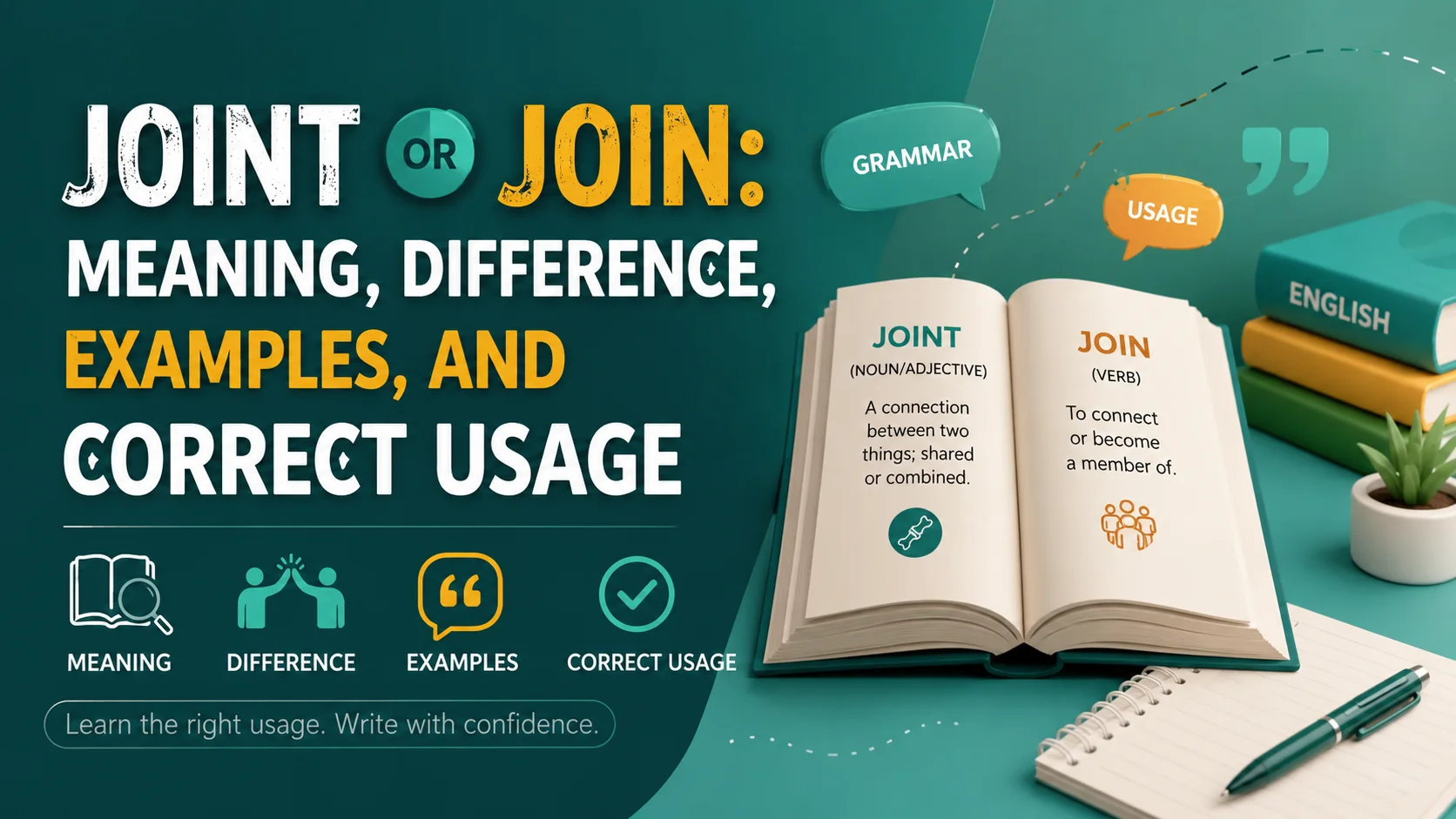
Joint’ or ‘Join can seem confusing because both words relate to bringing things or people together, but their meaning and grammatical function differ. Join is usually a verb that describes an action, such as entering a club, attending a meeting, or becoming part of a group. Joint usually works as a noun or adjective, describing a connection, something shared, or something involving two or more people or groups.
The easiest way to choose the right word is to focus on what you want to express. Use join when you mean connect, unite, coming together, attaching, or becoming part of something. For example, you can join your friends, join a team, or link objects such as pieces of wood. Use joint for a connection between things, such as a knee joint connecting leg bones, or for shared endeavors, such as a joint account or joint bank account. These different uses become easier to remember when you connect each word with its role.
A small spelling difference can change the clarity of your message and create a common mistake. Writing “I want to joint the team” uses the wrong word, because join is the correct standard verb. Likewise, “a join account” is incorrect when you mean an account shared by multiple people. In English, these pairs of words may sound alike or look closely related, but their uses can be worlds apart. Learning their definitions, grammar rules, examples, common mistakes, and useful expressions removes guesswork and builds confidence.
Quick Answer: Joint or Join?
Use join when you mean to connect, participate, accompany someone, or become a member of a group.
I want to join the team.
Use joint when you mean shared by two or more people or a place where two things connect.
They opened a joint bank account.
The joint between the pipes is leaking.
Here’s the difference at a glance:
| Word | Common role | Main meaning | Example |
| Join | Verb | Connect, participate, accompany, or become a member | Please join us. |
| Join | Noun | A place where things meet | The join is difficult to see. |
| Joint | Adjective | Shared or combined | They made a joint decision. |
| Joint | Noun | A connection or meeting point | The joint is damaged. |
| Joint | Verb | Fit together or provide with a joint | The pieces were jointed. |
A useful rule to remember is:
You join something. A joint is often the connection or shared arrangement.
This isn’t an absolute rule because both words have several meanings. Still, it works for most everyday situations.
What Does “Join” Mean?
Join primarily works as a verb. It can describe physical connection, social participation, membership, or movement into someone’s company.
Merriam-Webster defines join with meanings that include bringing things together, connecting separated items, entering someone’s company, becoming associated with a group, and taking part in a collective activity.
Join Means to Become a Member
One of the most common uses of join involves membership.
You join an organization, club, company, team, service, or group.
Examples:
- She joined the tennis club.
- He joined the company after college.
- I decided to join the committee.
- Thousands of people joined the organization.
- Would you like to join our team?
Here, join describes the action of becoming part of something.
That’s why this sentence is correct:
She joined the debate club.
Not:
She joint the debate club.
The word joint doesn’t work as the ordinary verb for becoming a member.
Join Means to Participate
Join can also mean taking part in something that other people are doing.
For example:
- Everyone joined the discussion.
- Would you like to join us for dinner?
- He joined the celebration.
- Several students joined the protest.
- Please join the meeting at 10 a.m.
In each example, the person becomes involved in an activity or group.
The American Dictionary entry for join specifically includes doing something with or being with someone.
Join Means to Accompany Someone
When you ask someone to come with you, join is the natural word.
Can I join you for lunch?
She joined her friends at the restaurant.
Come and join us.
This meaning appears constantly in everyday American English.
You don’t need a complicated grammar rule here. Think about the action: one person is coming into the company of another person.
Join Means to Connect Things
The word join doesn’t only apply to people.
You can also join physical objects.
Examples include:
- Join the two pieces with glue.
- The bridge joins the two islands.
- The road joins the two towns.
- The technician joined the wires.
- The carpenter joined the boards.
Cambridge defines this use as connecting or fastening things together. It also gives examples involving bridges, roads, and physical objects.
This is an important distinction because join can describe the action of creating a connection.
The worker joined the pipes.
The worker performed the action.
If you want to name the connection itself, joint may be more appropriate:
The joint between the pipes is leaking.
What Does “Joint” Mean?
Joint has several grammatical roles. It can work as an adjective, noun, or verb, although its adjective and noun uses are much more common in everyday writing.
Merriam-Webster lists all three functions.
Joint as an Adjective
As an adjective, joint commonly means shared, combined, or involving two or more people or groups.
This is one of the most important meanings to remember.
Examples:
- They opened a joint bank account.
- The companies released a joint statement.
- The schools organized a joint project.
- The partners made a joint decision.
- The two groups launched a joint campaign.
- They took joint responsibility for the project.
Oxford defines this adjective as involving two or more people together and gives examples such as joint account, joint effort, and joint owners.
Cambridge gives the same central idea: something belonging to or shared between two or more people.
So if something belongs to multiple people or involves them together, joint often fits naturally.
Joint as a Noun
As a noun, joint commonly refers to a place where two things meet or connect.
For example:
The joint between the two boards is weak.
The plumber repaired the pipe joint.
The bridge contains several metal joints.
Merriam-Webster defines this sense as a place where two things or parts are joined.
A joint can also refer to a place where bones meet in the body.
Examples include:
- knee joint
- hip joint
- shoulder joint
- elbow joint
- ankle joint
- wrist joint
Oxford defines a joint in anatomy as a place where two bones are joined in a way that allows movement.
The physical meaning creates a helpful mental picture: two parts meet at a particular point. That meeting point is the joint.
Joint as a Verb
Joint can also function as a verb. Merriam-Webster includes meanings such as fitting things together or providing something with a joint.
This use is more specialized than ordinary join.
For everyday writing, don’t automatically use joint whenever you mean “connect.” If you’re describing the ordinary action of connecting things, join is usually the natural choice.
Compare:
Join the two boards.
with:
The joint between the boards is strong.
The first sentence focuses on the action. The second focuses on the connection.
Joint or Join: The Core Difference
The clearest way to understand joint or join is to focus on the grammatical job each word performs.
Join Usually Describes an Action
Consider these examples:
- Join the team.
- Join the meeting.
- Join us for dinner.
- Join the two pieces.
- She joined the company.
- Everyone joined the discussion.
Something is happening in each sentence.
Someone becomes involved. Someone participates. Someone connects objects. Someone enters a group.
That’s why join commonly functions as a verb.
Joint Often Describes a Connection or Shared Situation
Now look at these examples:
- They have a joint account.
- The companies issued a joint statement.
- The pipe has a damaged joint.
- The knee joint allows movement.
- They made a joint decision.
Here, joint isn’t describing the action of joining.
Instead, it describes something that is shared or identifies a point of connection.
A simple memory formula works well:
Join = action
Joint = shared or connected thing
For example:
Join the companies together.
The companies created a joint project.
The first describes an action. The second describes something shared.
Joint vs. Join in Common Sentences
The following comparison shows how the words behave in everyday English.
| Meaning | Correct word | Example |
| Become a member | join | I want to join the club. |
| Participate | join | Please join the discussion. |
| Accompany someone | join | Can I join you? |
| Connect objects | join | Join the two pieces. |
| Connect roads or paths | join | The roads join near the bridge. |
| Describe something shared | joint | They made a joint decision. |
| Describe shared ownership | joint | They have joint ownership. |
| Name a physical connection | joint | The joint needs repair. |
| Name a body connection | joint | The knee joint is flexible. |
Notice how one letter changes the grammatical function.
Join the team.
Joint ownership.
Join the pieces.
The joint between the pieces.
Once you recognize this pattern, the difference becomes much easier.
Common Mistakes With Joint and Join
Writers often confuse joint and join, using one when the other is grammatically correct or needed in context.
“I Want to Joint the Club”
This is one of the clearest mistakes.
Incorrect:
I want to joint the club.
Correct:
I want to join the club.
Why? Because the sentence describes becoming a member. Join is the verb you need.
“They Have a Join Account”
Incorrect:
They have a join account.
Correct:
They have a joint account.
Here, joint works as an adjective. It describes an account shared by two or more people.
“Please Joint Us”
Incorrect:
Please joint us for dinner.
Correct:
Please join us for dinner.
The phrase requires the verb join because the person is being invited to participate or accompany others.
“They Made a Join Decision”
Incorrect:
They made a join decision.
Correct:
They made a joint decision.
A decision made together is a joint decision.
“The Join Is Leaking”
This example needs more care.
If you’re referring to a physical connection, joint is often the better word:
The joint is leaking.
However, join can also work as a noun in certain contexts. Cambridge defines the noun join as a place where things meet or are fastened together.
For example:
The join between the two pieces is almost invisible.
So context matters.
Joint or Join in Physical Connections
Physical connections offer one of the best ways to see the difference.
Imagine two pieces of wood.
The carpenter joins the pieces.
Afterward, the place where they connect is the joint.
This creates a simple sequence:
Action → join
Connection → joint
For example:
The carpenter joined the boards.
The joint between the boards is strong.
The same idea works with pipes:
The plumber joined the pipes.
The pipe joint needs sealing.
This distinction also appears in engineering, construction, manufacturing, woodworking, and other technical fields.
Join in Common Expressions
This section explores common expressions using “join in” and explains how to use them naturally in everyday English.
Join In
Join in means to participate in an activity.
Everyone joined in the singing.
Don’t just watch. Join in.
Merriam-Webster lists join in for taking part in a collective activity.
Join Up
Join up can describe becoming part of a group or organization.
He joined up after finishing school.
The exact meaning depends on context.
Join Forces
Join forces means to work together toward a common goal.
The two companies joined forces to develop the product.
This expression highlights cooperation.
Join Hands
Join hands literally means to hold hands with other people. It can also suggest unity.
The dancers joined hands and formed a circle.
Join the Dots
Join the dots means to connect separate points or ideas.
It can also have a figurative meaning: connecting separate facts to understand a larger situation. Cambridge includes this figurative use among its established expressions.
Joint in Common Expressions
The adjective joint appears in many established phrases.
Joint Account
A joint account is shared by multiple account holders.
The couple opened a joint account.
Joint Effort
A joint effort is work carried out together.
The cleanup was a joint effort.
Joint Decision
A joint decision is a decision made by multiple people or groups.
They reached a joint decision.
Joint Statement
A joint statement is issued by multiple parties.
The organizations released a joint statement.
Joint Ownership
Joint ownership means that ownership belongs to more than one person or party.
The brothers have joint ownership of the property.
Joint Venture
A joint venture involves two or more parties working together in a business arrangement.
The companies formed a joint venture.
These phrases all revolve around the same central idea: two or more parties share something or act together.
Joint or Join in Formal and Professional English
Neither joint nor join is inherently formal or informal.
Join appears naturally in professional writing:
Employees can join the training session at 9 a.m.
The researcher joined the project in June.
Joint is especially common in professional, business, government, and legal contexts.
Examples include:
- joint agreement
- joint statement
- joint committee
- joint ownership
- joint responsibility
- joint venture
- joint operation
- joint project
The word can communicate shared responsibility or participation with very little extra wording. That’s one reason it appears so often in formal documents.
Joint or Join in Different Real-Life Situations
Different real-life situations show how “joint” refers to something shared or connected, while “join” means to connect, become part of, or participate in something.
At Work
Imagine two companies working together.
You could say:
The companies joined forces to develop the software.
Once they begin working together, they might announce:
The companies issued a joint statement.
The first sentence describes an action. The second describes something shared.
At a Social Event
Someone might ask:
Would you like to join us for dinner?
That person is inviting you to participate.
If several people pay for the event together, you might describe their contribution as:
a joint effort
Again, the words aren’t interchangeable because they perform different jobs.
In Construction
A worker might:
join two sections of pipe
The connection itself can be called:
a pipe joint
This is perhaps the most concrete way to remember the distinction.
Parts of Speech: Joint vs. Join
Grammar provides another reliable shortcut.
| Word | Part of Speech | Typical Function | Example |
| join | Verb | Describe an action | Join the group. |
| join | Noun | Name a place of connection | The join is visible. |
| joint | Adjective | Describe something shared | A joint project |
| joint | Noun | Name a connection | The joint is loose. |
| joint | Verb | Describe specialized joining or fitting | The pieces were jointed. |
Merriam-Webster identifies join as a verb and noun while identifying joint as a noun, adjective, and verb.
This explains why simply memorizing spelling isn’t enough.
You need to identify what role the word plays in the sentence.
Join or Joint: A Useful Memory Trick
Try this simple mental test.
If You Can Replace It With “Become Part Of,” Use Join
I want to join the club.
You can think:
I want to become part of the club.
Therefore, join work.
If You Can Replace It With “Shared,” Use Joint
They opened a joint account.
You can think:
They opened a shared account.
Therefore, joint works.
If You Mean the Connection Itself, Think Joint
The joint between the pipes is damaged.
You’re naming the point where the parts meet.
If You Mean the Act of Connecting, Think Join
Join the two pipes.
You’re describing what someone should do.
This four-part test covers a surprisingly large number of everyday examples.
Etymology of Joint and Join
The similarity between these words has a genuine historical explanation.
Join comes through Middle English from Anglo-French joindre, which traces back to the Latin jungere, meaning “to join.” Merriam-Webster gives this etymological history for the modern verb.
Joint comes from the same broader word family. Merriam-Webster traces the noun and adjective through Middle English and Anglo-French forms connected with joindre.
So their resemblance isn’t a coincidence.
Both words developed around the idea of joining, connecting, or being united. Over centuries, English gave them different grammatical roles and specialized meanings.
Word Forms Related to Join and Joint
Understanding their forms can make writing easier.
Forms of Join
- join
- joins
- joined
- joining
Examples:
She joins the meeting every Monday.
She joined the company last year.
She is joining the discussion now.
Forms Related to Joint
- joint
- jointly
- jointed
- jointing
For example:
The project was jointly funded by two organizations.
The adverb jointly means something is done together or by multiple parties.
Joint or Join: Side-by-Side Sentence Comparison
| Join | Joint |
| Join the team. | They made a joint decision. |
| Please join us. | They opened a joint account. |
| Join the two boards. | The joint between the boards is strong. |
| She joined the company. | They have joint ownership. |
| Everyone joined the discussion. | It was a joint effort. |
| The roads join near the town. | The road has an expansion joint. |
These pairs show the difference more clearly than definitions alone.
In the left column, join generally describes an action.
In the right column, joint describes something shared or a point of connection.
A Simple Decision Guide for Joint or Join
When you’re writing and hesitate between joint or join, run through these questions.
Are you describing someone becoming a member?
→ Use join.
Are you describing participation?
→ Use join.
Are you asking someone to come with you?
→ Use join.
Are you describing the act of connecting things?
→ Use join.
Are you describing something shared by two or more people?
→ Use joint.
Are you naming the point where things connect?
→ Usually use joint.
For example:
Join the organization.
They have joint ownership.
Join the two pieces.
Inspect the joint.
Once you start thinking in terms of action versus shared connection, the choice becomes much faster.
Conclusion
Understanding Joint’ or ‘Join becomes easier when you focus on the word’s role in the sentence. Use join for an action, such as becoming part of a group, connecting things, or coming together. Use joint for a connection, something shared, or something involving two or more people or groups. Keeping this simple difference in mind can help you avoid common spelling and grammar mistakes.
FAQs
Q1. What is the difference between joint and join?
Join is mainly a verb that means to connect, unite, or become part of something. Joint is usually a noun or adjective that refers to a connection or something shared.
Q2. Is it correct to say “joint the team”?
No. The correct expression is “join the team.” Here, join describes the action of becoming part of the team.
Q3. Is “joint account” correct?
Yes. Joint account is correct when an account is shared by two or more people.
Q4. Is “join account” correct?
No, not when you mean an account shared by multiple people. The correct phrase is “joint account.”
Q5. How can I remember joint vs. join?
Remember join = action and joint = connection or shared. If you’re doing something to come together, use join. If you’re describing a connection or something shared, use joint.
About the Author