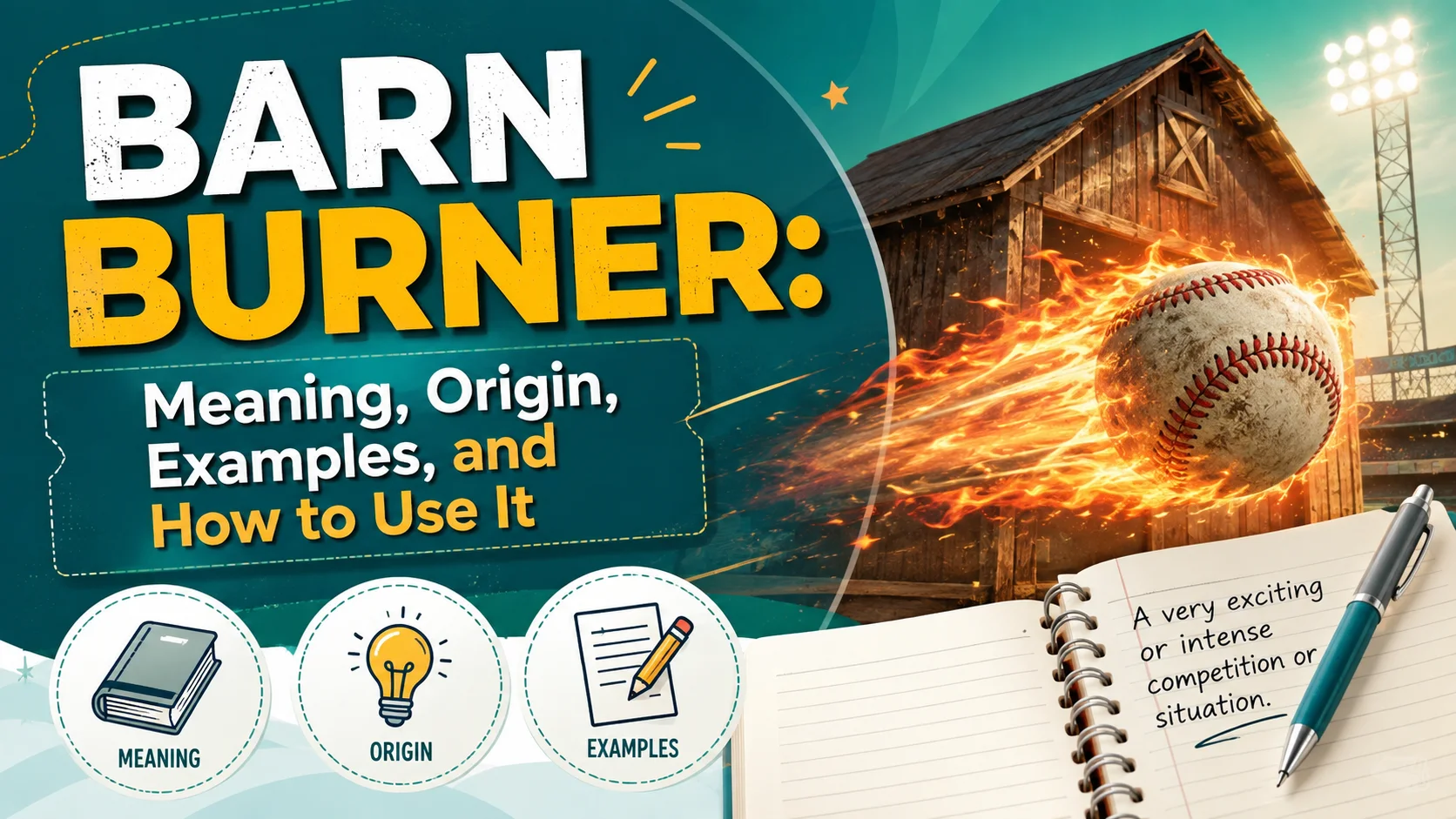
Barn Burner describes a game, debate, performance, or competition that becomes exceptionally exciting and keeps people on the edge of their seats. The expression is especially common in sports, where a close score, dramatic comeback, or last-second finish can make an ordinary contest unforgettable. You might hear a sports commentator use it after a sports game filled with action, especially when the high level of excitement makes the event feel unusually intense.
The expression also works outside sports. People can describe an intense debate, heated political race, or thrilling concert as a Barn Burner when it creates unusual excitement. The phrase has an interesting history connected to 19th-century American politics, when Barnburners referred to a progressive faction of the New York Democratic Party. Its modern meaning later developed in American English, with Merriam-Webster recording a 1934 example involving an exciting bridge hand.
The phrase has vivid imagery because its older idea suggests a burning barn or burning down a barn, something that would draw attention and create a dramatic scene. In modern terms, it describes something extremely exciting, thrilling, and intensely competitive. A real Barn Burner can make your heart race and your palms sweat, much like watching a literal fire captivate an audience. The expression packs a punch because it highlights strong intensity and an experience that feels highly impressive.
Quick Answer: What Does “Barn Burner” Mean?
Barn burner means an extremely exciting, intense, dramatic, or impressive event.
The expression appears most often in sports. A game with a close score, dramatic momentum shifts, an unexpected comeback, or an exciting finish can be called a barn burner.
For example:
The championship game was a real barn burner.
This means the championship game was exceptionally exciting.
The expression can also describe events outside sports:
- The debate was a barn burner.
- The election turned into a political barn burner.
- The concert finale was a barn burner.
- That boxing match was an absolute barn burner.
- The final episode was a real barn burner.
Cambridge Dictionary defines barnburner as a US informal noun meaning an exciting event, especially a sports event. It also recognizes barn burner as an alternative spelling.
Merriam-Webster gives the broader definition: something that arouses much interest or excitement.
In simple terms, if something is so exciting that it keeps everyone’s attention, barn burner may be the perfect description.
What Does Barn Burner Mean in Modern English?
The modern meaning of barn burner centers on exceptional excitement.
It doesn’t merely describe something that is good. It suggests that the event had unusual energy, suspense, intensity, or drama.
Imagine watching two basketball teams that trade the lead throughout the final quarter. With seconds left, one team takes the lead. The other team responds with a three-pointer at the buzzer.
That’s a barn burner.
The same idea works in a championship tennis match that goes to a deciding set, a hockey game settled in overtime, or a political race that remains uncertain until the final votes are counted.
What Usually Makes Something a Barn Burner?
A barn burner often contains several of these qualities:
- High intensity
- Strong competition
- An uncertain outcome
- Unexpected developments
- Momentum shifts
- Outstanding performances
- A dramatic conclusion
- Strong audience interest
There isn’t a strict checklist. Something doesn’t need every characteristic to qualify.
For instance, a spectacular performance could be called a barn burner even without a competition. The key idea is that the event generates an unusually high level of excitement or interest.
Collins particularly associates the expression with closely contested sporting events that are exciting, intense, and dramatic.
Why Is a Sports Game Called a Barn Burner?
Sports are probably the easiest place to understand the expression.
A typical game might be entertaining. A barn burner feels different. The action keeps changing, the outcome remains uncertain, and spectators have plenty of reasons to keep watching.
That’s why sports writers and commentators have embraced the phrase.
Barn Burner Examples by Sport
| Sport | Example of a Barn Burner |
| Basketball | A game decided by a buzzer-beating shot |
| Football | A high-scoring game settled in the final seconds |
| Baseball | A dramatic comeback in the final inning |
| Hockey | A back-and-forth overtime thriller |
| Soccer | A match with several late goals |
| Tennis | A long match decided in the final set |
| Boxing | A hard-fought bout with an uncertain result |
The expression doesn’t require a particular score.
A 102–101 basketball game could be a barn burner. So could a 56–55 football game. But a low-scoring soccer match can also qualify if the tension and drama remain high.
The experience matters more than the numbers.
Can Barn Burner Be Used Outside Sports?
Yes.
Although sports provide the most familiar setting, barn burner can describe many kinds of exciting events.
Cambridge Dictionary gives examples involving both a sports game and a political debate.
Political Debates
A debate can become a barn burner when the candidates strongly challenge each other and the discussion stays intense.
Last night’s debate was a political barn burner.
The expression suggests more than simple disagreement. It implies that the debate generated considerable excitement or interest.
Elections
A closely contested election can also be described this way.
The Senate race has become a real barn burner.
Here, the phrase highlights the competition and uncertainty surrounding the race.
Performances
The expression can describe an energetic performance too.
The band’s final concert was a barn burner.
This tells the reader that the performance was unusually powerful or exciting.
Movies and Television
You may also see barn burner used for entertainment.
The season finale was a barn burner.
This suggests that the finale was especially dramatic or exciting.
Speeches
A speech can occasionally receive the same description.
Her closing speech was a barn burner.
The phrase works particularly well when the speaker delivers an energetic, passionate, or memorable performance.
Where Did the Phrase Barn Burner Come From?
The history of barn burner is much older than its modern sports meaning.
The expression developed from a striking story about a person who supposedly burned down a barn to get rid of rats. The image became a metaphor for someone willing to destroy an entire structure to eliminate a problem.
That metaphor later became connected with American political reformers.
Merriam-Webster explains that Barnburners became the name of one of two competing factions within the New York State Democratic Party during the middle of the 19th century.
The Story Behind the Name
The traditional story describes an old Dutchman whose barn had become infested with rats.
Rather than finding a careful way to remove them, he supposedly burned down the barn.
The message behind the story is easy to understand:
The solution was so extreme that it destroyed the thing containing the problem.
Political opponents used this image to criticize reformers whom they believed were willing to dismantle an entire political system to eliminate its abuses.
That gave Barnburner a very different meaning from the one it has today.
Who Were the Historical Barnburners?
The Barnburners were a real political faction in 19th-century New York.
They represented the more progressive or radical wing of the state’s Democratic Party. Their opponents were known as the Hunkers.
The political conflict involved questions about government, patronage, reform, and eventually the expansion of slavery into the nation’s territories.
The term became a political label because opponents believed the reformers were willing to go too far.
Merriam-Webster notes that the Barnburners were considered the more radical of the two factions.
The historical meaning is important because it explains why the expression has such an unusual image behind it.
Barnburners and the Hunkers
The two names reflected opposing political attitudes.
| Group | General Character |
| Barnburners | More radical and reform-oriented faction |
| Hunkers | More conservative faction within New York’s Democratic Party |
The contrast became part of the political vocabulary of the period.
Eventually, the Barnburners’ political concerns became increasingly connected to the national debate over slavery and its expansion.
When Did Barn Burner Start Meaning “Exciting”?
The modern meaning developed later.
Merriam-Webster’s historical research identifies a 1934 example in which barn-burner described an exciting bridge hand. The citation appeared in the Omaha World-Herald on May 13, 1934.
That example is significant because bridge isn’t a sport in the conventional sense. It shows that the expression had already broadened into a general description of something exciting.
The Dictionary of American Regional English also records earlier examples of barn-burner being used for impressive or exciting things. One cited example dates to material from around 1865, while another 1925 example uses the expression for an impressive woman.
This evidence shows that the expression’s development wasn’t a simple overnight change.
Its meaning gradually expanded.
First, the phrase had a political association. Later, people began using it more broadly for something exceptional, impressive, or exciting.
Today, the political sense is largely historical while the excitement-related sense is common.
Barn Burner vs. Barnburner: Which Spelling Is Correct?
Here’s the good news: both are legitimate forms.
You can write:
- barn burner
- barnburner
Cambridge Dictionary uses barnburner as its main entry and identifies barn burner as an alternative.
Merriam-Webster lists barn burner as its dictionary headword.
So there isn’t a meaningful difference in pronunciation or modern meaning.
Barn Burner
The two-word version is straightforward:
That game was a barn burner.
Barnburner
The closed form is equally natural:
That game was a barnburner.
What About Barn-Burner?
You may encounter the hyphenated form, especially in older material.
Historical sources have recorded barn-burner as well. The Dictionary of American Regional English includes historical examples of the hyphenated form.
For modern general writing, however, barn burner and barnburner are the clearest choices.
If a publication has a specific style preference, follow that preference consistently.
How to Use Barn Burner in a Sentence
Barn burner works as a noun.
The most common pattern is simple:
That was a barn burner.
You can also modify it with words such as real, absolute, or complete.
Sports Examples
The two teams played a real barn burner.
Last night’s overtime game was a barn burner.
The semifinal turned into a barn burner.
Nobody expected the matchup to become such a barn burner.
The teams delivered a barn burner from start to finish.
Political Examples
The debate was a political barn burner.
The governor’s race has become a barn burner.
The final debate turned into an unexpected barn burner.
Entertainment Examples
The concert finale was a barn burner.
The movie’s final act was a barn burner.
The band finished the festival with a barn burner of a performance.
The expression works because it adds emotional force without requiring a long explanation.
What Does “A Barn Burner of a Game” Mean?
One particularly common construction is:
a barn burner of a + noun
For example:
It was a barn burner of a game.
This means the game was exceptionally exciting.
You can use the same structure with other nouns:
- a barn burner of a speech
- a barn burner of a performance
- a barn burner of a debate
- a barn burner of a contest
- a barn burner of a match
The structure gives the noun extra emphasis.
Compare these two sentences:
It was an exciting game.
It was a barn burner of a game.
The first is ordinary.
The second is vivid and conversational.
What Makes a Barn Burner Different From an Ordinary Exciting Event?
The phrase usually implies something above the ordinary level of excitement.
Calling a game “interesting” doesn’t necessarily make it a barn burner.
Calling it a barn burner tells the reader that the event really stood out.
Consider these levels:
| Description | Level of Excitement |
| Interesting | Mild |
| Entertaining | Moderate |
| Exciting | Strong |
| Thrilling | Very strong |
| Barn burner | Exceptionally exciting or intense |
These aren’t strict linguistic categories. They simply illustrate the feeling the expression often creates.
A barn burner is the kind of event people talk about afterward.
Barn Burner vs. Nail-Biter
Barn burner and nail-biter often appear in the same conversations, especially when people discuss sports.
However, they emphasize different things.
A nail-biter focuses on tension and uncertainty.
A barn burner focuses more broadly on excitement, intensity, and drama.
For example:
The game was a nail-biter because nobody knew who would win.
The focus is uncertainty.
Now consider:
The game was a barn burner because both teams traded spectacular plays throughout the night.
The focus is excitement.
Of course, one game can be both.
The championship was a barn burner and a nail-biter.
That’s perfectly natural.
Barn Burner vs. Blowout
These expressions describe very different types of sporting events.
A blowout is a one-sided contest in which one team or competitor wins easily.
A barn burner usually suggests a high level of excitement or intensity.
Compare:
The home team won 120–75 in a blowout.
with:
The home team won 120–118 after a last-second shot in a barn burner.
The second game contains uncertainty and drama.
The first doesn’t.
A blowout can still be entertaining. It simply isn’t what people usually mean by barn burner.
Barn Burner vs. Thriller
A thriller is another close relative.
Both words describe exciting experiences. However, thrillers are broader and work especially well for movies, books, and stories.
You might say:
The movie was a thriller.
But barn burner sounds more natural when describing an exciting event, contest, or performance.
For example:
The championship was a barn burner.
The final match was a thriller.
Both sentences work. The first emphasizes the event’s intensity. The second emphasizes its suspenseful quality.
Is Barn Burner Formal or Informal?
Barn burner is informal American English.
Cambridge specifically labels barnburner as US informal.
That makes it a strong choice for:
- Sports journalism
- Blogs
- News commentary
- Casual articles
- Conversations
- Entertainment writing
- Opinion pieces
It may sound too casual in highly formal academic or technical writing.
Instead of:
The meeting was a barn burner.
a formal report might say:
The meeting generated considerable discussion and interest.
Instead of:
The election was a barn burner.
a formal analysis could say:
The election was highly competitive and remained uncertain until the final count.
Neither version is inherently better. The right choice depends on your audience and purpose.
Common Mistakes When Using Barn Burner
Writers often misuse “barn burner” by applying it to ordinary or mildly exciting events instead of something genuinely thrilling, intense, or highly competitive.
Taking the Expression Literally
In modern usage, barn burner almost always has a figurative meaning.
The game was a barn burner.
This doesn’t mean someone burned down a barn.
The surrounding context normally makes that clear.
Assuming It Only Means “Close”
A close contest can be a barn burner, but closeness isn’t the entire definition.
A dramatic comeback can also produce a barn burner.
Merriam-Webster defines the expression more broadly as something that generates substantial interest or excitement.
Using It for Anything Successful
Success doesn’t automatically equal excitement.
A company can have an extremely successful quarter without anyone calling the financial report a barn burner.
The phrase works best when something is exciting, impressive, intense, or attention-grabbing.
Forgetting Its Informal Tone
The expression has a lively, conversational flavor.
That’s part of its charm.
Confusing the Historical Barnburners With the Modern Meaning
A historical text discussing Barnburners may be talking about 19th-century American politics.
A modern sports article discussing barn burners is talking about exciting contests.
Context tells you which meaning applies.
Real-World Contexts Where Barn Burner Works
“Barn burner” works in real-world contexts to describe an exciting, intense, and closely contested event, especially in sports, competitions, or performances.
Sports
This is the most common modern context.
The teams gave fans a barn burner in the final game of the series.
Politics
A close race or heated debate can earn the description.
The primary election became a political barn burner.
Concerts
A particularly energetic performance can qualify.
The singer closed the show with a barn burner.
Theater
A powerful production may receive the label.
The final act was a barn burner.
Debates
An intense exchange can be described this way.
The candidates delivered a barn burner of a debate.
General Events
The expression can describe almost any event where excitement is the central feature.
The important question isn’t what kind of event is it?
The better question is:
Was it unusually exciting or intense?
If so, barn burner may fit.
Barn Burner Synonyms
There are plenty of alternatives, but each one emphasizes something slightly different.
| Synonym | What It Emphasizes |
| Thriller | Excitement and suspense |
| Nail-biter | Tension and uncertainty |
| Epic | Extraordinary scale or importance |
| Showdown | Direct confrontation |
| Classic | Exceptional quality and memorability |
| Electrifying | Energy and excitement |
| Dramatic | Strong emotional or unexpected developments |
| High-stakes contest | Importance and consequences |
If you want to emphasize suspense, choose nail-biter.
If you want to emphasize confrontation, choose showdown.
If you want to emphasize exceptional excitement, barn burner is a strong choice.
Interesting Facts About Barn Burner
The expression has a surprisingly rich history.
- Barn burner has roots in 19th-century American political language.
- The historical Barnburners were a faction of the New York Democratic Party.
- Their opponents were known as the Hunkers.
- The Barnburner name referred to a story about burning a barn to get rid of rats.
- Merriam-Webster notes evidence that the term was used for radicals in Pennsylvania as early as 1840, slightly before the well-known New York political usage.
- The modern excitement-related meaning is documented by 1934 in Merriam-Webster’s historical files.
- The 1934 example referred to an exciting bridge hand, showing that the modern meaning wasn’t limited to major sporting events.
- Barnburner can describe something highly exciting or impressive.
- The word can also have a separate regional meaning for a type of wooden friction match, particularly in Pennsylvania.
- Both barnburner and barn burner remain accepted modern forms.
That last regional meaning is a useful reminder that words sometimes develop several unrelated senses.
A Simple Memory Trick for Barn Burner
Think about the image behind the expression.
Imagine an entire barn going up in flames.
It’s dramatic. It’s intense. It’s impossible to ignore.
That image makes the modern meaning easy to remember:
A barn burner is something so exciting that it grabs everyone’s attention.
This is a memory trick rather than a complete historical explanation. The actual history involves 19th-century political language and the Barnburner faction.
A Closer Look at the Historical Metaphor
The barn image works because it represents an extreme solution.
Suppose a farmer has a barn full of rats.
Instead of carefully removing the rats, he burns down the barn.
The solution destroys the problem along with everything around it.
Political opponents used that idea to portray the Barnburners as reformers who would go too far. Merriam-Webster describes them as the more radical faction in the New York Democratic Party and explains the metaphor behind their name.
This historical meaning explains something important about the word’s emotional force.
Barn burner has always carried a sense of something unusually forceful.
The modern meaning is much more positive, but the underlying image remains dramatic.
How to Know When Barn Burner Is the Right Word
Before using barn burner, ask yourself:
Did this event create an unusually high level of excitement, intensity, or interest?
If yes, the phrase may work.
Natural Examples
The overtime game was a barn burner.
The two candidates had a barn burner of a debate.
The concert ended with a barn burner of a performance.
The championship match turned into an unexpected barn burner.
Less Natural Example
The staff meeting was a barn burner because everyone arrived early.
That doesn’t work because arriving early isn’t inherently exciting.
The phrase needs something that gives the event real energy.
Conclusion
A Barn Burner is an event that delivers exceptional excitement, strong intensity, and memorable action. Although the phrase has roots in American political history and vivid barn-fire imagery, today it most often describes thrilling games, debates, competitions, and other events that keep everyone fully engaged.
FAQs
Q1. What does “Barn Burner” mean?
Barn Burner means an extremely exciting or intense event, especially a close and thrilling game, competition, debate, or performance.
Q2. Is “Barn Burner” usually used for sports?
Yes. It’s especially common in sports when a game has a close score, dramatic action, or a last-second finish that keeps everyone excited.
Q3. Can “Barn Burner” describe something other than a game?
Yes. You can use it for an intense debate, heated political race, thrilling concert, or another event that creates unusual excitement.
Q4. Where did the phrase “Barn Burner” come from?
The expression has connections to 19th-century American politics, where Barnburners was the name of a progressive faction of the New York Democratic Party. The modern sense later developed in American English.
Q5. Is it spelled “Barn Burner” or “Barnburner”?
Both barn burner and barnburner are used. The two forms refer to the same expression, meaning something exceptionally exciting or intense.
About the Author