
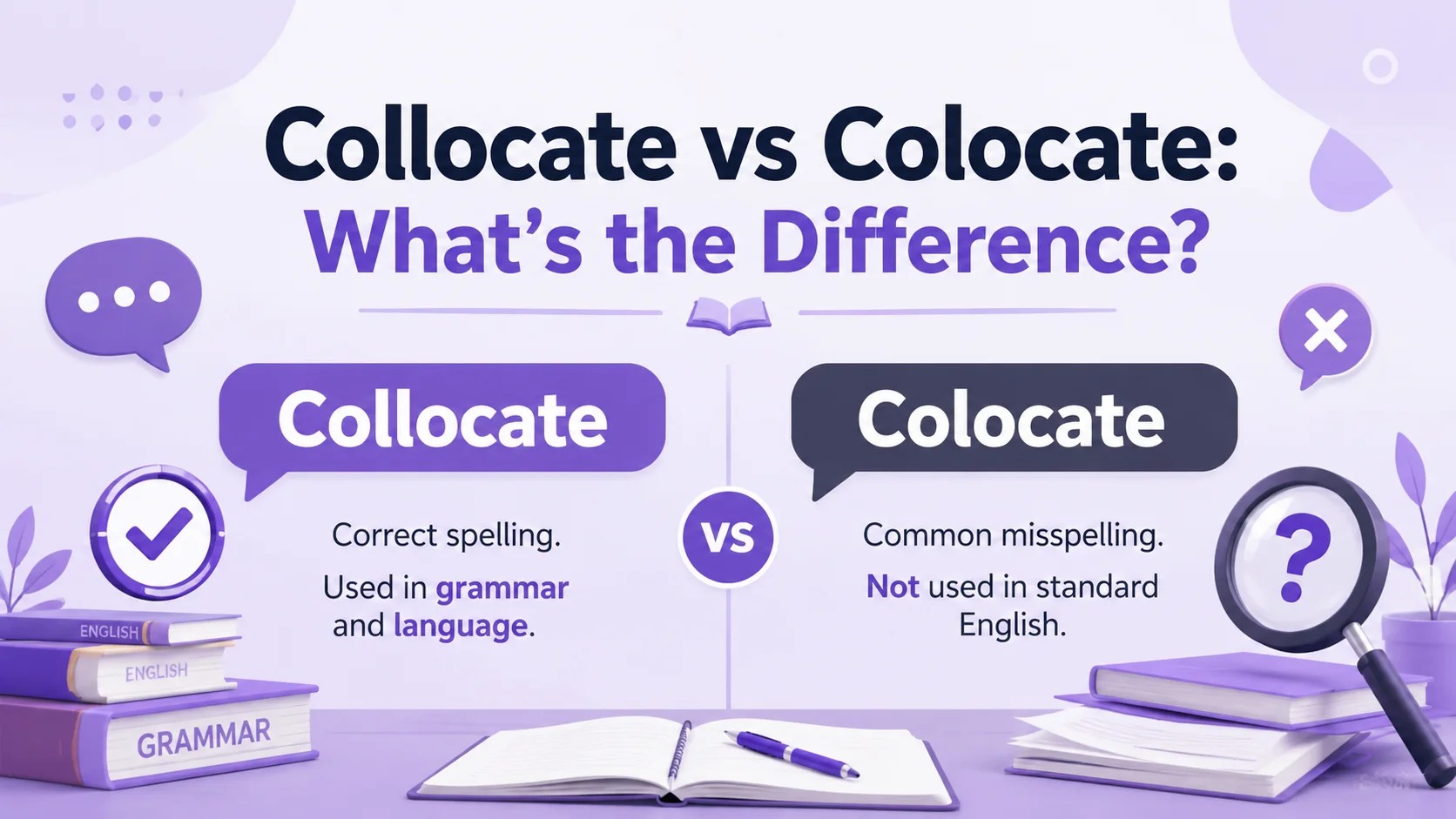
The Collocate vs Colocate difference becomes clearer when English words look or sound almost the same but have different meanings. Collocate is a verb that means to place words together in a particular order or sequence because they naturally pair in speech and writing. Seasoned speakers often recognize this natural arrangement without thinking about it, while misusing these terms can create funny situations or awkward situations. Learning these differences through a clear sentence and real examples makes it easier to use each word correctly and boost your language skills.
Collocate describes words that are commonly collocated and based on their context, genre, and everyday use in books and natural English. For instance, words often collocate because they repeatedly pair in familiar expressions. On the other hand, colocate refers to the physical placement of several entities in a single location. In technology, colocating can involve housing privately-owned servers and networking equipment in a third-party data center.
Many businesses use colocating to keep their servers in one location for better data management. Although collocate and colocate look similar, they have two distinct meanings and belong to different contexts. Understanding how each term works can help you avoid confusion and choose the right word when discussing language, technology, or everyday situations.
Quick Answer: Collocate vs Colocate
Here is the simple answer:
Use collocate when talking about words that commonly occur together. Use colocate when talking about people, services, equipment, or systems located together.
For example:
- “Heavy” collocates with “rain.”
- The company decided to colocate its teams in one building.
The first example is about language. The second is about physical location.
| Word | Main Meaning | Common Use |
| Collocate | To occur or be arranged together | Grammar, linguistics, language |
| Colocate | To locate together | Business, technology, facilities |
| Collocation | A natural combination of words | Language and grammar |
| Colocation | The arrangement of things in one location | Data centers, offices, services |
Understanding the Difference Between Collocate and Colocate
The easiest way to understand collocate vs colocate is to focus on the context.
Collocate is strongly connected with word combinations. When certain words frequently appear together and sound natural to native or experienced speakers, those words are called collocates.
For example:
- make progress
- take a break
- pay attention
- heavy traffic
- strong coffee
You could understand phrases such as do progress or powerful coffee, but they do not sound as natural in standard English. This is where collocation becomes important.
Colocate focuses on location. A business might colocate two departments in one office. A technology company might colocate servers in a data center. Several public services might also be colocated in one building.
The central difference is simple: collocate often focuses on association, while colocate focuses on location.
What Does Collocate Mean?
Collocate comes from Latin roots and means to place words together, especially words that commonly appear together in English.
Definition of Collocate
Collocate is a verb that means to occur together, particularly in language. It can also have a broader meaning involving placing or arranging things together.
The linguistic meaning is the one most people encounter when learning English vocabulary.
For example:
- The words “make” and “decision” collocate.
- “Heavy” commonly collocates with “rain.”
- Students should learn which adjectives collocate with “success.”
These examples show that some words develop strong and natural relationships with other words.
Collocate in Linguistics
In linguistics, a collocate is a word that commonly occurs near another word.
Consider the word decision. Several verbs can be used with it, but some combinations are much more natural:
- make a decision
- reach a decision
- reverse a decision
However, standard English does not normally use:
- do a decision
- build a decision
The words may be understandable, but they do not form common English collocations.
This makes collocations important for language learners. Knowing individual vocabulary words is useful, but knowing how words naturally work together helps your English sound smoother and more natural.
Other Uses of Collocate
Collocate can also refer more generally to placing or arranging things together.
For example:
- The museum collocated related objects in one display.
- The editor collocated the images beside the relevant text.
- The researchers collocated the equipment for easier access.
This broader meaning involves bringing things together, often through deliberate arrangement.
Origin and Meaning of Collocate
Collocate comes from Latin roots and means to place words together, especially words that commonly appear together in English.
Etymology of Collocate
Collocate developed from Latin roots connected with the idea of placing together.
Its structure reflects the basic idea behind the word:
together + place
Over time, the word developed an important linguistic meaning. Instead of physically placing objects together, language experts began using collocate to describe words that repeatedly appear together.
That development makes sense because words can also be considered “placed together” through regular usage.
Meaning and Usage of Collocate
Today, collocate is especially useful in discussions about:
- grammar
- vocabulary
- linguistics
- dictionaries
- language learning
- corpus research
- natural English expressions
Examples include:
- “Pay” collocates with “attention.”
- “Strong” collocates with “argument.”
- “Deep” collocates with “sleep.”
- “Catch” collocates with “a cold.”
A collocation is more than two words appearing together by accident. It is a combination that speakers repeatedly recognize as natural.
What Does Colocate Mean?
Definition of Colocate
Colocate means to place two or more people, things, services, or systems in the same location.
The word can also appear as co-locate.
Examples include:
- The company colocated two departments in one office.
- The agencies were colocated in the same building.
- The servers are colocated in a secure facility.
Unlike collocate, the main focus here is not language. The focus is physical placement.
Colocate in Business and Technology
Businesses often use colocate when combining operations in one location.
For example, a company may have separate offices for its:
- sales department
- customer support team
- finance team
- marketing department
The company may later move several teams into one building. In that situation, it can say that the teams were colocated.
Colocation can support:
- easier communication
- shared resources
- lower facility costs
- faster coordination
- centralized operations
In technology, the word has an important use involving servers and IT equipment.
Colocate in Data Centers
Data center colocation involves placing privately owned servers or equipment in a specialized facility.
Instead of keeping expensive technical equipment inside its own office, a company may use a professional facility designed for server operations.
The equipment remains the company’s responsibility, while the facility provides an appropriate environment and infrastructure.
For example:
The business decided to colocate its servers in a professional data center.
In this example, colocate clearly refers to physical equipment sharing a location.
Colocate in Public and Government Services
Public organizations can also colocate services.
For example, one building might contain:
- employment services
- social support offices
- public information desks
- administrative services
These services may have different responsibilities, but they operate from the same location.
A sentence might say:
The city decided to colocate several public services in one central building.
The goal may be to improve access and make coordination easier.
Colocate in Military and Operational Contexts
The word can also appear in military and operational planning.
For example:
- The units were colocated at the same base.
- Communications staff and equipment were colocated at the operations center.
- Support services were colocated near the main facility.
Once again, the important idea is shared physical location.
Collocate vs Colocate: Key Differences
The difference becomes clearer when you compare the words directly.
| Feature | Collocate | Colocate |
| Main idea | Occur or be arranged together | Be located together |
| Main context | Language and linguistics | Physical locations |
| Focus | Natural association | Shared place |
| Common noun | Collocation | Colocation |
| Example | “Heavy” collocates with “rain.” | The teams are colocated in one office. |
The most useful distinction is:
Collocate = words naturally go together.
Colocate = people or things share a location.
The Spelling Difference Between Collocate and Colocate
The spelling difference is small:
- Collocate has two l’s
- Colocate has one l
- Co-locate is also used as a spelling variant
This one-letter difference matters.
Look at these examples:
Correct: “Make” and “decision” collocate naturally.
Correct: The company will colocate its servers.
The first sentence is about a natural word combination.
The second sentence is about a physical location.
Because both words exist, you cannot always depend on spell-check software. You need to understand the context.
Collocate vs Colocate in Language and Grammar
When discussing words that naturally occur together, collocate is the correct choice.
Here are some common collocations:
Verb and Noun Collocations
- make a mistake
- take responsibility
- pay attention
- catch a cold
- break the law
Adjective and Noun Collocations
- heavy rain
- strong coffee
- serious problem
- deep sleep
- high demand
Adverb and Adjective Collocations
- highly successful
- deeply concerned
- completely different
- extremely important
Learning these patterns can help you choose vocabulary more naturally.
For this meaning, colocate should not replace collocate.
Collocate vs Colocate in Physical Locations
Use colocate when location is the main point.
Examples include:
- The company colocated its departments.
- The two agencies are colocated in one building.
- The business colocates its servers in a data center.
- The services were colocated to improve access.
The word works especially well when multiple people, resources, or systems are brought into the same facility.
A simple question can help:
Am I talking about where something is located?
If the answer is yes, colocate may be the correct choice.
Collocation vs Colocation
The nouns collocation and colocation follow the same distinction.
Meaning of Collocation
A collocation is a combination of words that commonly appear together.
Examples include:
- make the bed
- tell the truth
- save time
- heavy rain
- strong relationship
These combinations sound natural because speakers use them repeatedly.
Meaning of Colocation
Colocation means placing or operating things in the same location.
Examples include:
- office colocation
- server colocation
- service colocation
- data center colocation
The focus remains on a shared physical place.
Collocation vs Colocation Comparison
| Term | Meaning | Example |
| Collocation | Natural combination of words | Make a decision |
| Colocation | Things located together | Servers in one facility |
Remember:
Collocation relates to language.
Colocation relates to location.
Related Forms of Collocate and Colocate
Understanding related forms can help you use both words correctly.
Collocate Word Forms
- collocate
- collocates
- collocated
- collocating
- collocation
- collocational
Colocate Word Forms
- colocate
- co-locate
- colocates
- colocated
- colocating
- colocation
Choose the form according to the grammar of your sentence.
For example:
- These words collocate naturally.
- The words are commonly collocated.
- The company plans to colocate its teams.
- The teams were colocated last year.
Example Sentences Using Collocate
Collocate can be used naturally in sentences to show how one word commonly appears with another word.
Collocate in Language and Grammar
Here are examples of the linguistic use of collocate:
- The words “heavy” and “rain” frequently collocate in English.
- “Make” commonly collocates with “a decision.”
- Students should learn which verbs collocate with “attention.”
- “Strong” and “coffee” form a common collocation.
- The dictionary shows words that commonly collocate with “success.”
Collocate in General Placement
The broader meaning can involve arranging things together:
- The exhibit collocated related historical objects.
- The designer collocated the images and descriptions.
- The researchers collocated the instruments for easier comparison.
Example Sentences Using Colocate
Colocate means to place or exist together in the same location, often referring to people, things, or resources that share a space.
Colocate in Business
- The company decided to colocate its sales and support teams.
- Several departments were colocated in a new office.
- The organization plans to colocate regional employees.
Colocate in Technology
- The company colocates its servers in a secure facility.
- The technical equipment was colocated with network infrastructure.
- The business moved its hardware to a colocated environment.
Colocate in Public Services
- The city colocated several public services in one building.
- The agencies are colocated to make services easier to access.
- Multiple support programs were colocated under one roof.
A Simple Case Study: Language vs Location
A practical example shows the difference clearly.
Case Study: English Training
An English teacher says:
“The words ‘make’ and ‘decision’ collocate naturally.”
The teacher is discussing how words work together. Therefore, collocate is correct.
Other natural combinations include:
- make progress
- make an effort
- make a mistake
- reach a decision
Case Study: IT Operations
An IT manager says:
“We will colocate our servers in a specialized facility.”
The manager is discussing where physical equipment will be placed. Therefore, colocate is correct.
This is the easiest real-world rule to remember:
Words collocate. Physical things colocate.
Common Mistakes in Collocate vs Colocate
A common mistake is using “colocate” instead of “collocate,” even though collocate is the correct spelling for words that commonly appear together.
Using Colocate for Word Combinations
This is one of the most common mistakes.
Incorrect: “Heavy” and “rain” colocate.
Correct: “Heavy” and “rain” collocate.
Use collocate when discussing vocabulary combinations.
Treating the Words as Completely Interchangeable
Although both words involve the general idea of things being together, they do not always fit in the same sentence.
The context decides which word works best.
Collocate is strongly associated with language.
Colocate is strongly associated with physical location.
Confusing Collocation and Colocation
Remember the noun forms:
Collocation:
heavy rain
Colocation:
two departments operating from one building
One involves a natural language pattern. The other involves a physical arrangement.
How to Remember Collocate vs Colocate
Here are three easy ways to remember the difference.
Remember Collocate for Word Partnerships
Think about words that naturally work together.
Examples:
- pay attention
- heavy rain
- strong coffee
- take a break
These words collocate.
Remember Colocate for Shared Locations
Think about people, equipment, or services sharing a place.
Examples:
- colocated teams
- colocated servers
- colocated offices
- colocated services
These things colocate.
Ask One Simple Question
Ask:
Am I discussing language or location?
- Language = collocate
- Location = colocate
That simple rule will solve most collocate vs colocate confusion.
Conclusion
Understanding Collocate vs Colocate becomes easier when you focus on their distinct meanings. Collocate relates to words that naturally pair together, while colocate refers to placing people, equipment, or other entities in the same location. Knowing this simple difference can help you use each term correctly and avoid confusing mistakes in both English and technology.
FAQs
Q1. Is “collocate” a real word?
Yes, collocate is a standard English word used to describe words that commonly occur together.
Q2. What does “colocate” mean?
Colocate means to place two or more entities in the same physical location, especially in technology.
Q3. What is the main difference between collocate and colocate?
Collocate usually relates to language and word combinations, while colocate refers to physical placement.
Q4.Can “collocate” be used as a verb?
Yes. You can say that two words collocate when they commonly appear together in natural English.
Q5.Is “colocate” used in technology?
Yes. Colocate is common in technology when businesses place servers or networking equipment in a shared facility.
Q6.Are collocate and colocate pronounced the same?
They can sound very similar, but their meanings and typical contexts are different.
Q7.How can I remember the difference?
Think of collocate as words that go together and colocate as things that are placed together in one location.
About the Author