hisself or himself
When speaking or writing in English, small differences between words can sometimes create confusion. One common example is the question of hisself or himself. Both forms may sound familiar, especially because “hisself” appears in some varieties of speech and regional dialects. However, they do not have the same status in standard modern English.
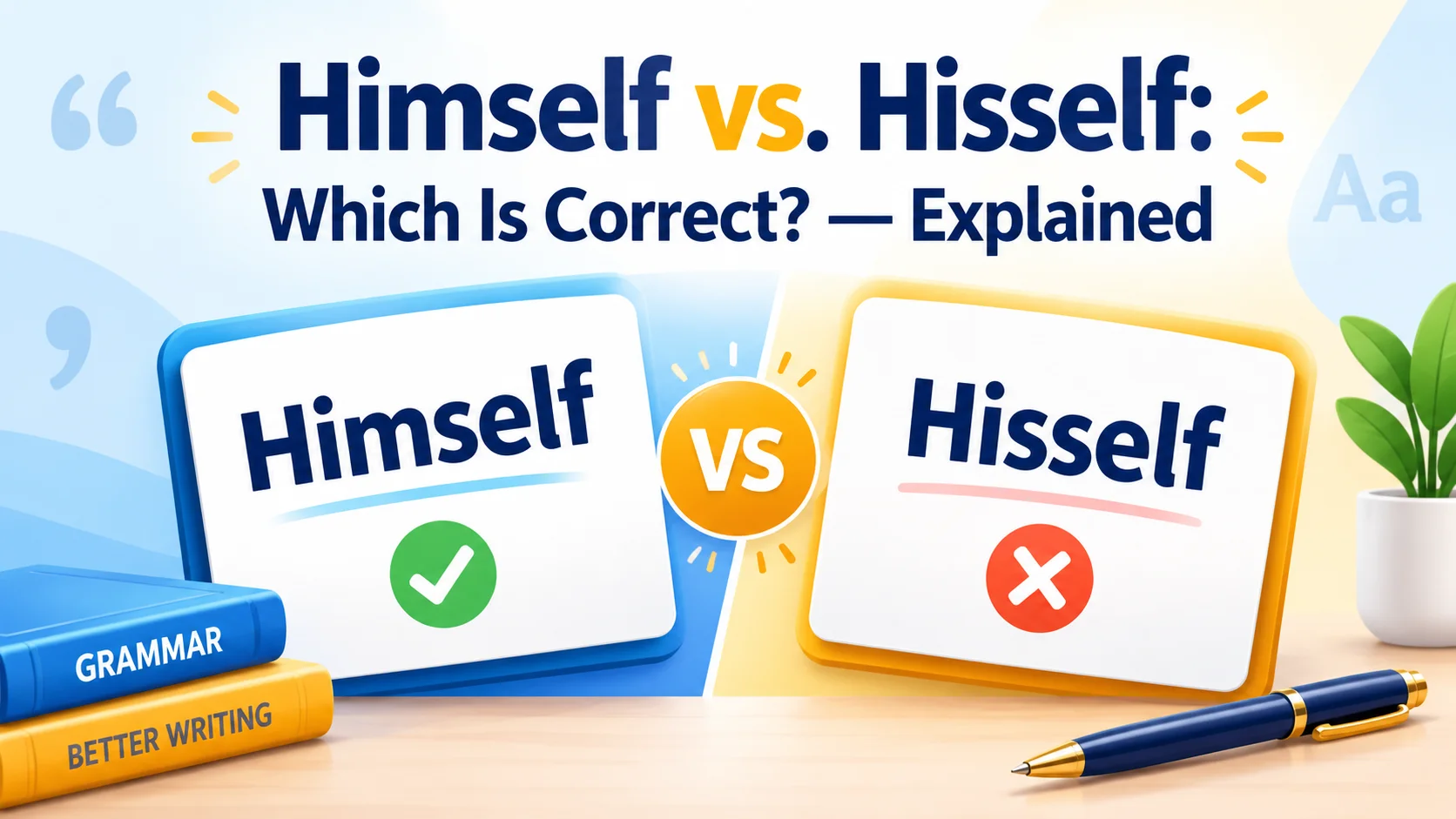
If you have ever wondered whether you should write “He did it hisself” or “He did it himself,” the answer is straightforward: “himself” is the correct standard English form. “Hisself” is generally considered nonstandard, dialectal, or informal.
Understanding why this is the case can help you avoid mistakes in school assignments, professional writing, emails, articles, and other formal situations. This article explores the difference between hisself or himself, explains how “himself” is used, discusses why “hisself” exists, and provides plenty of examples.
What Does “Himself” Mean?
“hisself or himself” is a reflexive pronoun. It is used when the person receiving an action is the same person who performs the action.
For example:
- James hurt himself.
- He introduced himself to the new manager.
- David taught himself how to play the guitar.
- He prepared the entire meal himself.
In each sentence, “himself” refers back to a male person already mentioned.
The word can also be used for emphasis:
He built the house himself.
Here, “himself” emphasizes that he personally built the house rather than simply supervising someone else.
“Himself” is the standard form used in contemporary English and is appropriate in both formal and informal writing.
Is “Hisself” Correct English?
The word “hisself” does appear in English, but it is not considered standard English in most modern contexts.
You may hear “hisself” in certain dialects, regional varieties, or informal speech. Some speakers naturally use it because of the way the word has developed in their local form of English. However, it is generally not the form expected in standard written English.
For example:
- Nonstandard: He did it hisself.
- Standard: He did it himself.
Another example:
- Nonstandard: John blamed hisself.
- Standard: John blamed himself.
If you are writing for a broad audience, particularly in an academic, professional, or formal setting, himself is the safer and correct choice.
Hisself or Himself: The Main Difference
The easiest way to understand hisself or himself is to remember that “himself” is the standard reflexive pronoun, while “hisself” is a nonstandard or dialectal variant.
| Word | Standard English? | Common Use |
|---|---|---|
| Himself | Yes | Formal and informal English |
| Hisself | Generally no | Dialectal or nonstandard speech |
This does not necessarily mean that people who say “hisself” are speaking without rules. Dialects have their own grammatical patterns and histories. A word can be common and meaningful in a particular community while still being outside standard written English.
Therefore, the choice depends partly on context. If your goal is standard English, use himself.
Why Do People Say “Hisself”?
There are several reasons why “hisself” exists. One important reason is that English has historically had different forms of reflexive pronouns.
Modern English reflexive pronouns include:
- myself
- yourself
- himself
- herself
- itself
- ourselves
- yourselves
- themselves
At first glance, “hisself” might seem logical because “his” and “self” can appear to fit together naturally. A learner might reason that if we have “myself” and “yourself,” then “his” plus “self” should produce “hisself.”
However, standard English developed himself rather than “hisself.” The object form “him” is used in this construction.
This can be confusing for learners because “his” is the possessive form associated with “he,” while “him” is the object form. English does not always create reflexive forms through an immediately obvious pattern.
Examples of “Himself” in Sentences
The best way to understand the correct usage is to see “himself” in different situations.
Reflexive Action
Use “himself” when someone performs an action on his own body.
- He cut himself while cooking.
- The boy accidentally injured himself.
- Mark looked at himself in the mirror.
- He blamed himself for the mistake.
In these examples, the action returns to the same person.
Emphasis
“Himself” can also emphasize the subject.
- He himself admitted the mistake.
- The president himself attended the meeting.
- Tom himself repaired the computer.
- The author himself explained the story.
In these sentences, “himself” adds emphasis. It tells the reader that the person personally performed or experienced something.
Meaning “Without Help”
“Himself” can also indicate that a person did something independently.
- He completed the project himself.
- Daniel painted the room himself.
- Robert fixed the bicycle himself.
- He built the website himself.
The word emphasizes personal involvement.
Common Mistakes With “Himself”
English learners sometimes confuse “himself” with “him,” “his,” or “he.” Understanding their different functions can make the choice easier.
He
“He” is a subject pronoun.
Example:
He went to the store.
Him
“Him” is an object pronoun.
Example:
I called him yesterday.
His
“His” is a possessive form.
Example:
That is his car.
Himself
“Himself” is a reflexive or emphatic pronoun.
Example:
He repaired the car himself.
These words are related, but they cannot normally be substituted for one another.
Why “He Did It Hisself” Sounds Familiar
Many people recognize “hisself” because spoken English is much more diverse than formal written English. Regional dialects can preserve words or grammatical patterns that are not normally used in standardized English.
You might hear someone say:
He fixed it hisself.
The meaning is usually perfectly understandable. The speaker intends “himself.”
However, if you are writing an essay, business document, website article, application, report, or formal message, it is better to write:
He fixed it himself.
This distinction between spoken dialect and standard written English is important. A nonstandard form is not necessarily meaningless or random. It simply does not belong to the conventional standard form expected in most formal writing.
Is “Hisself” Ever Used Intentionally?
Yes. Writers may deliberately use “hisself” when they want to represent a particular dialect, character, voice, or regional style.
For example, a novelist might write dialogue that reflects how a character naturally speaks. In that context, “hisself” can help establish personality or regional identity.
A writer could intentionally create dialogue such as:
“He’ll do it hisself,” the old farmer said.
Here, changing “hisself” to “himself” might make the dialogue less authentic to the character the writer is trying to portray.
However, intentional dialect writing is different from making an error in standard English. If you are simply trying to write grammatically correct English, himself should be your choice.
Hisself or Himself in Formal Writing
In formal writing, the answer is clear: use himself.
This applies to:
- School essays
- College assignments
- Business emails
- Reports
- Resumes and professional documents
- News articles
- Website content
- Academic writing
- Official correspondence
For example, consider this sentence:
The manager completed the report hisself.
For standard English, change it to:
The manager completed the report himself.
The second version is immediately recognizable as standard English and is suitable for professional communication.
Hisself or Himself in Casual Speech
Casual speech is more flexible. Depending on where a person lives and the dialect they use, “hisself” may occur naturally.
Even so, people who are learning English should generally learn himself as the standard form. Once you understand the standard form, you can recognize dialectal alternatives when you encounter them.
This is especially useful when watching movies, reading novels, listening to interviews, or communicating with people from different English-speaking communities.
A Simple Trick to Remember the Correct Form
If you frequently confuse hisself or himself, remember this basic rule:
He → him → himself
For example:
- He completed the work.
- I helped him.
- He completed the work himself.
The reflexive form corresponds to “him,” not “his.”
You can use the same idea with other pronouns:
- I → me → myself
- You → you → yourself
- He → him → himself
- She → her → herself
- We → us → ourselves
- They → them → themselves
This pattern makes “himself” easier to remember.
Examples: Incorrect and Correct
Here are several examples that demonstrate the difference clearly.
Nonstandard:
He cooked dinner hisself.
Standard:
He cooked dinner himself.
Nonstandard:
The child dressed hisself.
Standard:
The child dressed himself.
Nonstandard:
He taught hisself to play guitar.
Standard:
He taught himself to play guitar.
Nonstandard:
The man introduced hisself to everyone.
Standard:
The man introduced himself to everyone.
Nonstandard:
He blamed hisself for the accident.
Standard:
He blamed himself for the accident.
These examples show why “himself” is the preferred form in standard English.
“Himself” in Everyday English
“Himself” is extremely common in everyday communication. You do not need to reserve it for formal writing.
For example:
- He made breakfast himself.
- He wants to do it himself.
- He saw himself on television.
- He introduced himself.
- He told himself to stay calm.
- He bought himself a new phone.
These sentences sound natural in ordinary conversation.
Can “Hisself” Be Used in an English Dictionary?
Some dictionaries and language references may record “hisself or himself” as a dialectal or nonstandard form. The fact that a word appears in a dictionary does not automatically mean it is the preferred form for formal standard English.
Dictionaries often document how language is actually used, including regional and historical varieties. Therefore, seeing “hisself” listed somewhere does not mean you should replace “himself” with it in professional writing.
The context matters.
Final Verdict: Hisself or Himself?
When deciding between hisself or himself, choose himself for standard English.
“Hisself” can be encountered in dialectal, regional, informal, or intentionally stylized speech, but it is generally considered nonstandard. “Himself” is the established reflexive pronoun used in contemporary standard English.
If you are unsure which one to use, remember:
He → him → himself
For example:
He completed the project himself.
That is the correct standard form.
Understanding the difference between “hisself” and “himself” is a small but useful step toward stronger English grammar. While dialects add richness and variety to the language, standard English provides a consistent form for communication across different regions and situations. So, whether you are writing an essay, creating professional content, sending an email, or simply trying to improve your grammar, himself is the correct choice.
About the Author