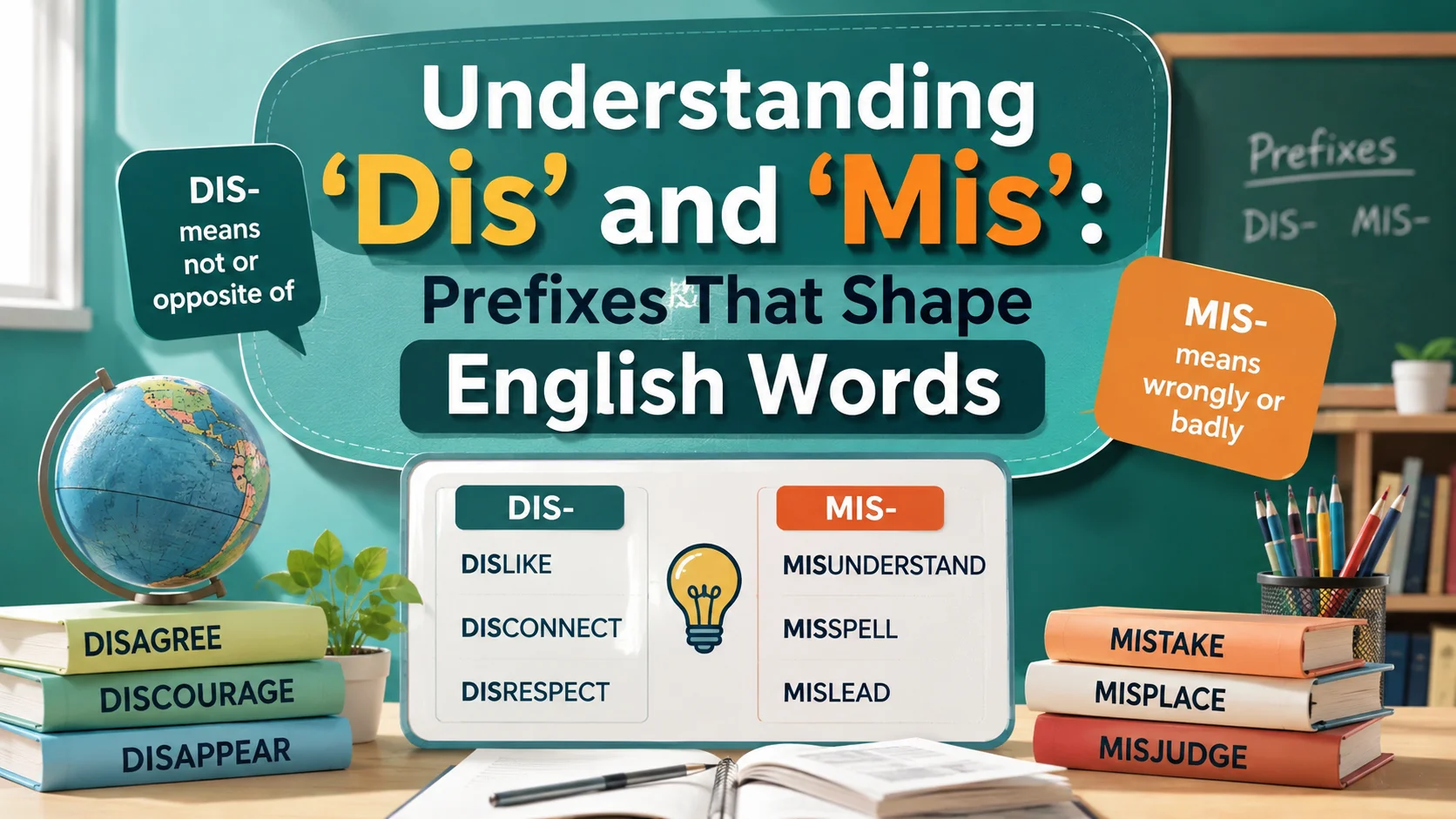
Understanding ‘Dis’ and ‘Mis’: Prefixes That Shape English Words helps English learners master prefixes through simple practice and clear examples daily. Learning English becomes easier when you understand how a prefix changes a base word. Many learners notice that these little bits at the beginning or start of words can completely change their meaning. In the English language, Dis, Mis, and Un play an important role in word formation, derivation, and affixation. Although they look small, they pack a punch by creating a negative or opposite meaning, or simply showing not. I was once mixed up by these two prefixes, but after figuring out the pattern, the whole idea became much easier to understand.
A smart way to improve vocabulary is to focus on prefix usage every day. Daily practice, adding letters to a word, and checking the context show how changing one part can affect both lexical meaning and semantic meaning. Grammar, morphology, word structure, structure, and function all work together to support communication, expression, comprehension, and interpretation. Reading examples, practicing writing, and building vocabulary also improve literacy, education, analysis, recognition, and a deeper understanding of how meanings develop.
As your knowledge grows, every new set of words becomes easier to unlock with the key of puzzle thinking. Instead of feeling disappointed, unconvinced, or uncomfortable, you will know the right choice for every use and correct usage. Transforming your skills often happens as a pleasant surprise because each small prefix shapes the language in meaningful ways. Intriguingly, the more you solve each puzzle, the less likely you are to trip, and every change helps you become a more confident learner.
Quick Answer: What Is the Difference Between Dis- and Mis-?
The dis- prefix generally means not, opposite of, remove, or reverse. It often expresses opposition or the absence of something.
The mis- prefix means wrongly, incorrectly, badly, or improperly. It usually describes an action performed in the wrong way rather than its opposite.
| Prefix | Primary Meaning | Example | Meaning |
| Dis- | Opposite, not, remove, reverse | Disagree | Have a different opinion |
| Dis- | Remove | Disconnect | Break a connection |
| Mis- | Incorrectly | Misspell | Spell a word incorrectly |
| Mis- | Wrongly | Misunderstand | Understand incorrectly |
Simple rule to remember:
- Choose dis- when something is opposite, removed, or reversed.
- Choose mis- when something is done incorrectly.
Understanding Prefixes in English
A prefix is a group of letters added to the beginning of a word to modify its meaning. Prefixes do not usually change a word’s grammatical category. Instead, they adjust or refine its meaning.
For example:
| Base Word | Prefix | New Word | Meaning |
| Happy | Un- | Unhappy | Not happy |
| Legal | Il- | Illegal | Not legal |
| Agree | Dis- | Disagree | Opposite opinion |
| Understand | Mis- | Misunderstand | Understand incorrectly |
Unlike suffixes, which are added to the end of words and often change word classes, prefixes mainly affect meaning.
Why Prefixes Matter
Understanding prefixes helps you:
- Expand vocabulary faster.
- Recognize unfamiliar words with confidence.
- Improve spelling accuracy.
- Strengthen reading comprehension.
- Write with greater precision.
- Decode technical and academic vocabulary.
Think of prefixes as road signs. They point you toward a word’s meaning before you even finish reading it.
Meaning and Function of the Prefix Dis-
The prefix dis- comes from Latin and appears in thousands of English words. While its meaning varies slightly depending on the base word, it generally expresses one of four ideas.
Dis- Means “Not” or “Opposite”
This is the most common use.
Examples include:
| Word | Meaning |
| Disagree | Hold an opposite opinion |
| Disapprove | Express a negative opinion |
| Dislike | Not like |
| Dishonest | Not honest |
| Disloyal | Not loyal |
These words describe the opposite quality or attitude.
Dis- Means “Remove”
Sometimes the prefix indicates taking something away.
Examples:
- Disconnect
- Disarm
- Disengage
- Disassemble
In each case, something becomes separated or removed.
Dis- Means “Reverse”
Some words describe reversing an earlier action.
Examples include:
- Discontinue
- Disqualify
- Disinherit
The action changes or cancels an earlier state.
Common Dis- Words
| Base Word | New Word | Meaning |
| Connect | Disconnect | Break a connection |
| Appear | Disappear | Become invisible |
| Continue | Discontinue | Stop doing something |
| Respect | Disrespect | Lack respect |
| Obey | Disobey | Refuse to follow rules |
Example Sentences
- They disagreed about the project’s deadline.
- Please disconnect the charger before cleaning the device.
- The magician appeared and then suddenly disappeared.
- Employees who repeatedly break safety rules may be disqualified.
Interesting Fact: The prefix dis- appears in thousands of English words because it originated from Latin, where it commonly expressed separation or reversal.
Meaning and Function of the Prefix Mis-
Unlike dis-, the prefix mis- almost always relates to doing something incorrectly.
Instead of expressing opposition, it highlights error.
Mis- Means “Wrongly”
Examples include:
- Misjudge
- Misread
- Mishear
- Misinterpret
Each word describes an action carried out incorrectly.
Mis- Means “Badly”
Sometimes the action is not merely wrong but poorly performed.
Examples:
- Mishandle
- Mismanage
- Miscalculate
The task happens, but it does not happen properly.
Common Mis- Words
| Base Word | New Word | Meaning |
| Understand | Misunderstand | Understand incorrectly |
| Spell | Misspell | Spell incorrectly |
| Inform | Misinform | Give false information |
| Lead | Mislead | Lead in the wrong direction |
| Judge | Misjudge | Judge incorrectly |
| Place | Misplace | Put in the wrong location |
Example Sentences
- I misunderstood your instructions.
- She accidentally misspelled the customer’s name.
- The report misinformed readers about the schedule.
- The accountant miscalculated the annual expenses.
Tip: If the action happened but happened the wrong way, mis- is usually the correct choice.
Dis- vs. Mis-: The Key Difference
Although both prefixes create negative meanings, they rarely express the same idea.
| Feature | Dis- | Mis- |
| Core Meaning | Opposite, remove, reverse | Incorrectly, wrongly |
| Focus | Opposition or absence | Error or incorrect action |
| Common Usage | Verbs, adjectives, nouns | Mostly verbs |
| Example | Disagree | Misunderstand |
| Example | Disconnect | Miscalculate |
Easy Comparison
Imagine a light switch.
- If you disconnect the power, you’ve removed the connection.
- If you misconnect the wires, you’ve connected them incorrectly.
Those are completely different actions.
When Both Prefixes Appear in Similar Words
Some word pairs look similar but carry distinct meanings.
Distrust vs. Mistrust
| Word | Meaning |
| Distrust | Lack confidence entirely |
| Mistrust | Feel suspicion or uncertainty |
Although dictionaries often treat them as near synonyms, mistrust sometimes suggests doubt while distrust can imply a stronger absence of trust.
Disinformation vs. Misinformation
This pair has become especially important in the digital age.
| Word | Meaning |
| Disinformation | False information shared intentionally |
| Misinformation | False information shared unintentionally |
Case Study
Imagine someone creates a fake news article to manipulate public opinion.
That is disinformation because the deception is deliberate.
Now imagine another person shares that article believing it’s true.
That is misinformation because the incorrect information spreads without malicious intent.
Understanding this distinction is essential when discussing media literacy and online content.
Common Words That Use Dis-
Actions
- Disconnect
- Disobey
- Disarm
- Discontinue
- Disassemble
- Disengage
Feelings and Attitudes
- Dislike
- Disapprove
- Disrespect
- Discourage
- Distrust
Personal Qualities
- Dishonest
- Disloyal
- Disorganized
- Discontented
- Disobedient
Everyday Examples
- The mechanic disassembled the engine.
- Students should never disrespect their classmates.
- We decided to discontinue the old software.
Common Words That Use Mis-
Many English words begin with the prefix mis-, which usually means wrongly, badly, or incorrectly. Adding mis- changes the meaning of a base word to show an error, misunderstanding, or improper action. Common examples include misunderstand, misspell, misplace, mislead, misbehave, misjudge, mispronounce, and misinform. Learning these words helps you expand your vocabulary and understand how prefixes change word meanings.
Communication
- Misquote
- Miscommunicate
- Misinform
- Misinterpret
Judgment
- Misjudge
- Miscalculate
- Misdiagnose
Everyday Actions
- Misplace
- Misread
- Misprint
- Misuse
- Mishandle
Everyday Examples
- He misplaced his passport before the flight.
- The editor misquoted the interview.
- They mismanaged the project budget.
Common Mistakes English Learners Make
Even advanced learners confuse these prefixes.
Using Dis- Instead of Mis-
❌ Disunderstand
✅ Misunderstand
Creating Words That Do Not Exist
Not every base word accepts every prefix.
Incorrect examples include:
- Misagree
- Disspell
- Mishonest
English vocabulary developed over centuries, so word formation isn’t always predictable.
Assuming Both Prefixes Mean the Same Thing
Consider these examples:
- Disconnect means removing a connection.
- Misconnect means connect incorrectly.
One removes.
The other makes an error.
Ignoring Context
Context often reveals which prefix fits.
Compare:
- She misread the email.
- She disregarded the email.
The first means she read it incorrectly.
The second means she ignored it.
Quick Tips to Choose the Right Prefix
When you’re unsure, ask yourself one question.
Was the action done incorrectly?
If yes, choose mis-.
Examples:
- Misread
- Misspell
- Misjudge
Was something removed, reversed, or made opposite?
If yes, choose dis-.
Examples:
- Disconnect
- Disagree
- Disappear
Helpful Memory Trick
- Dis- = Different or opposite
- Mis- = Mistake
Many learners remember mis- by linking it to the word mistake.
Practice Exercises
Fill in the Blank
Choose dis- or mis-.
- She ________ understood the assignment.
- Please ________ connect the power cable.
- He accidentally ________ spelled my name.
- The company decided to ________ continue production.
- They ________ trusted the suspicious website.
Answers
- Misunderstood
- Disconnected
- Misspelled
- Discontinue
- Distrusted
Match the Word to Its Meaning
| Word | Meaning |
| Disconnect | Remove a connection |
| Misjudge | Judge incorrectly |
| Disappear | Become invisible |
| Mislead | Lead someone wrongly |
| Disapprove | Express a negative opinion |
FAQs
1. What do the prefixes Dis and Mis mean in English?
Dis usually means “not” or “the opposite of,” while Mis means “wrong” or “incorrectly.” Both prefixes change the meaning of a word, but they do so in different ways.
2. How is Dis different from Mis?
Dis creates an opposite or negative meaning, whereas Mis shows that something is done wrongly, incorrectly, or by mistake.
3. Why are prefixes important in English?
Prefixes help expand your vocabulary, improve reading comprehension, and make it easier to understand the meaning of unfamiliar words.
4. Can Un be used in the same way as Dis?
Sometimes Un and Dis both mean “not,” but they cannot always replace each other. Their usage depends on the base word and accepted English grammar.
5. What is a base word?
A base word is the original word before a prefix or suffix is added. The prefix changes its meaning without changing the core word.
6. How can I remember the difference between Dis and Mis?
Think of Dis as meaning “not” or “opposite,” while Mis reminds you of mistakes, misunderstanding, or doing something wrong.
7. Does learning prefixes improve writing skills?
Yes. Understanding prefixes improves writing, communication, expression, and helps you choose the right words more confidently.
8. Are prefixes useful for English learners?
Absolutely. English learners use prefixes to recognize word patterns, understand new vocabulary, and improve overall language learning.
9. Which subjects use prefix knowledge the most?
Knowledge of prefixes is valuable in grammar, reading, writing, education, literacy, and many academic subjects.
10. What is the best way to practice prefixes?
Read regularly, study examples, learn one prefix at a time, and practice using new words in everyday conversations and writing.
Conclusion
Learning the prefixes Dis, Mis, and Un helps you understand how English words are formed and how their meanings change. Even small additions at the beginning of a word can create a completely different idea. By recognizing word patterns, base words, and prefix usage, you can build stronger vocabulary and improve your reading, writing, and communication skills.
The more you practice with examples and use these prefixes in real situations, the easier it becomes to identify the correct meaning and make the right choice while speaking or writing. Over time, this knowledge strengthens your language learning, boosts your confidence, and makes understanding English much more natural.
About the Author