damn it or dammit
Language is full of words and expressions that sound simple when spoken but become confusing when written. One common example is “damn it or dammit.” Both forms are widely seen in everyday English, especially in informal conversations, social media posts, books, movies, and casual writing. However, many people wonder whether one spelling is correct, whether the two expressions have different meanings, and when each version should be used.
If you have ever stopped while writing and asked yourself whether you should type “damn it” or “dammit,” you are not alone. The confusion exists because the two forms are pronounced almost identically, and their meanings are closely related. The main difference is how the expression is written and how it functions stylistically.
This article explains damn it or dammit in detail, including its meaning, spelling, pronunciation, grammar, history, examples, and appropriate usage.
What Does “Damn It” Mean?
“damn it or dammit” is an informal exclamation used to express frustration, annoyance, anger, disappointment, or irritation. It is often said when something goes wrong or when a person becomes impatient.
For example:
- “Damn it, I forgot my keys.”
- “Damn it! The computer stopped working.”
- “Damn it, we are late again.”
- “I lost the file. Damn it!”
The word “damn” has a long history in English and has traditionally been associated with condemnation. Over time, however, “damn it” developed into a common emotional expression. In modern everyday English, it usually communicates frustration rather than a literal religious judgment.
The exact strength of the expression depends on the speaker and situation. For some people, “damn it” is relatively mild. For others, it may sound rude or inappropriate, particularly in formal settings.
What Does “Dammit” Mean?
“Dammit” is generally a closed-up, informal spelling of “damn it.” It is used to represent the way the expression is commonly pronounced as a single unit.
For example:
- “Dammit, I missed the bus.”
- “Dammit! Why did I do that?”
- “I knew I had forgotten something. Dammit!”
- “Dammit, this is harder than I expected.”
In most situations, “dammit” and “damn it” have essentially the same meaning. The primary difference is spelling and style.
“Dammit” often looks more conversational because it represents the expression as one word. It is particularly common in dialogue, informal writing, fiction, online communication, and situations where the writer wants to capture natural speech.
Damn It or Dammit: Which One Is Correct?
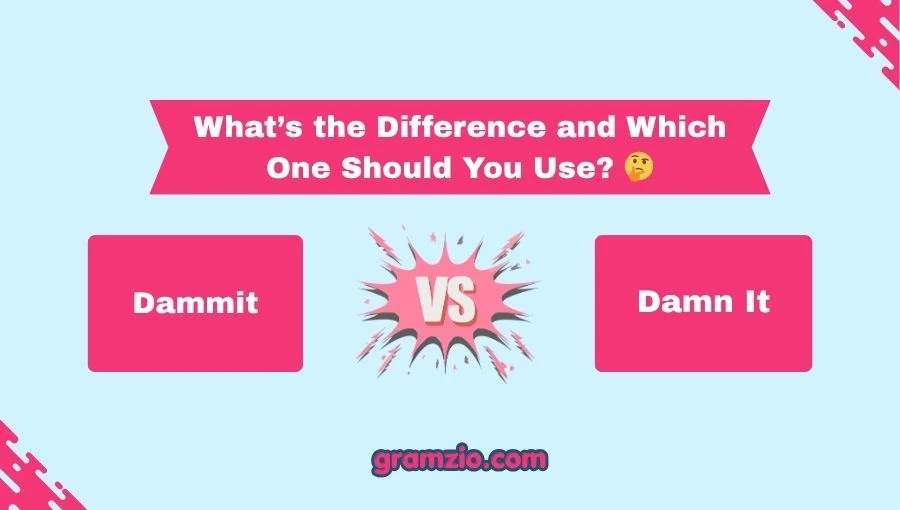
Both “damn it” and “dammit” are recognized forms of the expression.
However, they are not identical in grammatical appearance.
“Damn it” consists of two words:
damn + it
“Dammit” is written as one word.
If you are writing formal or carefully edited English, “damn it” may be the safer choice because it preserves the original two-word structure. “Dammit” is strongly associated with informal usage and conversational writing.
That does not mean “dammit” is wrong. It is a well-established informal spelling.
For example:
More traditional:
“Damn it, I forgot to call her.”
More informal:
“Dammit, I forgot to call her.”
The meaning remains practically the same.
Why Do People Write “Dammit” as One Word?
The reason is closely connected to pronunciation.
When people say “damn it” quickly, the two words often blend together. Instead of clearly pronouncing “damn” and then “it,” the expression can sound like one word.
English speakers frequently turn commonly repeated phrases into single written forms over time. This process happens because spoken language influences informal spelling.
“Dammit” reflects this natural blending.
It is similar to other English forms that developed from speech patterns. Although “damn it” is grammatically made up of two words, the phrase is often pronounced as one rhythmic unit.
Is “Dammit” a Real Word?
Yes. “Dammit” is widely recognized as an informal interjection or exclamation.
It appears in dictionaries and edited writing, especially in contexts where informal speech is being represented. It is not simply a random spelling mistake.
Still, its informal nature matters.
If you are writing an academic paper, professional report, business email, or formal letter, you would normally avoid both “damn it” and “dammit” unless there is a specific reason to quote someone.
In a novel, screenplay, personal message, social media post, or casual conversation, either form can be appropriate depending on the tone.
Damn It vs. Dammit in Everyday Writing
Choosing between the two often comes down to the tone you want.
“Damn it” can feel slightly more deliberate because the two words are separated.
For example:
“Damn it, I should have checked the address.”
“Dammit” can feel more immediate and emotional:
“Dammit, I should have checked the address!”
The difference is subtle. Neither version automatically expresses more anger than the other.
Writers may choose “dammit” when they want dialogue to sound natural and spontaneous. On the other hand, “damn it” may be preferred when the writer wants to follow the traditional spelling.
Examples of “Damn It”
Here are several examples showing how “damn it” can be used:
- “Damn it, I left my phone at home.”
- “Damn it! That was the wrong answer.”
- “Damn it, we have to start over.”
- “I thought I had enough money, but damn it, I was wrong.”
- “Damn it, why didn’t anyone tell me?”
- “The door is locked. Damn it!”
- “Damn it, I missed the last train.”
In each example, the expression communicates frustration or disappointment.
Examples of “Dammit”
The same situations can be written with “dammit”:
- “Dammit, I left my phone at home.”
- “Dammit! That was the wrong answer.”
- “Dammit, we have to start over.”
- “I thought I had enough money, but dammit, I was wrong.”
- “Dammit, why didn’t anyone tell me?”
- “The door is locked. Dammit!”
- “Dammit, I missed the last train.”
Notice that the meaning has not significantly changed.
Is “Damn It” a Bad Word?
The word “damn” can be considered profanity or mild swearing depending on the culture, audience, and context.
Compared with stronger swear words in English, “damn” is generally regarded as relatively mild. However, it is still not always appropriate in professional or highly formal environments.
For example, saying “Damn it!” among close friends may not attract much attention. Saying the same thing during a formal presentation could sound unprofessional.
The best approach is to consider your audience.
If you are unsure whether a person or environment accepts mild profanity, choose a neutral alternative.
Some alternatives include:
- “Oh no!”
- “That’s frustrating.”
- “What a shame!”
- “Seriously?”
- “I can’t believe it.”
- “This is annoying.”
These expressions can communicate frustration without profanity.
Is “Damn It” or “Dammit” More Common?
Both forms are common, but their popularity can vary according to the type of writing.
“Damn it” is often preferred in standard writing because it clearly represents the phrase as two words.
“Dammit” is especially common in informal dialogue and fiction. It can make written speech feel more direct and natural.
Online communication has also helped informal spellings become more visible. People often write words according to how they sound, especially when expressing emotion.
As a result, you may see:
“Damn it!”
and
“Dammit!”
used interchangeably in comments, messages, captions, stories, and conversations.
How to Pronounce “Damn It”
“Damn it” is commonly pronounced in a way that blends the two words together.
In fast speech, the phrase can sound very similar to “dammit.” The pronunciation is one reason the one-word spelling developed.
The “n” in “damn” is generally not strongly pronounced. The expression often comes out quickly, especially when the speaker is angry or frustrated.
This explains why someone might hear “dammit” and naturally assume it should always be written as one word.
However, pronunciation alone does not determine standard spelling.
Can “Damn It” Be Used at the Beginning of a Sentence?
Yes. In fact, this is one of its most common positions.
For example:
“Damn it, I forgot the appointment.”
Here, “damn it” functions as an interjection. It expresses the speaker’s emotional reaction before the main statement.
It can also appear at the end:
“I forgot the appointment, damn it!”
Or independently:
“Damn it!”
Punctuation can help show how the expression functions in a sentence.
Damn It or Dammit in Formal Writing
Neither form is usually recommended for formal writing.
If you are writing:
- An academic essay
- A business report
- A professional email
- A formal application
- A research paper
- A workplace announcement
you will usually want to replace the expression with something more neutral.
For example:
Instead of:
“Damn it, we missed the deadline.”
You could write:
“Unfortunately, we missed the deadline.”
Instead of:
“Dammit, the system failed again.”
You could write:
“Unfortunately, the system failed again.”
This keeps the message professional and avoids unnecessary profanity.
Damn It or Dammit in Fiction
Fiction is different because dialogue is supposed to reflect realistic speech.
A character who is angry might naturally say:
“Dammit! Get out of my way!”
Another character might say:
“Damn it, I knew this would happen.”
Both are perfectly understandable.
Authors often choose the spelling that best matches the voice of the character. A polished, restrained character might use “damn it,” while a character speaking quickly and emotionally might use “dammit.”
There is no universal rule requiring fiction writers to choose one over the other.
Common Mistakes With “Damn It” and “Dammit”
One common mistake is assuming that “dammit” is simply an incorrect spelling. It is better understood as an informal, established form.
Another mistake is believing that the two forms have completely different meanings. In ordinary modern English, they generally do not.
A third mistake is using either expression without considering the audience. Even mild profanity can be inappropriate in certain professional or cultural contexts.
Finally, some writers confuse “damn it” with “damned.” These forms are related but function differently.
For example:
“Damn it!”
is an exclamation.
But:
“That damned machine is broken.”
uses “damned” as an adjective-like intensifier.
Understanding these differences can make your writing more accurate.
Which Form Should You Choose?
If you want a simple rule, consider your purpose.
Choose “damn it or dammit” when you want the traditional two-word form or when writing more carefully edited prose.
Choose “dammit” when you want an informal, conversational, or speech-like style.
For example, in a casual text message:
“Dammit, I forgot the tickets.”
In a piece of carefully edited dialogue:
“Damn it, I forgot the tickets.”
Both communicate essentially the same idea.
Final Thoughts on Damn It or Dammit
The question of damn it or dammit is mainly a question of spelling, style, and context rather than meaning. Both forms are used to express frustration, annoyance, anger, or disappointment. “Damn it” preserves the phrase as two words, while “dammit” represents the common spoken form as a single informal word.
Neither form should automatically be considered incorrect. The best choice depends on the kind of writing you are producing and the audience you are addressing.
For formal communication, it is usually better to avoid the expression altogether and use a neutral alternative. For casual conversation, personal messages, social media, and fictional dialogue, either “damn it” or “dammit” can work naturally.
Ultimately, understanding damn it or dammit is less about memorizing a complicated grammar rule and more about recognizing how English changes between formal writing and everyday speech. Once you understand the difference in style, choosing the right form becomes much easier.
About the Author