The errors that damage a mark most are not the ones students worry about. An apostrophe in the wrong place costs very little. A piece that slips from formal into casual halfway through can cap the band regardless of how clean the punctuation is. IGCSE English is marked against level descriptors covering purpose, audience, structure and control, and only one strand of that is accuracy. Students who spend their revision on comma rules while ignoring register are optimising the cheapest variable in the mark scheme.
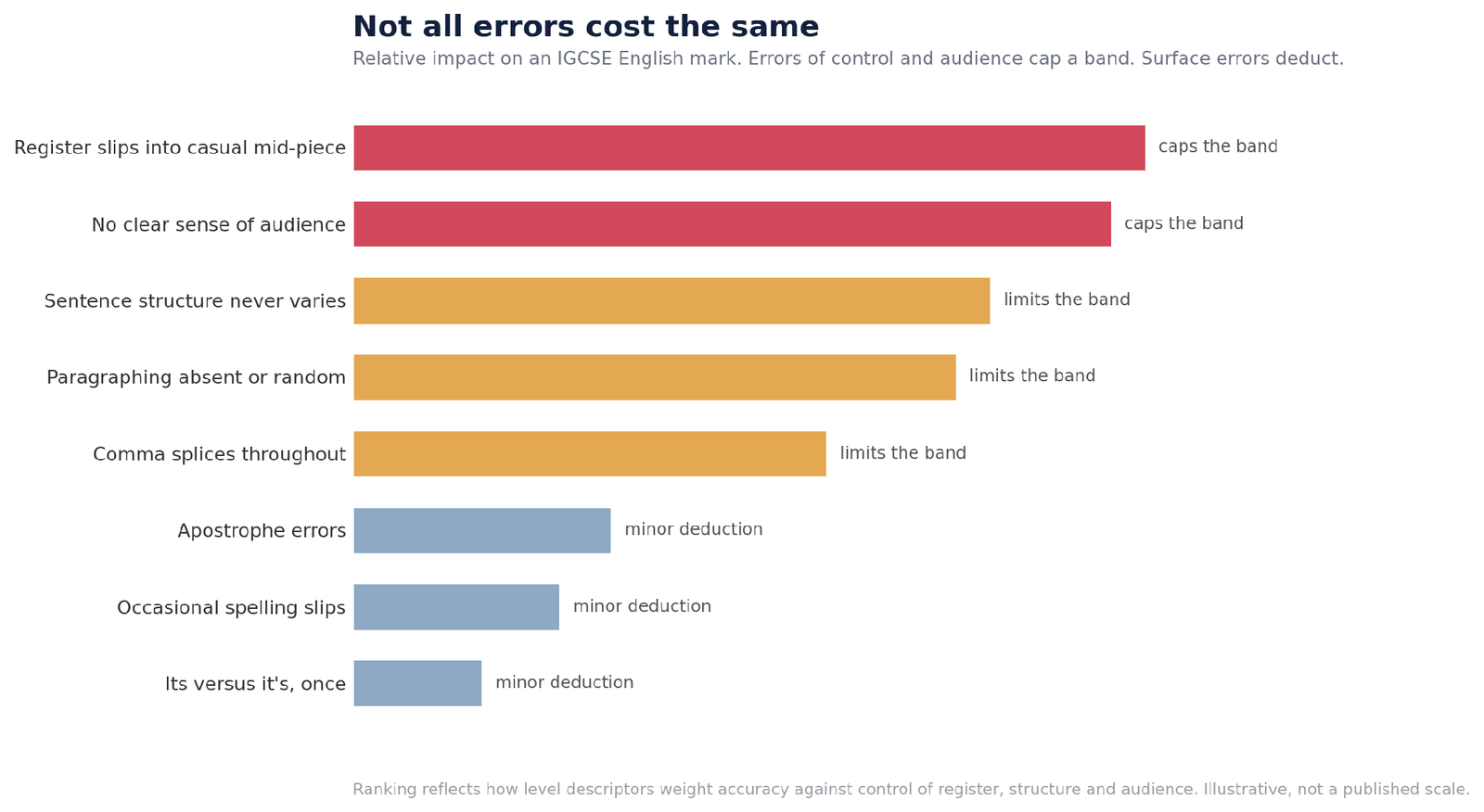
Here is what actually costs, ranked.
The hierarchy
There are two categories, and confusing them is the root problem.
Band-capping errors stop a piece reaching a higher level no matter what else it does well. They concern control: whether the writer is in charge of the register, the structure and the reader’s experience.
Deductive errors cost small amounts within a band. They concern accuracy: spelling, punctuation, individual grammatical slips.
A piece with flawless punctuation and no sense of audience sits in the middle. A piece with a handful of surface errors and complete control of the register sits above it. Students assume the reverse, because accuracy is what gets marked in red at school.
The expensive ones
Register drift. The single most costly error in the paper. A formal letter opens correctly and then, around two thirds through as the writer tires, a casual phrase appears. “The situation is unsatisfactory” becomes “it’s a bit of a mess”. One slip is often enough to signal that the control is not secure.
Watch for it specifically in closing paragraphs, which is where fatigue lands.
No sense of audience. The descriptors reward writing clearly aimed at someone. A great many responses are written to nobody, which produces a flat middle-band register that is technically correct and completely inert. Before writing, a student should be able to say who reads this and what they should think differently afterwards.
Uniform sentence structure. Twenty sentences of similar length and construction reads as competent and scores as competent. Varying length deliberately, including the occasional very short sentence for emphasis, is one of the most reliable ways to lift a piece. It is also entirely learnable in an afternoon.
Absent or arbitrary paragraphing. Paragraph signal structure. A wall of text tells the examiner the writer has not organised their thinking, whatever the content says.
Comma splices throughout. Two independent clauses joined by a comma. One is a slip. A consistent pattern reads as not knowing where a sentence ends, which speaks to control rather than accuracy and therefore costs more than its surface appearance suggests.
These are all questions of control rather than accuracy, and Edexcel IGCSE English Language tutors tend to work on them directly rather than running accuracy drills, because that is where the band movement sits.
The cheap ones
These matter, but far less than students fear.
Apostrophes. Its versus it’s, plural versus possessive. Worth fixing, genuinely, but a single error here will not move a grade. Students who spend a revision session on apostrophes have chosen the lowest-yield hour available.
Occasional spelling errors. Examiners expect some in a timed handwritten response. Consistent misspelling of common words starts to register, but a few slips do not.
Homophones. Their, there, they’re. Same logic. Noticeable, low-cost.
Slightly awkward phrasing. If the meaning is clear, the cost is small.
The one everyone gets backwards
Elaborate vocabulary.
Students believe reaching for sophisticated words lifts a mark. In practice, imprecise use of an ambitious word costs more than precise use of an ordinary one, because it demonstrates the opposite of control.
“The protagonist’s demeanour was inordinately lugubrious” is not better than “he seemed miserable”. It is worse, because the writer has reached past their range and the strain is visible.
The descriptors reward precision, not decoration. A student writing confidently within their vocabulary outscores one writing uncertainly outside it, every time.
What to actually do
Read your last paragraph first when checking. Register drift concentrates there. If the tone at the end does not match the tone at the start, fix that before anything else.
Name your reader before writing. One sentence, in your head: this is a letter to a headteacher who has already refused once. Everything downstream gets easier.
Vary one sentence per paragraph deliberately. Make one noticeably shorter. This is a mechanical trick and it works.
Read the level descriptors, not the indicative content. Most students check whether they included the right points. The descriptors describe the quality required, and exam boards publish guidance on what assessments look for. This is the highest-yield thirty minutes in the whole subject.
Practise the same content in two registers. One scenario, written formally, then as a message to a friend. This teaches register faster than any rule.
The underlying point
School marking trains students to see errors as the enemy. Red pen goes on spelling, punctuation and grammar, because those are objectively wrong and quick to mark.
Examination marking works differently. It asks whether the writing does its job, and accuracy is one input among four. A student who understands that reallocates their effort, usually away from the things they were most anxious about.
That is uncomfortable advice, because “worry less about grammar” sounds like bad advice from a grammar perspective. It is not. It is a claim about proportion. Get the register right, know who you are writing to, and vary your sentences. Then fix the apostrophes In that order, because that is the order the marks are in.
About the Author