
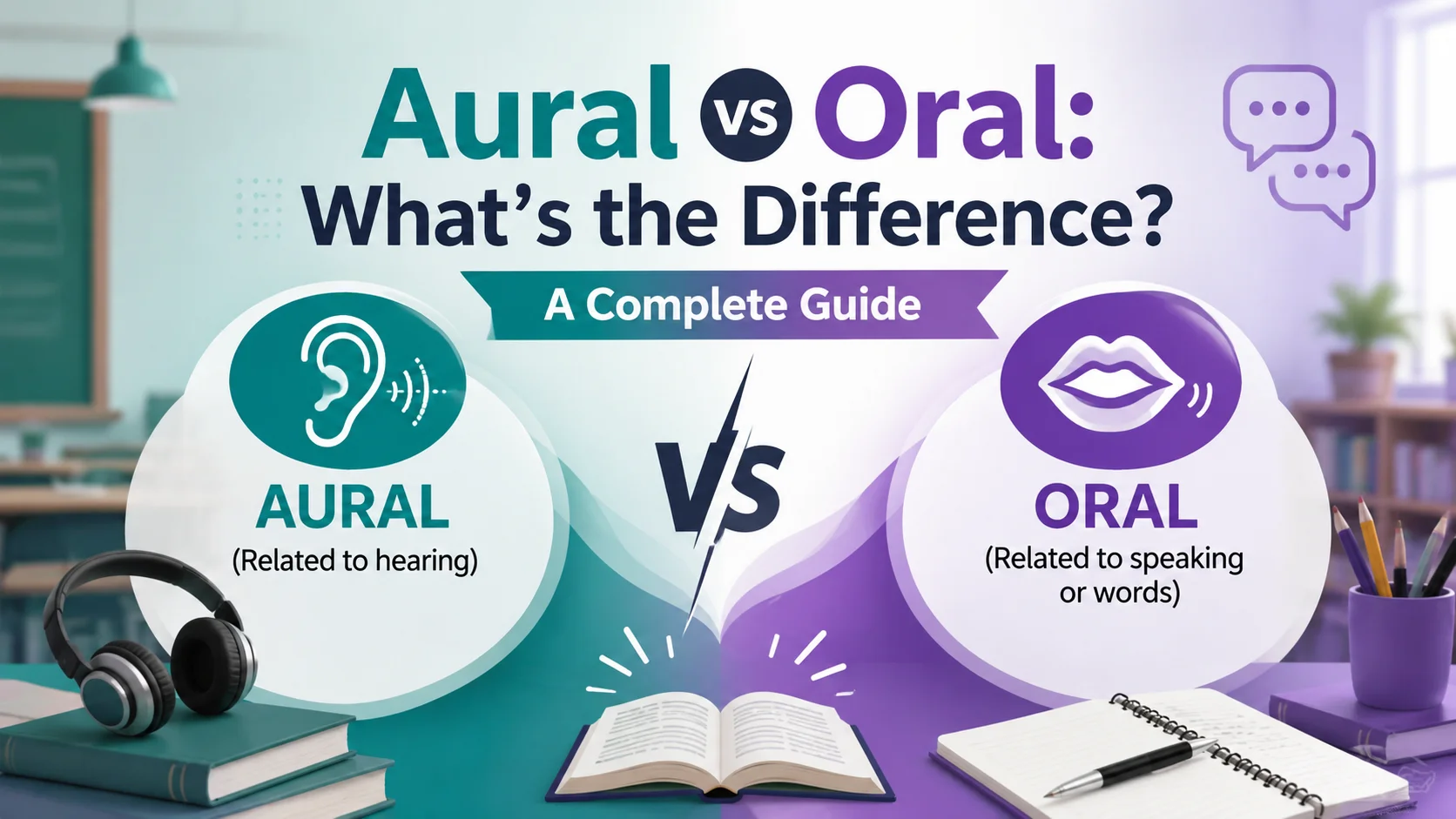
Aural vs Oral: What’s the Difference? explains how these two words create confusion because they sound similar but have different meanings in English. When you hear Aural and Oral during a conversation, they may seem almost the same because their pronunciation is very close.
Many learners find it difficult to pronounce these words correctly. After being looked up in major dictionaries, including the Longman Pronunciation Dictionary, a useful note shows the standard pronunciation as ˈɔːr əl. Sometimes, speakers use ˈaʊər əl to avoid confusion
. This pronunciation twist is rarely mentioned, but it helps explain the distinction between the two terms. The Bolding and underlining of the small schwa sound-symbol highlight the sound position above the line at the apostrophe level in the dictionary, creating a slightly voiced sound or voiced sound effect.
Quick Answer: Aural vs Oral Difference
The main difference between aural and oral is what they describe:
| Word | Meaning | Connection | Example |
| Aural | Related to hearing or sound | Ears and listening | “The musician developed excellent aural skills.” |
| Oral | Related to speaking, speech, or the mouth | Mouth and spoken words | “The student gave an oral presentation.” |
A simple way to remember the difference:
- Aural = Audio = Hearing
- Oral = Oral communication = Speaking
If something involves receiving sound, use aural. If something involves producing words through speech, use oral.
What Does Aural Mean?
The word aural is an adjective that describes anything connected to hearing or the sense of sound. It focuses on how people receive, recognize, or understand sounds through their ears.
The term is commonly used in areas such as:
- Music education
- Hearing science
- Language learning
- Sound engineering
- Audio technology
When someone talks about a person’s aural ability, they are usually referring to how well that person can identify sounds, tones, rhythms, or patterns.
For example, a musician with strong aural skills can recognize whether a note is sharp or flat without looking at sheet music.
Examples of Aural in Sentences
Here are some examples that show how aural works:
- “The singer improved her aural memory by practicing musical patterns daily.”
- “The doctor performed an aural examination to check the patient’s hearing.”
- “The movie created an impressive aural experience through background sounds and music.”
- “Language learners often use aural exercises to improve listening comprehension.”
In each example, the focus is on sound or hearing.
What Does Oral Mean?
The word oral relates to the mouth, spoken communication, or words expressed through speech.
Unlike aural, which involves receiving information through hearing, oral usually involves creating or delivering information through spoken words.
The word appears frequently in:
- Public speaking
- Education
- Healthcare
- History
- Communication studies
For example, an oral presentation requires a person to speak in front of others. An oral history project collects stories shared verbally by people.
Examples of Oral in Sentences
- “The student prepared an oral presentation for the science class.”
- “The dentist explained the importance of good oral hygiene.”
- “The company recorded an oral history from its original founders.”
- “The interview included an oral discussion about workplace changes.”
Here, oral focuses on speech or the mouth.
Aural vs Oral: Key Differences Explained
Although aural and oral sound similar, they describe different actions.
Aural Relates to Hearing
Aural describes the process of receiving and understanding sounds.
Think about activities involving your ears:
- Listening to music
- Hearing a lecture
- Understanding spoken instructions
- Recognizing different sounds
A student practicing listening exercises in a foreign language is developing aural skills.
For example:
A Spanish learner may listen to native speakers repeatedly to improve pronunciation recognition. This activity strengthens aural comprehension.
Oral Relates to Speaking
Oral describes the act of using spoken words or the mouth.
Examples include:
- Giving a speech
- Answering questions aloud
- Participating in a conversation
- Explaining an idea verbally
Someone with strong oral communication skills can express thoughts clearly through speaking.
For example:
A business manager presenting a new plan during a meeting uses oral communication.
Aural Is About Ears, Oral Is About Mouth
The easiest comparison:
| Aural | Oral |
| Connected to hearing | Connected to speaking |
| Uses ears | Uses mouth |
| Receiving sounds | Producing words |
| Listening skills | Speaking skills |
A simple memory trick:
Your ears hear aural sounds. Your mouth creates oral words.
Aural vs Oral: Word Origins and History
Understanding the origins of these words makes them easier to remember.
Origin of Aural
The word aural comes from the Latin word auris, which means ear.
This root appears in other hearing-related words, including:
- Auris → ear
- Auricle → outer part of the ear
- Aural → related to hearing
Because of this connection, aural always points toward sound perception.
Origin of Oral
The word oral comes from the Latin word os or oris, meaning mouth.
This root connects to words involving speech and the mouth, such as:
- Oral
- Orifice
- Oratory (the art of speaking)
Knowing these roots creates a strong mental shortcut:
- Auris = Ear = Aural
- Oris = Mouth = Oral
Aural vs Oral Communication: Understanding the Difference
Communication involves both listening and speaking. That is why people often confuse these two terms.
Aural Communication
Aural communication happens when information reaches you through sound.
Examples:
- Listening to a podcast
- Hearing a teacher explain a lesson
- Understanding a phone conversation
- Following audio instructions
A person uses aural processing to interpret sounds and understand meaning.
Oral Communication
Oral communication happens when someone shares information through spoken words.
Examples:
- Giving a presentation
- Talking with a friend
- Participating in a meeting
- Conducting an interview
Strong oral communication requires skills like:
- Clear pronunciation
- Confidence
- Good vocabulary
- Organized thoughts
Aural vs Oral Exams: What Is the Difference?
Students often encounter both terms in education.
| Exam Type | Purpose | Skill Tested |
| Aural exam | Tests listening ability | Understanding sounds and spoken information |
| Oral exam | Tests speaking ability | Expressing ideas verbally |
Aural Exam Example
A language student may listen to an audio recording and answer questions about it.
The exam measures:
- Listening comprehension
- Sound recognition
- Understanding spoken language
Oral Exam Example
A student may answer questions verbally in front of a teacher.
The exam measures:
- Speaking ability
- Pronunciation
- Fluency
- Vocabulary usage
A student preparing for an oral exam practices speaking. A student preparing for an aural exam practices listening.
Aural vs Oral Health: Understanding the Medical Difference
These words also appear in healthcare.
Aural Health
Aural health relates to the ears and hearing.
Examples include:
- Hearing tests
- Ear infections
- Sound perception
- Hearing loss prevention
An audiologist may evaluate a person’s aural health through hearing assessments.
Oral Health
Oral health relates to the mouth, teeth, and gums.
It includes:
- Tooth care
- Gum health
- Dental hygiene
- Mouth-related conditions
According to dental health professionals, brushing twice daily and regular dental checkups help maintain good oral health.
Common Mistakes When Using Aural and Oral
Many writers confuse these words because they sound nearly identical.
Here are common mistakes:
Mistake: Using Oral for Hearing
Incorrect:
❌ “The student improved her oral listening skills.”
Correct:
✅ “The student improved her aural listening skills.”
Listening involves hearing, so aural is the correct choice.
Mistake: Using Aural for Speaking
Incorrect:
❌ “He delivered an aural presentation.”
Correct:
✅ “He delivered an oral presentation.”
A presentation involves speaking, so use oral.
Aural vs Oral Examples to Remember the Difference
Understanding the difference between aural and oral becomes easier when you connect each word with its meaning. Aural relates to hearing or sound, while oral relates to speaking or the mouth. For example, an aural exam tests your ability to listen, whereas an oral presentation requires you to speak clearly. Remembering these everyday examples can help you choose the right word with confidence.
Examples of Aural
- Aural training helps musicians recognize notes.
- Aural learning uses listening activities.
- Aural perception involves understanding sounds.
- Aural memory helps people remember melodies.
Examples of Oral
- Oral presentation involves speaking before an audience.
- Oral agreement happens through spoken words.
- Oral interview requires verbal responses.
- Oral hygiene involves caring for the mouth.
Aural and Oral in Different Fields
The words aural and oral appear in different fields, so their meanings can shift slightly with context. Aural is common in music, language learning, and hearing-related contexts, while oral frequently appears in education, medicine, communication, and presentations. For example, musicians may develop aural skills, while students may take an oral examination to demonstrate their speaking knowledge.
Aural and Oral in Education
Teachers use both skills when helping students learn.
Aural learning helps students:
- Understand lectures
- Improve listening skills
- Recognize pronunciation
Oral learning activities help students:
- Speak confidently
- Share ideas
- Practice conversations
Aural and Oral in Music
Musicians rely heavily on aural skills.
A trained musician can:
- Identify pitch differences
- Recognize rhythm patterns
- Repeat melodies accurately
Oral skills also matter when singers use their voices to perform.
Aural and Oral in Business
Successful professionals need both abilities.
Strong oral communication helps with:
- Presentations
- Negotiations
- Meetings
Strong aural skills help with:
- Active listening
- Understanding clients
- Responding effectively
Aural vs Auditory vs Oral: Are They the Same?
These words overlap but are not identical.
Aural vs Auditory
Both relate to hearing.
However:
- Aural often describes personal hearing experiences or skills.
- Auditory often appears in scientific or technical contexts.
Examples:
- Aural training for musicians
- Auditory processing disorder in healthcare
Aural vs Oral vs Verbal
| Word | Meaning |
| Aural | Related to hearing |
| Oral | Related to speaking or the mouth |
| Verbal | Related to words and language |
For example:
- Listening to instructions = aural
- Giving instructions aloud = oral
- Using words to communicate = verbal
FAQs
Q1. What is the main difference between aural and oral?
The main difference is that aural relates to hearing and sound, while oral relates to speaking, spoken words, or the mouth. If you receive information through your ears, it is aural. If you share information through speech, it is oral.
Q2. Is aural connected to the ears?
Yes, aural is directly connected to the ears and hearing ability. It describes anything involving sounds, listening, or the way people process what they hear.
Q3. Does oral only mean speaking?
No. Oral has two common meanings. It can describe spoken communication, such as an oral presentation, or it can refer to the mouth, such as oral health and oral hygiene.
Q4. What is an example of an aural activity?
Listening to a podcast, identifying musical notes, practicing pronunciation through audio recordings, and completing listening exercises are examples of aural activities because they involve hearing.
Q5. What is an example of oral communication?
A speech, interview, classroom discussion, or business presentation are examples of oral communication because they involve expressing ideas through spoken words.
Q6. Are aural and auditory the same?
Aural and auditory have similar meanings because both relate to hearing. However, auditory is often used in scientific or medical contexts, while aural is commonly used for listening skills, music, and sound experiences.
Q7. Is an oral exam the same as an aural exam?
No, they test different skills. An oral exam checks your ability to speak and explain ideas, while an aural exam checks your ability to listen and understand sounds or spoken information.
Q8. How can I easily remember the difference between aural and oral?
Use this simple memory trick: Aural starts with “aur,” which connects to audio and ears. Oral starts with “or,” which connects to the mouth and speaking. Remember: aural = ears, oral = mouth.
Q9. Can a person have both strong aural and oral skills?
Yes. Effective communication requires both. Strong aural skills help you listen carefully and understand others, while strong oral skills help you express your thoughts clearly.
Q10. Why do people confuse aural and oral?
People often confuse these words because they sound almost identical. However, their meanings are different. Aural focuses on receiving sounds, while oral focuses on producing speech or relating to the mouth.
Conclusion
Understanding the difference between Aural vs Oral helps you choose the correct word in everyday communication. Aural describes anything connected to hearing, sounds, and listening, while oral describes things connected to speaking, spoken language, or the mouth. Although these words sound similar, they represent two different parts of communication: listening and speaking. Remember the easy rule: aural = ears and oral = mouth. Once you understand this simple distinction, you can avoid common mistakes and use both words with confidence.
Clear word choice improves your writing, conversations, and professional communication. Whether you are discussing aural training, oral presentations, hearing skills, or spoken communication, using the right term makes your message more accurate and easier to understand. Small vocabulary differences often create a big impact, and mastering pairs like aural and oral helps you communicate with greater clarity and confidence.
About the Author