A high-end cooking appliance can develop small problems long before it stops working completely. Maybe a burner needs a second or third attempt to ignite. Perhaps the oven takes noticeably longer to preheat than it used to. You might even notice that food is browning unevenly despite using the same temperature and cooking time you’ve relied on for years.
It’s tempting to live with these annoyances. After all, the appliance still works. But changes in performance can be early signs of worn or failing components, and catching them early can make the repair process much simpler.
Here are several warning signs that deserve attention rather than another few months of “we’ll see how it goes.”
The Oven Isn’t Holding a Consistent Temperature
An oven doesn’t need to stop heating completely to have a problem.
One of the more frustrating issues is temperature drift. You set the oven to 375°F, but your food behaves as though it’s cooking at a completely different temperature. Cakes brown too quickly on one side. Roasts need considerably longer than expected. A recipe you’ve made dozens of times suddenly becomes unpredictable.
Several components can contribute to inaccurate temperatures, including the temperature sensor, heating elements, convection system, and door seal.
Before assuming something has failed, you can compare the oven’s temperature with a separate oven thermometer. Give the appliance enough time to preheat and cycle normally rather than judging it immediately after the preheat signal.
A small variation isn’t necessarily concerning because ovens naturally cycle above and below their set temperature. A large or persistent difference is another story.
Preheating Suddenly Takes Much Longer
You probably have a rough idea of how long your oven normally needs to get ready. That’s why a sudden change is fairly easy to notice.
If an oven that previously heated quickly now seems to take forever, something may no longer be operating efficiently.
Possible causes include a weakening heating element, inaccurate temperature sensor, convection fan problem, or heat escaping through a worn door gasket.
Don’t judge the appliance from a single slow preheat. Opening the door repeatedly, putting cold cookware inside, or starting with an unusually cold kitchen can affect heating time.
A pattern is what matters.
If preheating becomes consistently slower without an obvious explanation, having the appliance inspected can identify the problem before a component fails completely.
Burners Keep Clicking Without Igniting
Click. Click. Click.
The sound of an igniter attempting to light a burner is normal for a few moments. Continuous clicking isn’t.
Sometimes the explanation is surprisingly simple. Moisture from cleaning or a recent boil-over can interfere with ignition. Food residue around the burner can also prevent proper operation.
Allowing the area to dry completely and carefully cleaning removable burner components may solve the problem.
If the burner continues clicking, however, the problem could involve the igniter electrode, ignition switch, spark module, or another component.
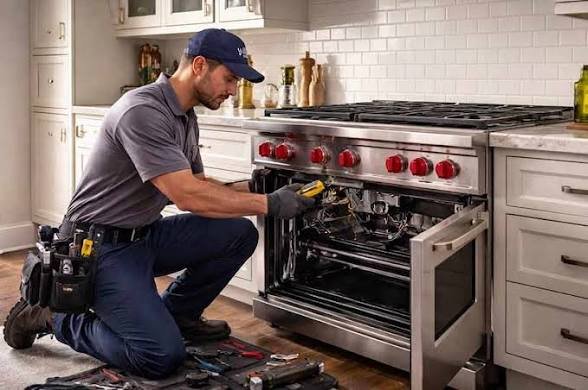
This is where professional Wolf appliance repair becomes more sensible than repeatedly trying to ignite a burner that’s clearly behaving differently.
Gas appliance problems shouldn’t become long-term experiments.
The Flame Looks Different
People often notice whether a burner lights but pay less attention to how it burns afterward.
Changes in flame performance can tell you quite a lot.
For example, a burner may suddenly produce a much weaker flame than the others. The flame might become uneven around the burner head, or certain sections might not ignite at all.
Food residue and grease can block burner ports, particularly after spills and boil-overs. Once the burner has cooled completely, removable components can usually be inspected for obvious debris and cleaned according to the appliance’s instructions.
If cleaning doesn’t restore normal performance, don’t start dismantling gas components yourself.
A technician can determine whether the issue comes from the burner assembly, ignition system, gas delivery, or another part.
The Convection Fan Sounds Wrong
Convection ovens aren’t silent, so some fan noise is expected.
What you’re looking for is a change.
A fan that suddenly starts squealing, scraping, rattling, or producing a noticeably louder hum deserves attention. Mechanical noises can point to worn motor bearings, an obstruction, or another issue affecting the fan assembly.
The fan also matters for cooking performance. If it isn’t circulating heated air properly, you may notice uneven browning or unexpected differences between racks.
You don’t necessarily need to diagnose which component is responsible. Simply recognizing that the sound or cooking performance has changed gives a repair technician useful information.
The Door Doesn’t Close Like It Used To
Oven doors do more than keep you from touching a hot interior. They help maintain the controlled cooking environment inside the cavity.
Check whether the door sits evenly when closed. Look at the gasket around the opening as well. It shouldn’t be obviously torn, severely compressed, loose, or hanging away from its normal position.
A damaged seal can allow heat to escape, contributing to slow preheating and inconsistent temperatures.
Hinges can also wear over time. If the door feels unusually loose, doesn’t remain in its expected position, or won’t sit flush against the oven, don’t force it closed.
The underlying problem may be mechanical rather than something that can be corrected by pushing harder.
Error Messages Keep Coming Back
An error message appearing once after a power interruption may disappear after the appliance is properly restarted.
An error that keeps returning deserves more attention.
Modern cooking appliances monitor numerous functions, including temperature, electronic controls, door mechanisms, and other systems. A persistent fault code can therefore provide useful diagnostic information.
Write the exact code down rather than trying to remember it later.
You should also note what the appliance was doing when the message appeared. Did it happen during preheating? During self-cleaning? Immediately after turning the oven on?
Those details can help narrow down the cause.
Repeatedly resetting an appliance without investigating a recurring fault can hide the symptom temporarily without addressing what’s producing it.
There’s a Gas Smell That Doesn’t Go Away
This one belongs in a different category from uneven baking or slow preheating.
A persistent or unexplained gas odor requires immediate attention.
Turn the appliance off and follow appropriate gas-safety procedures for your home. Avoid flames or anything else that could create an ignition source, and contact the appropriate gas emergency service or qualified professional.
Don’t continue testing burners to figure out which one might be responsible.
There’s a big difference between troubleshooting an oven that’s ten degrees off and experimenting with a suspected gas leak. The second isn’t a reasonable DIY project.
Small Changes Are Often the Best Warning
Appliances rarely announce a developing problem with a dramatic breakdown.
More often, something simply starts behaving differently.
The oven takes longer. One burner becomes unreliable. The fan develops a strange noise. Temperatures become inconsistent. An error code disappears after a reset, then returns a week later.
Paying attention to those changes gives you the chance to investigate while the appliance is still partially functional.
You don’t need to panic every time cooking takes an extra five minutes. But when the same symptom keeps appearing, treating it as useful information rather than an inconvenience can prevent a minor performance problem from becoming a much bigger repair.
About the Author