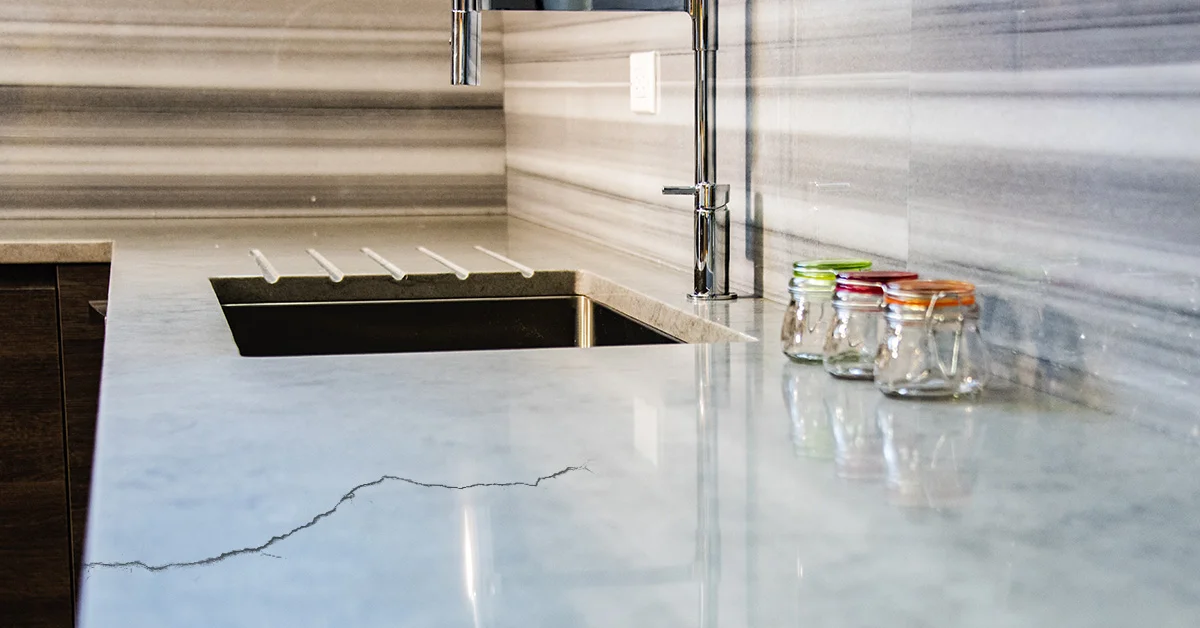
Porcelain has a reputation for being close to indestructible, and in everyday use it earns it. Hot pans do not mark it, knives do not scratch it, and it never needs sealing. So when a corner chips on installation day, it feels like the material has failed.
Usually nothing has. Porcelain is very hard, but it is not flexible, and those are two different things. Hardness stops a benchtop from getting scratched. Flexibility lets a material take a knock without breaking, and porcelain has almost none of it.
Hard is not the same as unbreakable
Think of a pane of glass. You cannot scratch it with a knife, but tap the edge and it chips. Porcelain behaves similarly.
Porcelain slabs are made from clay and minerals pressed together and fired at very high temperatures, which is what makes them dense and non-porous. They come as large, thin sheets: usually 6mm for walls and splashbacks, 12mm for benchtops, and 20mm for outdoor areas.
A full sheet can be around 3200mm long and 1600mm wide at only 12mm thick. That is a big, thin panel rather than a solid block. A 30mm granite benchtop has enough material to absorb a bump. A thin porcelain sheet does not, so any knock or bend ends up at the edges and corners, which is where the chips appear.
Where chips actually happen
Handling and transport
Most damage happens before a single cut is made. Big slabs need to stay upright, travel on an A-frame and be lifted with a frame or vacuum lifter, never carried flat by hand. If a sheet bends in the middle, the edges cop it.
Standing a slab on a hard floor without timber packing under it, or dragging it over grit, is enough to nick an edge. So is clipping a doorframe.
Cutting and cutouts
Porcelain needs the right blade, plenty of water and a slow, steady cut. Rushing it or letting the blade run dry chips the edge along the cut line, especially where the blade comes out the far side.
Cutouts are the bigger risk. Sink and cooktop openings need rounded corners, drilled before the straight cuts are made. A sharp square corner is a weak point and a common starting place for cracks that show up days later.
Mitred edges
A mitre is how a thin slab is made to look thick, with two pieces cut at 45 degrees and joined at the corner. It is the most fragile detail in the job, because the tip of that join is close to paper thin. It chips easily if it is knocked, clamped unevenly or glued up without support behind it.
The cabinetry underneath matters
Porcelain needs to sit on a flat, fully supported base. If the cabinets are twisted, out of level or leave a gap underneath, the slab rests on a few high spots instead of the whole surface. All the weight then sits on those points, and the edges chip as the slab settles or as clamps go on.
Checking and packing the cabinets before the slab arrives takes twenty minutes and prevents damage that cannot be undone.
What can be repaired?
Small edge chips can often be filled with colour-matched resin, which is a fair result somewhere out of sight.
The catch is the pattern. On most porcelain, the veining is printed on the surface, so a chip exposes the plain body colour underneath and a repair has to imitate the veining by hand. Full-body porcelain, where the pattern runs all the way through, hides damage much better. Chips on a mitre join or a visible front edge, usually mean recutting or replacing the piece.
Getting it right before the slab is cut
- Use a stonemason who works with large porcelain sheets regularly, not occasionally
- Confirm that sink and cooktop cutouts will have rounded, pre-drilled corners
- Ask how the mitre joins will be supported
- Have the cabinets checked for level before delivery day
- Clear the access route so slabs never have to be bent or twisted through tight spots
- Match the thickness to the job: 6mm for walls and splashbacks, 12mm for benchtops, 20mm outdoors
Choosing with your installer in mind
Porcelain performs extremely well once it is in place. The risky window is short, and it runs from the truck to the final clamp. Pick the right thickness for the job, use people who handle these slabs every week, and see them at full size before deciding, because pattern, finish and body colour all change how a chip would look if one ever happens.
Frequently asked questions
Is chipping a sign of a low quality slab?
Rarely. It usually comes down to handling, tooling or support rather than the slab itself. Quality does affect how a sheet cuts, but even a good slab chips if it is bent or cut dry.
Can porcelain be cut on site?
Small adjustments, yes, with the right blade and water. Cutouts and mitres belong in a workshop with proper benches and tooling.
Does a chip weaken the whole benchtop?
A surface chip generally does not. Damage at a mitre join or next to a cutout is different, because those are already the weakest points. Have it looked at rather than filled and forgotten.
About the Author