Modern web applications rarely run as a single unit. They are built from dozens of independent services communicating over networks. When one service fails, the failure can cascade across the system and bring down the entire application. The Circuit Breaker Pattern is a well-established engineering technique that prevents this kind of cascading failure. Understanding it is a core competency for any developer working with distributed systems.
What Is the Circuit Breaker Pattern?
The Circuit Breaker Pattern is a design pattern borrowed from electrical engineering. In an electrical circuit, a breaker trips automatically when it detects a fault, cutting off current before damage spreads. The same logic applies in software.
In a distributed system, a circuit breaker wraps a remote service call. It monitors whether that call is succeeding or failing. If failures exceed a defined threshold, the breaker “opens” and stops sending requests to the failing service. Instead of allowing every request to wait, timeout, and fail, the breaker returns an error immediately. This protects both the calling service and the downstream system from further strain.
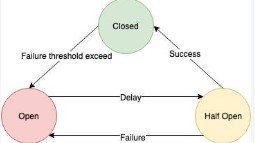
The pattern operates across three distinct states:
- Closed: The circuit is functioning normally. Requests pass through, and the breaker counts failures silently in the background.
- Open: Failure thresholds have been breached. The breaker blocks all requests and returns a fallback response without contacting the failing service.
- Half-Open: After a configured wait period, the breaker allows a limited number of test requests through. If those succeed, it closes again. If they fail, it returns to the open state.
This three-state model gives the system time to recover while keeping the rest of the application running.
Why Distributed Systems Need This Pattern
A monolithic application usually fails as a single unit. Distributed systems fail in far more complex ways. A slow database query in one microservice can exhaust the thread pool of another, causing latency to ripple outward across unrelated services.
Without protective mechanisms, a single unhealthy dependency can consume all available connections and block every incoming request. The Circuit Breaker Pattern prevents this by failing fast. Returning an error in milliseconds is almost always preferable to holding thousands of connections open while waiting on an unresponsive service.
This is especially relevant in modern full-stack architectures where a Node.js API gateway might call ten different backend services to render a single page. If one of those services starts timing out, the entire page load suffers. A circuit breaker isolates the fault and allows the application to serve a degraded but functional response.
Implementing Circuit Breakers in Practice
Most production implementations rely on libraries rather than hand-rolled solutions. Netflix’s Hystrix was one of the earliest and most influential, though it has since moved to maintenance mode. Resilience4j is the current standard in the Java ecosystem. For JavaScript and Node.js environments, libraries like opossum provide straightforward circuit breaker support with configurable thresholds and fallback functions.
A basic implementation involves three configurable parameters: the failure rate threshold that opens the circuit, the wait duration in the open state before moving to half-open, and the number of test calls permitted in the half-open state. Setting these values correctly requires observing real traffic patterns in your specific environment.
Beyond the code itself, circuit breakers work best alongside complementary patterns. Bulkheads isolate resource pools so one failing service cannot exhaust shared connections. Retries with exponential backoff reduce the risk of hammering a recovering service. Health checks and observability dashboards ensure that engineering teams can see when breakers fire and quickly investigate root causes.
Developers who enrol in a full stack developer course in Chennai often encounter these reliability patterns when studying microservices architecture, since the Chennai tech ecosystem has a strong focus on production-grade system design.
Observability and Operational Considerations
A circuit breaker is only as useful as the visibility you have into its behaviour. Teams should expose breaker state as a metric and set up alerts for when circuits open unexpectedly. Distributed tracing tools like Jaeger or Zipkin can show exactly where in a request chain a breaker is intervening.
It is also important to define meaningful fallback behaviour. A fallback does not have to be an error message. It can be cached data, a default response, or a gracefully degraded feature. The goal is to keep the user experience acceptable even when a dependency is unavailable.
Conclusion
The Circuit Breaker Pattern is a practical and proven approach to building resilient distributed systems. By detecting failure early and preventing cascading damage, it keeps applications stable under adverse conditions. For developers pursuing a full stack developer course in Chennai or elsewhere, understanding fault tolerance patterns like this one is essential for building services that hold up in real-world production environments. Fault tolerance is not an optional feature. It is a core requirement of modern distributed web stacks.
About the Author