Selecting the right technology stack is arguably one of the most important decisions you can make in modern app development. The stack you choose has a massive impact on performance, scalability, speed of development and long term maintainability. The most common stacks in use today are MERN, MEAN and Java Spring. Each of those has its own merits, its own applications and its own learning curve. If you’re looking at a full stack developer course then it’s absolutely vital that you understand these stacks as they will inform your career choices and your project choices.
This is a fairly clear comparison of MERN, MEAN and Java Spring, looking at the architecture, the pros and cons and the practical applications of each.
Understanding the MERN Stack
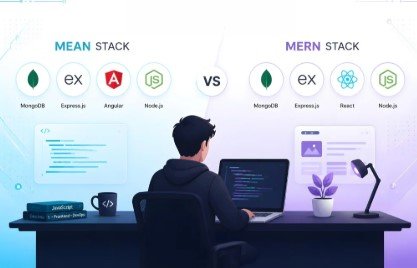
The MERN stack (MongoDB, Express.js, React, Node.js) is a Javascript based stack for building dynamic, responsive web apps.
Key Characteristics
- Uses JavaScript across both frontend and backend
- React enables component-based UI development
- MongoDB offers flexible schema design
- Node.js supports asynchronous processing
Advantages
- Single programming language simplifies development
- Strong community support and extensive libraries
- Ideal for building fast, interactive user interfaces
- Efficient handling of real-time applications
Limitations
- Managing large-scale applications can become complex
- Requires additional structuring for enterprise-level projects
MERN is the choice of choice for a lot of startups and teams who are all about rapid development and building applications around the user.
Understanding the MEAN Stack
The MEAN stack is MongoDB, Express.js, Angular and Node.js. It’s also Javascript based like MERN, just uses Angular rather than React on the front end.
Key Characteristics
- Angular provides a complete framework with built-in features
- Follows a structured and opinionated approach
- Strong support for two-way data binding
Advantages
- Well-defined architecture reduces ambiguity
- Suitable for large-scale enterprise application
- Built-in tools for testing and dependency management
Limitations
- Steeper learning curve compared to React
- Angular applications can become heavy if not optimized
MEAN is widely used in the enterprise world where you’ve got a need for structured development and maintainability.
Understanding Java Spring Framework
Java Spring is a very widely used backend framework for building fairly robust and scalable applications. It’s almost always used in conjunction with some kind of frontend technology (Angular, React, JSP etc).
Key Characteristics
- Based on Java programming language
- Strong support for dependency injection and microservices
- Spring Boot simplifies configuration and deployment
Advantages
- Highly secure and stable for enterprise applications
- Excellent performance under heavy workloads
- Extensive ecosystem and long-term support
Limitations
- Requires knowledge of Java and object-oriented programming
- Development speed may be slower compared to JavaScript stacks
Java Spring is extremely widely used in banking, healthcare and in large enterprise systems where reliability and security are paramount.
Key Comparison: MERN vs MEAN vs Java Spring
Development Speed
- MERN offers faster development due to flexibility and React’s lightweight nature
- MEAN provides moderate speed with structured guidelines
- Java Spring focuses on robustness rather than speed
Scalability
- MERN scales well for modern web apps but needs careful architecture
- MEAN handles scalability efficiently in enterprise setups
- Java Spring excels in large-scale, high-performance systems
Learning Curve
- MERN is relatively easier for beginners familiar with JavaScript
- MEAN requires deeper understanding of Angular concepts
- Java Spring demands strong Java fundamentals
Use Cases
- MERN is suitable for social platforms, dashboards, and single-page applications
- MEAN works well for enterprise portals and structured application
- Java Spring is ideal for financial systems, APIs, and microservices architecture
Understanding the difference makes it much easier for developers to match their skills to what the market is looking for and what the project actually requires.
Choosing the Right Stack for Your Needs
The tech stack you pick is going to be a function of a number of things including the complexity of the project, the skillset of the team, how scalable you need it to be and the timescale.
- Choose MERN if you need rapid development and modern UI capabilities
- Choose MEAN if your project requires a structured framework with built-in features
- Choose Java Spring if your focus is on security, scalability, and enterprise-grade performance
It’s also worth bearing in mind the long term maintenance and community support when making this decision. A lot of organisations these days are taking a hybrid approach with Spring on the back end and a modern JS framework on the front end.
For anyone doing a full stack developer course, getting some exposure to at least one JS stack and one enterprise backend framework is going to be a massive improvement to job readiness.
Conclusion
MERN, MEAN and Java Spring are all different beasts in the development world. MERN is all about flexibility and speed. MEAN is all about structure and consistency. Java Spring is all about reliability and enterprise level performance.
There’s no such thing as a one size fits all stack. The right stack is going to be very much dependent on the problem you’re trying to solve, the scale of the application and the development environment. Knowing the strengths and weaknesses of the various options is key to making the right choice and building an application that is both efficient and scalable in line with modern day industry practice.
About the Author