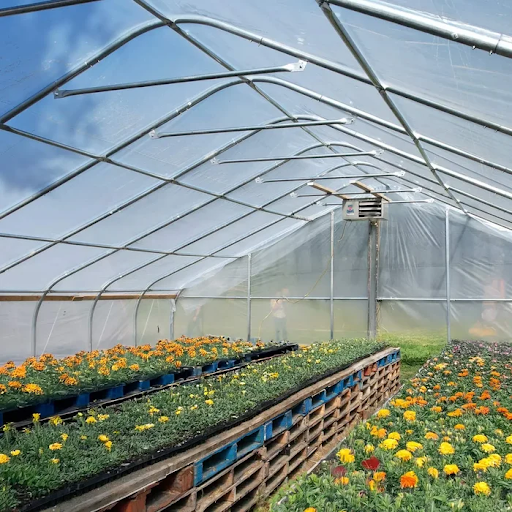
Growers across the northern states buy covered space to start earlier and finish later than the open field allows. A thirty by fifty foot structure adds roughly six weeks at each end of the season across most of that territory, and the component delivering those weeks is not the frame.
It is the film stretched over it. That is why cover specification is the first question rather than the last, and why a tunnel greenhouse grow tent with a well-chosen cover performs year after year while the same frame under thin film becomes an annual re-covering project.
What the Cover Is Actually Doing
Thickness Is Mechanical, Not Optical
Six mil greenhouse plastic resists tearing at the fasteners, survives hail that would open a thinner sheet, and holds its shape under wind loading instead of drumming against the hoops. That drumming is what fatigues a cover over a season and starts the tears.
Clarity Against Diffusion
Clear film transmits a high percentage of available light, which matters in a short northern season where every hour counts. Diffused films scatter light deeper into the canopy and reduce leaf scorch, so the choice depends on whether light quantity or light distribution is the limiting factor.
Ultraviolet Stabilization
This separates a greenhouse film from a hardware store sheet. Unstabilized polyethylene goes brittle in a single season of direct sun, and the failure arrives as sudden shattering rather than gradual wear, which is why a rated service life is the honest basis for comparison.
Infrared Retention
Films formulated to hold longer wavelength radiation inside slow the heat loss that happens on a clear calm night, which is precisely when a late frost arrives. On a plastic greenhouse used for season extension, that property beats a few percent of daylight transmission.
Frame Capacity Comes From Spacing
Hoops Before Tube Diameter
Plastic greenhouse frame capacity comes from hoop spacing more than from tube wall thickness. Closing the spacing raises both snow and wind capacity substantially, and it is what separates a structure built for a windy site from one sized for a sheltered yard.
Purlins Make It One Structure
A greenhouse frame with a ridge purlin and side purlins behaves as a braced assembly. One without them racks along its length until the end walls take loads they were never meant to carry, and that is where the first failure usually appears.
End Walls Face the Weather
A long tunnel presents a large sail area, and the end facing the prevailing wind carries the pressure. Bracing that end, and running the tunnel’s length with the wind rather than across it, costs nothing at layout time.
Ventilation at Thirty by Fifty Feet
A plastic greenhouse this long cannot be ventilated by opening a door. Roll-up sides along both long walls give a continuous low inlet, and warm air leaves through ridge vents or the far side depending on which way the wind is running that afternoon.
A few points settle the ventilation question early:
• Compare vent area as a ratio to floor area
• Fit automatic openers rather than relying on presence
• Provide a low inlet for every high outlet
• Choose anti-condensate film in humid climates
Undersized ventilation produces midday temperatures that stall growth, and the damage is invisible because nothing wilts dramatically. Condensation runs alongside it, because warm humid air meeting cold film deposits water that drips onto foliage and establishes disease.
Replacing the Cover Without Losing a Season
Plan It Rather Than React
Doing it in settled weather, with enough hands to keep the sheet under control, takes an afternoon. Doing it after a failure means working in whatever conditions caused that failure, usually with a crop underneath that cannot wait for better weather.
Fastening Decides Survival
Channel and wiggle wire systems clamp the film along its length and allow re-tensioning, while batten strips and screws concentrate stress at points and tear. Rounded edges on every surface the film touches prevent the abrasion that starts holes.
Tension Needs Revisiting
Polyethylene relaxes through its first weeks and moves with temperature, so a cover drum-tight on a warm afternoon is slack on a cold morning. Walking the perimeter twice in the first month is normal practice rather than a sign of a problem.
Where Covered Growing Is Going
Five-year and seven-year rated covers have become common where three-year film was standard, and thermostat-driven vent motors have dropped to prices that make sense on a single tunnel rather than only on a commercial greenhouse range.
For a grower the conclusion is that the cover and the ventilation deserve the attention usually given to the frame. TMG Industrial lists film thickness, hoop spacing and vent configuration together, which allows a structure to be matched to a site and a growing season rather than to a footprint.
About the Author