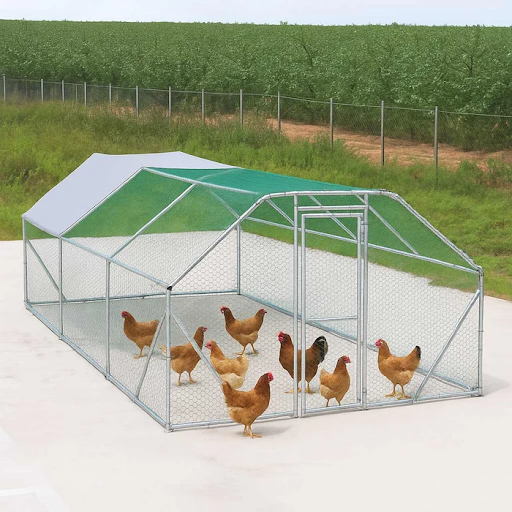
Space for poultry gets quoted as one figure, and that figure usually describes the henhouse. Birds sleep inside and live outside it, so the number that governs their day is the run. A chicken coop run shelter is sized against a different standard than the box it attaches to, and confusing the two is how a flock ends up crowded in daylight and comfortable only at night.
Two numbers doing two different jobs
Inside the chicken coop, roughly three to four square feet per standard hen is the common guide. The birds are asleep for most of the time they spend there, so the limit is roost space and air volume rather than floor area.
Outside, eight to ten square feet per bird keeps a flock calm. That space is where they forage, dust bathe and establish order, and it runs out first because all of the activity happens there.
What crowding looks like before it looks like fighting
Feather picking is the first sign, and it is usually read as a diet problem. A bare patch at the base of the tail on two or three birds in a flock of a dozen is more often about space. Bare ground is the second. Hens strip vegetation in a predictable radius around the house, and when that circle reaches the fence on every side, the run has stopped providing anything except containment.
Predators arrive from underneath more often than over
Raccoons and dogs test the perimeter of a chicken coop, and the point they test is the ground line. Digging under a fence takes a determined animal a few minutes, which is why wire that simply stops at grade is the usual failure.
A predator proof chicken coop solves it with an apron rather than a trench. Eighteen to twenty four inches of mesh laid flat outside the fence and pegged down turns the dig into a problem the animal does not solve, because it starts the hole at the fence rather than a foot away.
Mesh size matters more than mesh strength
Poultry netting keeps hens in. It does not keep a raccoon out, because the hexagonal openings are large enough for a paw and the wire is light enough to tear. Welded mesh with openings of half an inch to one inch is the material that resists both. The distinction matters most at night and lowest down, which is why many setups use heavy mesh for the first three feet and lighter material above it.
A run is daytime space, not night shelter
An open mesh structure gives protection from hawks and from casual intrusion while birds are awake and alert. It is not a substitute for a closed house after dark, when predators are most active and hens will not move.
Three habits cover most of the risk:
• Shut the house door at dusk, every night
• Walk the ground line weekly for digging
• Keep feed inside, never in the run
Feed is the one people miss. Scattered grain in an open run is what brings rats and raccoons to the fence in the first place, and a predator that visits for spilled feed eventually notices the birds.
Ground cover decides how long it stays usable
Bare soil in a run turns to mud and then to a surface that holds droppings against the birds. Deep litter, coarse wood chips or sand all work, and depth matters more than the choice, because a thin layer disappears into the soil within a season.
Six inches of coarse material drains, composts slowly and gives hens something to scratch through. It also keeps the ground line dry, which matters because a permanently wet fence base is where wire rusts through first.
Roof, shade and Canadian weather
A covered section changes how much of the run gets used. Hens avoid open ground in heavy rain and full sun, so an uncovered run of generous size still works like a small one for much of the year.
Snow load is the winter version of the same question. A mesh roof sheds nothing, so in most of Canada the covered portion needs either a pitched panel or a seasonal routine of clearing it before the weight accumulates.
Sizing before buying rather than after
A ten by twenty foot footprint gives two hundred square feet, which suits roughly twenty birds at ten square feet each, or fewer if the flock spends all winter inside it. Working the arithmetic from bird count rather than from available yard space is the step that gets skipped.
TMG Industrial builds this one as a wire mesh structure intended to attach to an existing house rather than replace it. Deciding how many birds the run has to hold through a long winter, rather than through a summer afternoon, is what sizes it correctly.
About the Author