old chip off the block meaning
Language is full of interesting expressions that make everyday conversations more colorful and meaningful. Some phrases describe people’s personalities, while others explain family relationships, habits, and similarities between parents and children. One such expression is “old chip off the block,” which people sometimes use when talking about someone who resembles a parent or another family member.
Understanding the old chip off the block meaning helps you recognize how English speakers use this expression in casual conversations, family discussions, and written communication. Although the phrase may sound unusual at first, its meaning becomes clear when you understand the words behind it and the traditional expression from which it comes.
In this article, we will explore the definition, origin, examples, common variations, and correct usage of “old chip off the block.” You will also learn the difference between this expression and similar idioms, along with practical tips for using it naturally in everyday English.
What Is the Old Chip Off the Block Meaning?
The phrase “old chip off the block meaning” is generally understood as a variation or mistaken version of the established English idiom “a chip off the old block.”
The traditional expression “a chip off the old block” means a person who closely resembles one of their parents, especially in personality, behavior, appearance, abilities, or habits. It suggests that the person is similar to their parent in the same way that a small piece of wood resembles the larger piece from which it was cut.
For example, if a father is an excellent musician and his daughter develops the same musical talent, someone might say, “She is a chip off the old block.”
The expression does not necessarily refer to physical appearance. It can also describe shared characteristics such as humor, intelligence, determination, kindness, or even stubbornness.
When people search for “old chip off the block meaning,” they may be trying to understand this familiar idiom or determine whether the word “old” belongs at the beginning of the phrase. The most widely accepted and natural wording is “a chip off the old block.”
A Simple Definition
In simple English, the expression means that someone is very much like their parent.
Here are a few examples:
- A son who loves repairing cars just like his father may be called a chip off the old block.
- A daughter who has her mother’s sense of humor may be described as a chip off the old block.
- A child who shares a parent’s leadership skills, confidence, or determination may also fit this description.
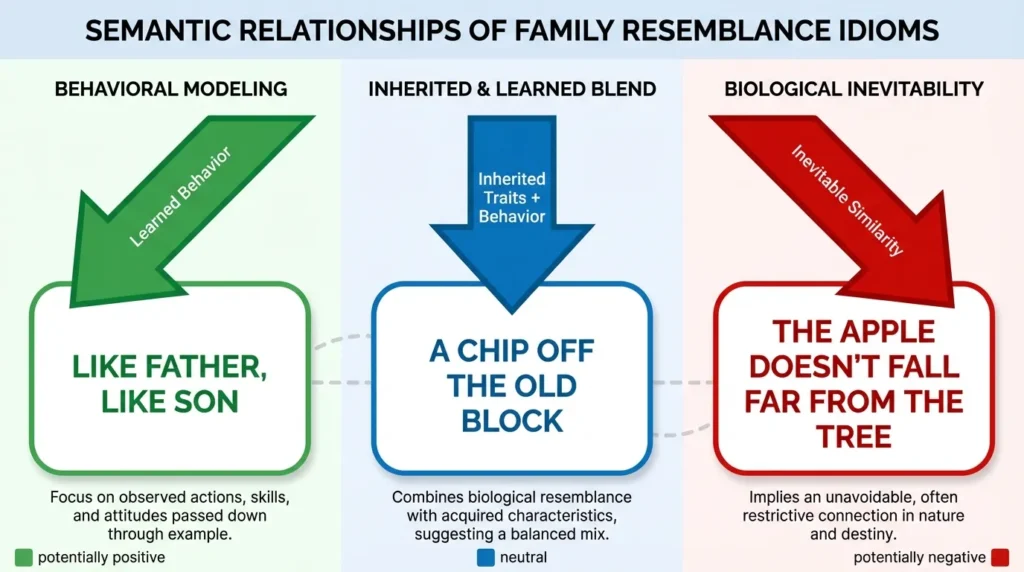
The expression can be used positively, negatively, or neutrally, depending on the qualities being discussed.
Understanding the Words Behind the Expression
To understand the idiom fully, it helps to examine its individual words.
What Does “Chip” Mean?
A chip is a small piece of material that has broken off or been cut from something larger. For example, a woodworker may remove a small chip from a wooden board while shaping it.
In the expression, the chip represents a child or younger person.
What Does “Old” Mean?
The word “old” refers to the original or larger piece of material. In the idiom, it represents the parent or older family member.
It does not necessarily mean that the parent is elderly. Instead, it distinguishes the original person from the younger person who resembles them.
What Does “Block” Mean?
A block is a solid piece of material, often wood, that can be cut or shaped into smaller pieces.
Within the idiom, the block symbolizes the parent, while the chip symbolizes the child. The comparison suggests that the child has inherited or developed characteristics similar to those of the parent.
Together, these words create a memorable image of a smaller piece coming from a larger original piece.
The Origin of “A Chip Off the Old Block”
The expression “a chip off the old block” has been used in English for centuries. It is commonly associated with the idea that a small piece of wood retains the qualities of the larger piece from which it was separated.
The image is straightforward: when a piece of wood is cut from a block, the smaller piece comes from the original material. Similarly, a child may display characteristics that resemble those of a parent.
The expression appeared in English literature several centuries ago and became an established idiom. It has remained popular because it communicates a familiar human experience in just a few words.
Parents and children often share interests, habits, talents, and personality traits. Some similarities may be inherited, while others develop through observation, upbringing, and spending time together. The idiom captures these similarities without requiring a lengthy explanation.
Although its imagery comes from woodworking, the phrase is now used almost entirely in a figurative sense. People rarely think about actual pieces of wood when using it in conversation.
Examples of “A Chip Off the Old Block” in Everyday Life
The best way to understand an idiom is to see how people use it in realistic situations.
Example 1: A Child Who Loves Sports
Imagine that a father has played cricket for many years. His son becomes interested in the sport, practices regularly, and eventually joins a local team.
A family friend might say:
“Your son is a chip off the old block. He loves cricket just as much as you do.”
Here, the expression highlights a shared interest between the father and son.
Example 2: A Daughter With Her Mother’s Personality
Suppose a mother is outgoing, confident, and always ready to help others. Her daughter grows up with similar qualities and enjoys meeting new people.
Someone might comment:
“She is a chip off the old block. She has the same friendly personality as her mother.”
This example shows that the idiom can describe personality rather than appearance.
Example 3: A Family Business
Consider a family that owns a small restaurant. The father is known for his excellent cooking and dedication to customers. Years later, his daughter takes over the business and maintains the same standards.
A customer might say:
“The daughter is a chip off the old block. She runs the restaurant just like her father did.”
The phrase suggests that the daughter has adopted or inherited her father’s work ethic and professional skills.
Example 4: A Similar Sense of Humor
Imagine a grandfather who enjoys telling jokes at family gatherings. His grandson develops the same playful personality and makes everyone laugh.
A relative might say:
“That boy is a chip off the old block. His grandfather was exactly the same.”
In this case, the idiom describes a shared sense of humor.
Example 5: A Negative Personality Trait
The phrase does not always describe admirable qualities.
Suppose a father is famously stubborn, and his son refuses to change his mind even when presented with convincing arguments.
A family member might say:
“He is a chip off the old block. His father was just as stubborn.”
Although the statement may sound humorous, it points out a less desirable similarity.
These examples demonstrate that context determines whether the expression sounds complimentary, critical, or simply descriptive.
Is “Old Chip Off the Block” Grammatically Correct?
The phrase “old chip off the block” is understandable, but it is not the standard form of the traditional idiom.
The established expression is:
“A chip off the old block.”
For example:
- Correct: “He is a chip off the old block.”
- Correct: “She is a chip off the old block, just like her mother.”
- Less natural as a standalone idiom: “He is an old chip off the block.”
The last sentence may be understood, but adding “old” before “chip” changes the familiar structure and can make the wording sound awkward.
The key distinction is that “old” traditionally appears immediately before “block,” not before “chip.”
If you are writing an article, preparing an English assignment, or speaking in a formal setting, it is best to use the established wording.
Why Do People Say “Old Chip Off the Block”?
People may use the shortened or rearranged version because they remember the main words but not their exact order. English contains thousands of idioms, and many expressions can be difficult for learners to remember.
Another reason is that people may encounter the phrase in informal conversations, social media posts, or search queries where grammar is not always carefully checked.
Some people also type the words they remember into a search engine rather than the complete expression. As a result, “old chip off the block meaning” becomes a search phrase even though “a chip off the old block” is the conventional idiom.
If you encounter this variation, you can usually infer the intended meaning from the context. However, understanding the standard version will help you use the expression more accurately.
Similar Expressions and Their Meanings
English has several expressions that communicate ideas similar to “a chip off the old block.” Learning these alternatives can expand your vocabulary and make your writing more varied.
Like Father, Like Son
This expression suggests that a son resembles his father in behavior, personality, or habits.
Example: “His father was a talented football player, and now he is one too. Like father, like son.”
Although the expression specifically mentions fathers and sons, it is sometimes used more broadly to describe similarities between parents and children.
The Apple Doesn’t Fall Far From the Tree
This idiom means that children often resemble their parents in their characteristics or behavior.
Example: “Her mother is an excellent artist, and she has become one as well. The apple doesn’t fall far from the tree.”
It is particularly useful when discussing inherited talents, habits, or personality traits.
Following in Someone’s Footsteps
This phrase means choosing a similar path to another person’s, especially in education, work, or career.
Example: “His mother is a doctor, and he is following in her footsteps by studying medicine.”
Unlike “a chip off the old block,” this expression focuses more on actions and life choices than on natural similarities.
Cut From the Same Cloth
This expression describes two people who are very similar in personality, values, or behavior.
Example: “The two brothers are cut from the same cloth. They both have the same determination and sense of humor.”
It can refer to relatives, friends, colleagues, or anyone with similar characteristics.
Is the Expression Always About Parents and Children?
Traditionally, “a chip off the old block” describes a child who resembles a parent. This remains its most common meaning.
However, people sometimes use it more loosely to describe a younger relative who resembles an older family member, such as a grandparent, aunt, or uncle.
For instance, if a young girl has the same artistic talent and patient nature as her grandmother, a relative might use the expression to emphasize their resemblance.
The phrase can also be applied humorously to someone who strongly resembles a mentor or another influential person, although this is less typical than its family-related use.
It is important to remember that the expression communicates similarity. It does not prove that the person has inherited a particular trait genetically. Similarities may result from learning, shared experiences, family culture, or personal choices.
How to Use the Expression Naturally
If you want to use this idiom confidently, follow a few simple guidelines.
First, use the correct word order. Remember “a chip off the old block,” rather than “an old chip off the block.”
Second, connect it to a recognizable similarity. The expression works best when the person shares a clear trait with a parent or older family member.
Third, consider the tone. It can express admiration, affection, humor, or criticism. The surrounding words help listeners understand your intention.
Fourth, avoid taking the phrase literally. It is an idiom, so its meaning concerns people and their characteristics rather than actual blocks or chips of wood.
Here are a few natural sentences you can practice:
- “My daughter is a chip off the old block because she loves reading just like I do.”
- “Everyone says that Daniel is a chip off the old block because he has his father’s confidence.”
- “She inherited her mother’s artistic talent and is truly a chip off the old block.”
- “He is a chip off the old block when it comes to being competitive.”
- “The young businessman is a chip off the old block, following his father’s example.”
Using examples like these will help you remember the expression and apply it correctly.
Common Mistakes to Avoid
English learners sometimes confuse idioms because their meanings cannot always be determined from individual words.
One common mistake is rearranging the phrase. Saying “an old chip off the block” may communicate your intention, but it does not follow the traditional wording.
Another mistake is assuming the expression only refers to physical resemblance. In reality, it frequently describes behavior, interests, talents, and personality.
A third mistake is believing that the idiom must always be positive. Someone can be called a chip off the old block because they share a parent’s impatience, stubbornness, or other undesirable habits.
Finally, avoid confusing this expression with “following in someone’s footsteps.” The two phrases overlap, but they emphasize different things. A person who is a chip off the old block resembles a parent, while someone following in a parent’s footsteps deliberately pursues a similar path.
Understanding these distinctions will make your English sound more natural and precise.
Why This Idiom Remains Popular
Despite its long history, “old chip off the block meaning” remains useful because family similarities are a universal part of human experience.
Parents often recognize their own habits in their children. A child may laugh in the same way as a parent, develop a similar passion for music, or approach problems with the same determination. These moments create opportunities for affectionate observations and lighthearted comments.
The idiom also makes communication more concise. Instead of saying that a person strongly resembles a parent in several ways, a speaker can use one familiar expression to communicate the general idea.
Its vivid imagery makes it memorable, too. The comparison between a small chip and a larger block provides a simple picture of how one person can resemble another.
In everyday conversations, family celebrations, personal stories, and informal writing, this expression remains an effective way to describe similarities between generations.
Conclusion
The old chip off the block meaning is connected to the familiar English idiom “a chip off the old block,” which describes someone who resembles a parent or older family member in personality, behavior, appearance, talents, or habits.
The phrase comes from the image of a small piece of wood separated from a larger block. Figuratively, the smaller piece represents a child, while the original block represents the parent. It can describe positive qualities, such as kindness and intelligence, as well as negative traits, such as stubbornness.
Although “old chip off the block” may appear in searches and informal writing, “a chip off the old block” is the standard and most natural expression to use. Similar idioms include “like father, like son,” “the apple doesn’t fall far from the tree,” and “cut from the same cloth.”
By learning its meaning, origin, examples, and correct grammatical structure, you can use this popular idiom confidently. Whether you are discussing a child’s talents, a family’s shared habits, or similarities between generations, “a chip off the old block” is a simple and memorable way to express the idea that people often remind us of those who came before them.
Is this conversation helpful so far?
About the Author