envolved
Language is constantly evolving, and people often encounter words that look familiar but create confusion when they try to understand their meaning or use them in writing. One such word is “envolved.” Although it appears in online searches, informal conversations, and occasional written content, many people are unsure whether it is correct English or a misspelling of another word. Understanding the meaning, spelling, and proper use of envolved can help readers improve their vocabulary and communicate more effectively.
In most standard English contexts, “envolved” is a misspelling of “involved” or “evolved,” depending on what the writer wants to express. These two words have different meanings, so choosing the correct one is important. This article explores the possible meanings of envolved, explains the differences between involved and evolved, provides examples, and offers practical advice for using the correct word in everyday communication.
What Does Envolved Mean?
The term envolved is not generally recognized as a standard English word in modern dictionaries. It most often appears because someone has accidentally combined the spelling patterns of “involved” and “evolved.” Both words are common in English, but they describe different ideas.
The intended meaning depends on the sentence in which the word appears. For example, a person who writes, “She was envolved in the project,” probably means “She was involved in the project.” In contrast, someone who writes, “Technology has envolved over time,” may intend to say “Technology has evolved over time.”
Understanding the surrounding sentence is therefore essential. A spelling correction should not be made without considering the writer’s intended message.
Although people may use unfamiliar spellings in informal online communication, standard spelling remains important in academic assignments, professional emails, business documents, and published articles.
Is Envolved a Correct English Word?
In standard contemporary English, envolved is not an accepted spelling of either involved or evolved. It is best treated as a spelling error unless a particular context establishes that it is a name, a specialized term, or an intentionally invented expression.
English contains many words that look or sound similar. Because of these similarities, writers sometimes confuse their spelling, especially when typing quickly or relying on pronunciation.
The confusion surrounding envolved is understandable. Both involved and evolved describe situations in which something happens or changes, but their meanings are not interchangeable.
For example, being involved in a business means participating in its activities. Saying that a business evolved means that it developed or changed over time. A business can be involved in a project while also evolving as an organization, but these expressions communicate different information.
When you encounter envolved in a sentence, examine the intended meaning before correcting it.
Understanding the Word Involved
The word “involved” is the past tense and past participle of the verb “involve.” It can describe participation, connection, engagement, or complexity.
In everyday English, involved is commonly used when someone takes part in an activity, works on a project, or has a connection to a particular situation.
For example, consider the sentence, “David was involved in organizing the event.” This means David participated in the planning or preparation of the event.
The word can also describe complicated situations. If someone says, “The instructions are involved,” they mean the instructions are complicated or require careful attention.
Involved as Participation
One of the most common meanings of involved is taking part in something.
Examples include:
- Maria was involved in the school competition.
- Several employees were involved in the new project.
- He became involved in community activities.
- The students were involved in planning the presentation.
In each example, involved communicates participation or engagement.
Involved in Relationships
The word can also describe a personal or romantic relationship.
For instance, the sentence “They have been involved for several months” may suggest that two people have a romantic connection. The precise meaning depends on the context.
In other situations, involved may refer to a person’s connection to a dispute, investigation, or disagreement.
Involved in Complicated Situations
Another important meaning relates to complexity.
Consider the sentence, “The process is more involved than we expected.” Here, involved means complicated, detailed, or requiring several steps.
These different meanings explain why involved is a flexible and frequently used English word.
Understanding the Word Evolved
The word “evolved” is the past tense and past participle of “evolve.” It means developed gradually, changed over time, or progressed from an earlier form into a different one.
Evolution can describe changes in living organisms, technology, personal habits, ideas, cultures, and organizations.
For example, “The company evolved from a small family business into an international organization” means the company gradually developed and changed.
Unlike involved, evolved does not normally mean participating in an activity. Its central idea is development or transformation.
Evolved in Science
In biology, evolved refers to changes in inherited characteristics of populations across generations. Biological evolution is a central scientific concept used to explain the diversity of life.
For example, scientists study how species evolved in response to environmental conditions over long periods.
This meaning is different from an individual organism simply growing older. Biological evolution concerns changes in populations across generations.
Evolved in Technology
The word evolved is also widely used when discussing technological progress.
For example:
- Mobile phones have evolved significantly over the years.
- Online education has evolved with digital technology.
- Modern transportation systems have evolved to meet changing needs.
- Computer software has evolved through repeated improvements.
In these sentences, evolved indicates development and transformation rather than participation.
Evolved in Personal Development
People sometimes use evolved to describe personal growth.
For example, “Her leadership style has evolved over the years” means her approach to leadership has changed and developed through experience.
Similarly, a person’s opinions, priorities, or habits may evolve as they gain knowledge and encounter new situations.
Envolved vs. Involved vs. Evolved
Understanding the differences among these words is the easiest way to avoid spelling mistakes.
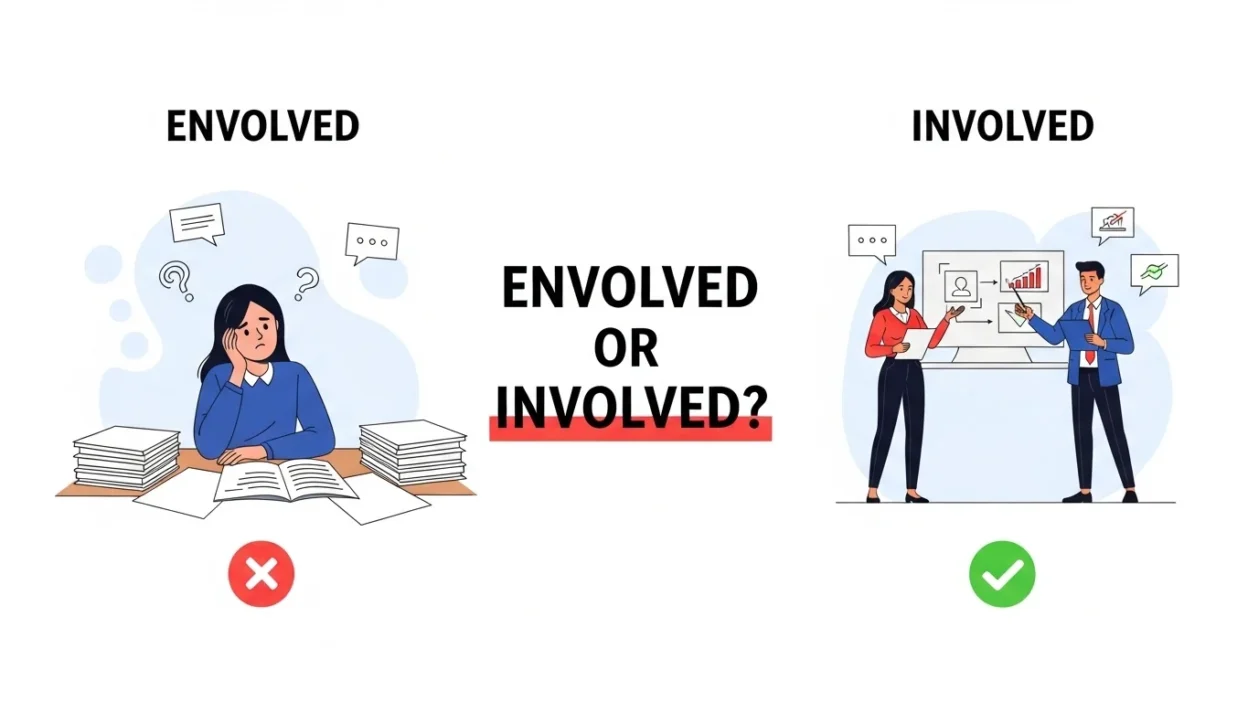
Envolved: Generally a nonstandard spelling that should be corrected according to the intended meaning.
Involved: Describes participation, connection, engagement, or complexity.
Evolved: Describes gradual development, change, or transformation over time.
Consider the following examples.
Incorrect: “I was envolved in the meeting.”
Correct: “I was involved in the meeting.”
The corrected sentence explains that the speaker participated in the meeting.
Incorrect: “The business has envolved over the past decade.”
Correct: “The business has evolved over the past decade.”
The corrected sentence explains that the business has developed or changed over ten years.
Another example demonstrates the difference more clearly.
“The employee was involved in improving the system” means the employee participated in the improvement process.
“The system evolved through several improvements” means the system changed and developed through those improvements.
Both sentences are correct, but they describe different aspects of the same general situation.
Why Do People Write Envolved Instead of Involved?
There are several reasons why people may produce this spelling.
Confusion Between Similar Words
Involved and evolved share several letters and have related-looking forms. When someone remembers the general sound of a word without remembering its exact spelling, they may combine elements of both words.
This is particularly common when people are learning English or writing quickly.
Typing Errors
Typing errors are another possible explanation. Writers may accidentally enter the wrong letters, especially when composing messages on mobile devices or using unfamiliar keyboards.
Autocorrect tools do not always identify every error. A misspelled word may remain unchanged if the software fails to recognize the intended word.
Pronunciation and Listening
People who learn English primarily through conversation may know a word’s pronunciation before they understand its written form.
When they later attempt to spell the word, they may choose a form that appears logical but is not standard.
Listening carefully to the word in different sentences and reading examples can help solve this problem.
Limited Vocabulary Practice
Regular reading exposes people to correct spelling, grammar, and sentence structure. Someone who rarely encounters a particular word in written English may have difficulty remembering how it is spelled.
Vocabulary practice and repeated exposure can reduce these mistakes over time.
How to Use Involved Correctly in Sentences
The best way to learn the correct spelling is to practice it in realistic situations.
Here are several examples of involved in everyday English.
Example 1: “My brother was involved in organizing the family celebration.”
This sentence indicates that the brother helped plan the celebration.
Example 2: “The teacher involved every student in the classroom discussion.”
In this example, involved is the past tense of the verb involve. The teacher encouraged every student to participate.
Example 3: “The investigation involved several important documents.”
Here, involved means that the documents were part of the investigation.
Example 4: “The repair work was more involved than the technician expected.”
In this sentence, involved describes a complicated task.
Example 5: “She wants to become more involved in local community projects.”
This sentence expresses a desire to participate more actively.
Practicing examples from different contexts helps readers recognize the word’s meaning and use it naturally.
How to Use Evolved Correctly in Sentences
Evolved should be used when the intended meaning concerns development or change.
Example 1: “The company’s business model evolved as customer needs changed.”
This sentence describes gradual development in the company’s approach.
Example 2: “Communication methods have evolved considerably since the introduction of the internet.”
The sentence explains how communication has changed over time.
Example 3: “His understanding of leadership evolved through practical experience.”
Here, evolved refers to a change in knowledge and perspective.
Example 4: “The design evolved after several rounds of testing.”
This means the design changed as improvements were introduced.
Example 5: “Many cultural traditions have evolved over generations.”
This describes gradual changes in traditions over time.
These examples demonstrate that evolved is appropriate when discussing progress, development, and transformation.
Common Mistakes to Avoid
Writers can improve their English by recognizing a few common mistakes associated with envolved.
Choosing a Word Without Checking Its Meaning
The first mistake is assuming that involved and evolved mean the same thing. Although both can appear in sentences about projects, organizations, or personal experiences, their meanings differ.
Before choosing a word, ask yourself whether the sentence describes participation or development.
If someone takes part in an activity, involved is usually appropriate. If something changes over time, evolved is usually the better choice.
Relying Entirely on Pronunciation
Pronunciation can help identify words, but it is not always enough to determine spelling. English contains many words whose spellings cannot be predicted perfectly from their sounds.
Reading correct examples and checking a dictionary can help establish the appropriate spelling.
Ignoring the Sentence Context
A word should always fit the meaning of the entire sentence.
For example, “She was involved in the research” and “Her research methods evolved” are both grammatically correct. However, replacing one key word with the other changes the message.
Context is therefore essential when correcting unfamiliar words.
Failing to Proofread
Even experienced writers make spelling mistakes. Reviewing a document before submitting or publishing it can help identify errors that were missed during the first draft.
Spell-checking tools are useful, but writers should also read their sentences carefully to ensure that the chosen word communicates the intended meaning.
Tips for Remembering the Correct Spelling
Remembering the distinction between involved and evolved becomes easier when you associate each word with a simple idea.
First, connect involved with participation. If someone is involved, that person is taking part in something or has a connection to it.
Second, connect evolved with change. If something has evolved, it has developed or transformed over time.
Third, create your own example sentences. Writing “I was involved in the project” and “The project evolved over several months” reinforces the different meanings.
Fourth, read English articles, books, and educational materials regularly. Seeing words in meaningful contexts makes their spelling easier to remember.
Finally, use a reliable dictionary whenever you are uncertain. Developing the habit of checking unfamiliar words can improve spelling and vocabulary steadily.
Frequently Asked Questions About Envolved
Is envolved a real English word?
Envolved is not generally accepted as a standard English spelling. In most contexts, it is a misspelling of involved or evolved. The intended meaning determines which correction is appropriate.
What is the correct spelling of envolved?
The correct spelling is usually involved when referring to participation or connection. Use evolved when referring to development or change over time.
What is the difference between involved and evolved?
Involved generally describes participation, connection, or complexity. Evolved describes gradual change, development, or transformation.
Can I use envolved in formal writing?
It is best to avoid envolved in formal writing unless you are deliberately referring to a specific name or specialized term that uses that spelling. For ordinary English, choose involved or evolved according to the intended meaning.
How can I avoid making this spelling mistake?
Read regularly, practice example sentences, proofread your work, and use a dictionary when necessary. Learning the meanings of similar words is more effective than memorizing their spelling alone.
Why do people search for envolved?
People may search for the term because they have encountered it in a message, article, social media post, or online discussion. They may want to discover its meaning, verify its spelling, or determine whether it should be replaced with involved or evolved.
Conclusion
The word envolved illustrates how easily spelling confusion can occur when two familiar English words look similar. Although the term appears in informal writing and online searches, it is generally not the standard spelling intended in ordinary English sentences.
The most important lesson is to distinguish between involved and evolved. Involved refers to participation, connection, engagement, or complexity. Evolved refers to gradual development, change, or transformation over time.
By understanding these differences, practicing example sentences, and checking unfamiliar words before using them, writers can improve their vocabulary and communicate more clearly. Whether you are writing an academic assignment, preparing a professional email, or creating online content, choosing the correct word helps make your message accurate, readable, and effective.
About the Author