brite meaning
Language constantly changes as people develop new ways to communicate online, in conversations, and through written messages. Some words have traditional spellings, while others appear in shortened, creative, or informal forms. One example is the word “brite.” If you have recently encountered this term in a message, advertisement, product name, or online discussion, you may be wondering what it means and how to use it correctly.
Understanding the brite meaning requires looking at its relationship with the familiar English word “bright.” Although the two words are closely connected, they are not always interchangeable. The spelling “brite” often appears in brand names, informal writing, marketing materials, and creative expressions. Its exact meaning can depend on the context in which it is used.
This article explores the definition of brite, its origins, common uses, examples, differences from bright, and situations in which the spelling may be appropriate.
What Is the Brite Meaning?
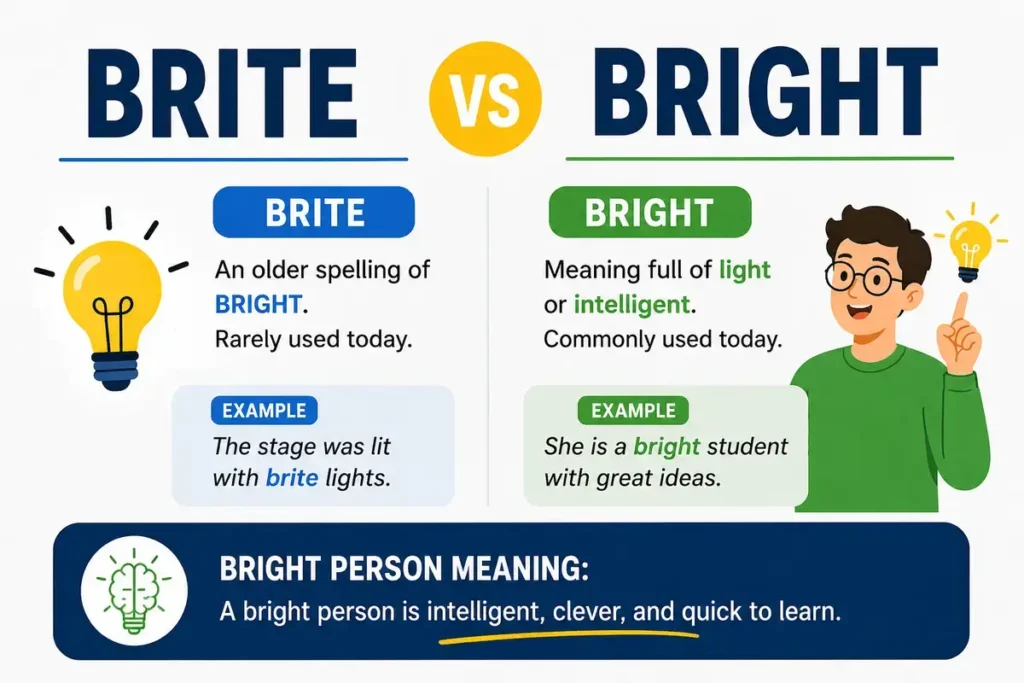
The word “brite meaning” is commonly used as an alternative spelling of “bright.” The traditional word bright describes something that produces a lot of light, has vivid colors, shows intelligence, or suggests a positive future.
For example, a bright room receives plenty of light, a bright student learns quickly, and a bright future suggests promising opportunities.
Brite often communicates similar ideas, particularly in brand names, product descriptions, advertising, and informal expressions. Businesses may choose this spelling because it looks distinctive, feels modern, or makes a name easier to remember.
However, brite is not the standard spelling of the adjective bright in ordinary formal English. When writing essays, professional documents, academic assignments, or business correspondence, bright is generally the appropriate choice unless brite is part of an official name or title.
In simple terms, brite usually refers to brightness, light, vividness, intelligence, or positivity when used as a creative spelling of bright.
The Origin of the Word Brite
To understand brite, it helps to examine the history of bright. The standard English word has Germanic roots and has been used for centuries to describe shining light, visual clarity, and qualities associated with intelligence.
Over time, bright developed several related meanings. It came to describe not only physical light but also sharp thinking, cheerful moods, vivid colors, and promising circumstances.
The spelling brite developed as an alternative form that can resemble a simplified or stylized version of bright. In modern commercial and informal settings, spelling variations are sometimes used to create memorable names or distinctive visual identities.
Companies may choose brite because it is short and visually appealing. It can also make a product name look playful, energetic, or contemporary.
Nevertheless, brite should not automatically be treated as a historical or universally accepted spelling replacement for bright. Its interpretation depends on how and where it appears.
Common Meanings of Brite
The meaning of brite can vary according to its context. The following interpretations are among the most common.
1. Light or Brightness
One of the most familiar interpretations of brite relates to light. It may appear in product names associated with illumination, lighting equipment, screens, or visual effects.
For example, a company might use a name containing brite to suggest that its products provide strong illumination or improve visibility.
In this context, the intended meaning is closely related to the standard adjective bright.
Example: “The company introduced a new Brite lighting system.”
Here, Brite is presented as part of a product name rather than as an ordinary adjective.
2. Vivid and Attractive Colors
Brite may also suggest strong, vivid, or eye-catching colors. Businesses selling clothing, stationery, paint, decorations, or art supplies sometimes use spelling variations of bright to create attractive product names.
For instance, a collection described using the word brite might contain neon pink, electric blue, vivid yellow, and other noticeable shades.
Example: “The store displayed a collection of Brite-colored accessories.”
Although the sentence communicates the intended idea, standard formal writing would usually use “bright-colored accessories” or “brightly colored accessories” instead.
3. Intelligence and Quick Thinking
Bright can describe a person who learns quickly, understands difficult ideas, or demonstrates strong reasoning skills.
Because brite is sometimes used as a creative spelling of bright, it can carry a similar association in names or informal expressions.
For example, an educational program might include Brite in its name to suggest learning, creativity, or intellectual development.
Example: “The Brite Learning Center offers activities designed to encourage curiosity.”
In this example, Brite functions as part of a proper name. It does not replace bright in standard English grammar.
4. Positivity and Hope
Another meaning associated with bright is optimism. Expressions such as “a bright future” and “bright prospects” suggest hope, success, and favorable possibilities.
A business or organization might use Brite in its name to communicate a positive outlook or an emphasis on improvement.
For example, a career service could use a name containing Brite to suggest opportunities for professional growth.
This interpretation is symbolic rather than literal. The word does not necessarily describe physical light; instead, it communicates encouraging ideas.
5. A Brand or Product Name
Brite frequently appears as a stylized element in names. Businesses may use it for products, services, educational organizations, cleaning supplies, technology, or other commercial offerings.
When a person encounters Brite on packaging, a website, or an advertisement, the word may not have an independent dictionary definition in that particular context. It may simply be part of a trademark or chosen business identity.
Therefore, identifying the surrounding words is essential for understanding the intended meaning.
What Is the Difference Between Brite and Bright?
Although brite and bright look similar, they have different roles in standard English.
Bright is the conventional spelling of the adjective. Brite is generally a nonstandard or stylized alternative that appears in particular names and informal contexts.
Consider the following comparison:
| Feature | Bright | Brite |
|---|---|---|
| Standard English spelling | Yes | Generally no |
| Describes strong light | Yes | Sometimes, especially in names |
| Describes intelligence | Yes | Possible in creative usage |
| Suggests optimism | Yes | Possible in branding |
| Common in official brand names | Yes | Yes |
| Recommended for formal writing | Yes | Only when required by a name or title |
The main distinction is that bright is the normal spelling for everyday English, while brite often serves a stylistic or naming purpose.
For example, the sentence “The sun is bright today” follows standard spelling rules. Writing “The sun is brite today” would generally be considered a spelling error unless the unusual spelling were intentional for a specific creative purpose.
Understanding this difference helps writers avoid mistakes while still recognizing brite when it appears in real-world contexts.
Examples of Brite in Sentences
Examples can make the brite meaning easier to understand. The following sentences demonstrate how the spelling may appear in different situations.
Example 1: A business name
“The Brite Learning Academy provides educational programs for children.”
Brite is part of the institution’s name. Its spelling should be preserved if that is the official name.
Example 2: A product description
“The package features the name Brite to emphasize the product’s clean and modern appearance.”
Here, the word functions as part of a product identity.
Example 3: Advertising
“The company selected Brite as its campaign name to communicate energy and positivity.”
In this sentence, the spelling is used for branding purposes.
Example 4: Informal digital communication
“Let’s make the design more brite and colorful.”
This example illustrates informal spelling, but a standard edited version would be “Let’s make the design brighter and more colorful.”
Example 5: Educational branding
“The Brite program encourages students to explore science through practical activities.”
Brite is a name, so its spelling is intentional.
Example 6: A standard English sentence
“The classroom is bright enough for reading.”
This example demonstrates the conventional spelling that should be used when describing light.
These examples show why context matters. A word can appear in a proper name, an advertisement, or informal writing without becoming the preferred spelling in standard English.
Why Do Companies Use the Spelling Brite?
Businesses often make deliberate decisions about how their names look and sound. Choosing brite instead of bright may help create a distinctive identity.
Brand Recognition
A unique spelling can make a business name easier to distinguish from similar names. When people see the same spelling repeatedly on packaging, advertisements, or signs, they may begin associating it with a particular company.
A Modern Appearance
Some businesses prefer shortened or unconventional spellings because they look contemporary. Removing a letter can create a compact visual style that works well in logos and product labels.
Memorability
A short, recognizable name may be easier to remember than a longer expression. Brite can provide a simple visual identity for a company that wants to communicate energy, clarity, or positivity.
Creative Expression
Brands are not always restricted to ordinary dictionary spellings. They may combine words, invent names, or alter conventional spellings to communicate a particular personality.
However, a distinctive spelling does not automatically mean that a product is better, safer, or more effective. The spelling is primarily a naming choice, and the quality of a product must be assessed independently.
Is Brite a Real English Word?
The answer depends on what is meant by a real word.
Brite is a recognizable spelling that appears in names, commercial language, and informal writing. People may understand it as a reference to bright because the two forms are visually and phonetically similar.
However, bright remains the standard spelling used in conventional English writing. Brite should not generally be substituted for bright in formal communication.
This distinction is important because English includes many names, abbreviations, invented terms, and creative spellings that are meaningful in particular contexts without being standard replacements for ordinary words.
For example, a company may officially spell its name Brite. Writers should reproduce that spelling when referring to the company. But when describing a sunny day, a colorful painting, or an intelligent student, they should ordinarily use bright.
In other words, brite can be meaningful and recognizable without being the standard spelling for every situation.
How Is Brite Used on the Internet?
The internet has encouraged the growth of creative spelling. Social media usernames, online stores, gaming communities, and advertising campaigns frequently use unusual spellings to make names distinctive.
Brite may appear in a username, a product listing, a company profile, or a digital advertisement. In these cases, it may communicate the same general ideas associated with bright, such as light, color, energy, or positivity.
It can also be used simply because the preferred name is unavailable with the conventional spelling. Someone creating an online identity might choose Brite rather than Bright to distinguish the account from existing usernames.
When searching for the meaning of the term online, readers should examine the entire phrase rather than relying on the spelling alone.
For instance, Brite in a cleaning product’s name may suggest cleanliness or a bright appearance. The same word in an educational organization’s name may suggest learning and intellectual growth.
Context provides the strongest clue to the intended interpretation.
Common Mistakes When Understanding Brite
People sometimes assume that every unusual spelling has a completely different meaning from its conventional equivalent. This is not necessarily true.
One common mistake is believing that brite is always a separate English adjective with a meaning unrelated to bright. In many contexts, it is simply a stylized variation.
Another mistake is using brite in formal writing because it appears in a company name or advertisement. Brand spelling does not automatically establish a standard spelling rule for the English language.
A third mistake is assuming that every business using Brite intends exactly the same message. One company may associate the term with illumination, while another may use it to suggest innovation, education, or a positive outlook.
Finally, readers should avoid assigning a precise meaning to a name without examining its context. A proper name may have a specific explanation chosen by its creator, and that explanation may differ from the general associations of the word.
When Should You Use Brite Instead of Bright?
The correct choice depends on your purpose.
Use bright when writing ordinary English sentences, academic work, professional emails, reports, or articles. It is the standard spelling for descriptions involving light, colors, intelligence, and optimism.
Use Brite when reproducing an official business name, product name, organization name, or title that deliberately uses that spelling.
You may also encounter brite in creative writing, informal messages, advertising, or usernames. In these situations, the choice may be intentional, but readers should understand that it is not the normal spelling for formal English.
For example:
- Correct standard usage: “She has a bright idea.”
- Correct standard usage: “The room looks bright and welcoming.”
- Appropriate proper-name usage: “The Brite Center opened a new location.”
- Informal or nonstandard usage: “That design looks brite.”
The first three examples illustrate conventional spelling or intentional naming. The final example may be understandable, but most edited English would use bright instead.
Frequently Asked Questions About Brite Meaning
1. What does brite mean in simple words?
Brite usually represents a stylized spelling of bright. Depending on its context, it can suggest light, vivid colors, intelligence, energy, or positivity.
2. Is brite the same as bright?
The two forms are closely related, but they are not interchangeable in every situation. Bright is the standard English spelling, while brite commonly appears in brand names and informal or creative writing.
3. Is brite grammatically correct?
Brite may be appropriate when it is an official name or an intentional stylistic choice. In ordinary formal English, bright is generally the correct spelling.
4. Why is brite used in business names?
Businesses may select brite because it looks distinctive, is easy to recognize, and communicates associations with brightness, energy, or positivity.
5. Does brite mean intelligent?
It can suggest intelligence when used as a creative variation of bright. However, the intended meaning depends on the specific context, particularly when brite appears in a name or title.
6. Can I use brite in an article?
You can use Brite when discussing a name that uses that exact spelling. If you intend to describe something as luminous, colorful, intelligent, or promising, bright is usually the better choice.
7. How can I determine the meaning of brite in a specific context?
Look at the surrounding words, the type of product or organization, and how the term is presented. A business name may have a specific intended meaning that differs from the general meaning associated with bright.
Conclusion
The brite meaning is closely connected to the familiar English word bright. It commonly suggests light, vivid colors, intelligence, energy, or optimism, especially when used in creative spelling, advertising, and brand names.
However, the distinction between brite and bright is important. Bright is the standard spelling for ordinary English, while brite is generally a stylized alternative used in specific contexts. Understanding this difference helps readers interpret advertisements, product names, online expressions, and business identities more accurately.
Ultimately, context determines how brite should be understood. When the word appears as part of an official name, its unusual spelling may be intentional. When it appears in an ordinary sentence, bright is usually the correct choice. By recognizing these differences, you can understand the term more confidently and use the appropriate spelling in your own writing.
About the Author