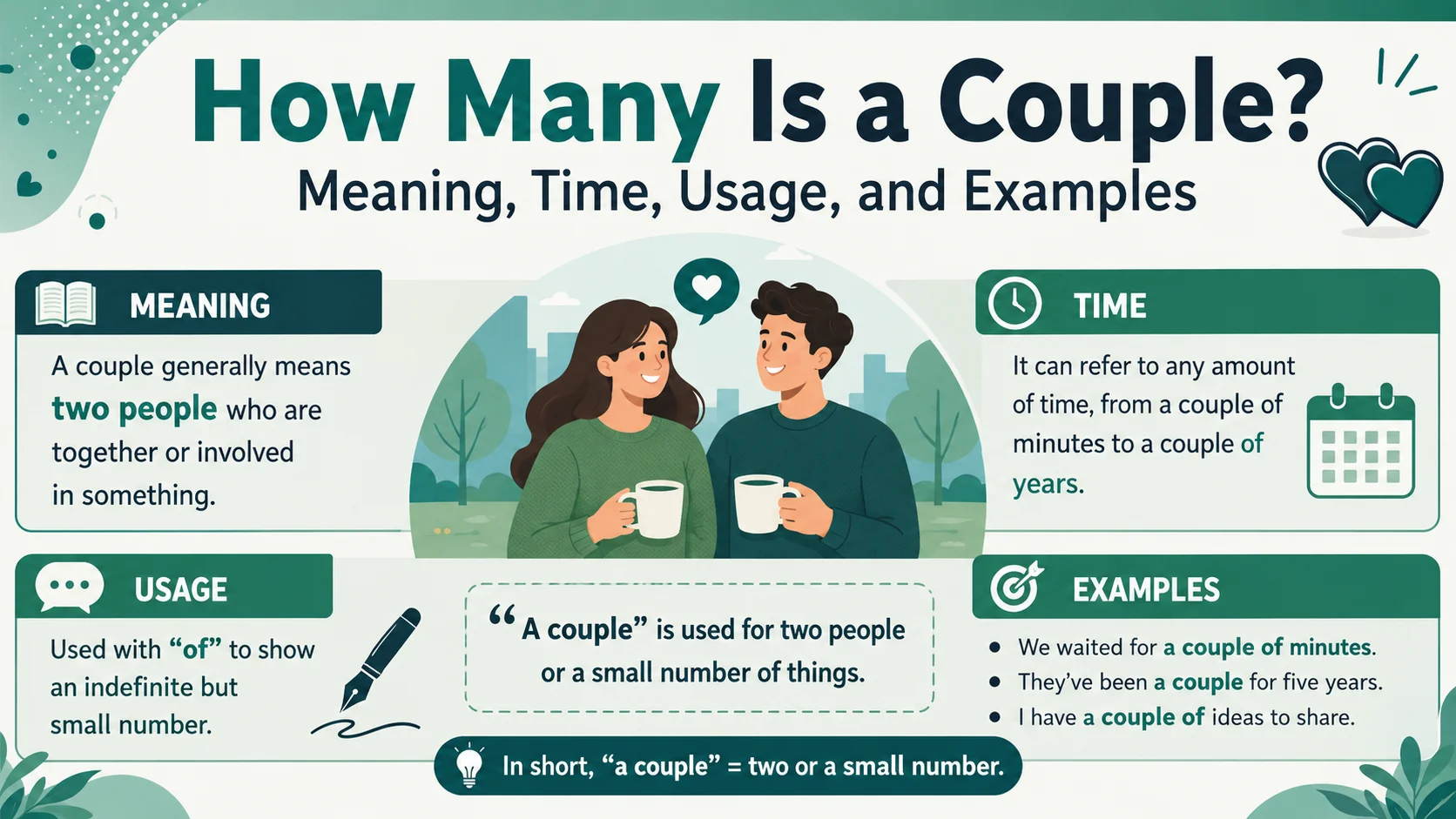
How Many Is a Couple usually means two, especially when referring to two people or two things that are paired together. In traditional dictionary meanings, Merriam-Webster and Oxford describe a couple as two items considered together. However, in casual conversation, the word can have a broader meaning and refer to a small indefinite number. For example, “I need a couple of minutes” commonly means around two minutes, or about 120 seconds, but it doesn’t always mean exactly 120 seconds. This flexible usage can cause confusion because the traditional meaning suggests exactly two, while everyday speech may communicate an approximate amount. In plain English, the safest choice depends on the intended quantity and the level of clarity needed.
The same pattern appears when talking about time. A couple of hours generally suggests two hours, while a couple of days usually means two days. Speakers can also use a couple with weeks, months, and years when they want to give a rough idea rather than state an exact number. For instance, “I’ll arrive in a couple of days” gives a general expectation but doesn’t guarantee that the arrival will happen after precisely two days. This flexible meaning works well in everyday communication, especially when the exact amount isn’t important. However, time-sensitive activities, such as appointments, deadlines, meetings, or deliveries, may require a precise quantity. In those situations, saying “two hours” or “two days” is clearer than using an expression that could create ambiguity.
Context also matters in personal communication and professional communication. If someone asks for a couple of examples, they may expect two, although a small number of examples might also satisfy the request. From my experience explaining plain English, I’ve found that people usually understand “a couple” as close to two when the conversation is informal. Still, when understanding expectations is important, using two gives the listener a definite number and removes uncertainty about the actual number. So, a couple traditionally means two, but its everyday phrase meaning can be flexible when speakers are giving an approximate amount rather than stating a precise quantity.
Quick Answer: How Many Is a Couple?
A couple usually means two, but “a couple of” can also mean a small number or approximately two in everyday English.
For time expressions, the usual interpretation looks like this:
| Expression | Common interpretation | Exactly? |
| a couple of minutes | around two minutes | No |
| a couple of hours | around two hours | No |
| a couple of days | around two days | No |
| a couple of weeks | around two weeks | No |
| a couple of months | around two months | No |
| a couple of years | around two years | No |
| two days | two days | Yes |
| 48 hours | 48 hours | Yes |
So, if you need to communicate an exact duration, use a specific number. If you’re having a casual conversation, a couple works naturally.
Understanding “A Couple” in Everyday English
The clearest meaning of a couple is two people or things considered together. You can see this meaning in phrases such as a married couple, a couple of shoes, or a couple of tickets.
However, English doesn’t always keep a couple inside such a neat numerical box. Dictionaries recognize a second sense in which a couple of means a small or indefinite number. Oxford specifically gives examples such as a couple of minutes, a couple of hours, a couple of days, and a couple of weeks.
Consider these examples:
- They are a couple. → Two people in a relationship.
- I bought a couple of books. → Usually two books.
- Give me a couple of minutes. → Roughly two minutes.
- We stayed for a couple of weeks. → Around two weeks.
- There are a couple of things to discuss. → Two or a small number of things.
The context does a lot of work.
Does “A Couple” Mean Exactly Two?
In its precise sense, yes. A couple is a pair, and a pair contains two members.
But everyday language doesn’t always behave like arithmetic. Merriam-Webster explains that couple commonly means two, while also having a long-established meaning of an indefinite small number.
That broader usage isn’t a recent mistake. Merriam-Webster traces the use of “a couple of” for an indefinite small number back centuries, with examples dating to the 1500s and 1700s.
So this statement is too rigid:
“A couple can only ever mean exactly two.”
A more accurate explanation is:
“A couple normally points to two, while a couple of can also refer to a small, approximate number.”
That distinction reflects how English speakers actually use the expression.
A Couple vs. Two: Is There a Difference?
There can be a significant difference in precision.
Compare:
I need two hours.
with:
I need a couple of hours.
The first statement presents two hours as an exact quantity. The second gives a rough estimate.
That difference becomes important in situations involving schedules, deadlines, contracts, or measurements.
| Phrase | Meaning |
| two hours | Exactly two hours |
| about two hours | Approximately two hours |
| a couple of hours | Usually around two hours |
| a few hours | A small number of hours |
| several hours | More than two in many contexts |
Don’t turn these expressions into rigid mathematical formulas. English speakers use a few and several differently depending on context. Merriam-Webster likewise describes few as an indeterminately small number and several as potentially more than two but fewer than many.
A Couple vs. A Few vs. Several
These three expressions often appear together because all of them describe quantities without giving a precise number.
A couple generally has the strongest connection to two. A few indicates a small number without specifying exactly how many. Several generally suggest more than two, although it still isn’t an exact measurement.
For example:
- I have a couple of questions.
- I have a few questions.
- I have several questions.
The first often suggests two. The second gives a small, unspecified number. The third usually suggests more than two.
There isn’t a universal rule that says:
couple = 2, few = 3, several = 7.
Real English doesn’t work that way.
How Long Is “A Couple of Minutes”?
A couple of minutes usually means around two minutes.
If a friend says:
“Wait a couple of minutes.”
you’ll probably understand the request as a short wait, not as a laboratory measurement of exactly 120 seconds.
The phrase is useful because casual conversations rarely require that level of precision.
For example:
- I’ll call you back in a couple of minutes.
- The food should be ready in a couple of minutes.
- Give me a couple of minutes to finish this.
- The presentation starts in a couple of minutes.
In each case, the speaker gives you a rough timeframe.
If precision matters, however, say:
“Give me exactly two minutes.”
That wording leaves much less room for interpretation.
“A Couple of Hours” Compared With Exact Time
A couple of hours generally means approximately two hours.
Imagine someone says:
“The drive takes a couple of hours.”
You probably won’t interpret that as a guarantee of exactly 120 minutes. Traffic, stops, road conditions, and other factors can easily change the duration.
That’s why the expression works well for estimates.
Everyday examples
The meeting should take a couple of hours.
I’ll finish the assignment in a couple of hours.
We spent a couple of hours at the museum.
The repair could take a couple of hours.
Each sentence communicates a useful estimate without pretending to offer stopwatch-level accuracy.
For a formal report, though, an exact figure is better:
The test lasted 2 hours and 15 minutes.
The difference is simple: “a couple” describes approximately; a number measures precisely.
Interpreting “A Couple of Days”
A couple of days normally suggests around two days, but it doesn’t necessarily mean an exact 48-hour period.
This is one of the most common places where people ask about the meaning of couple. Oxford specifically uses “a couple of days” as an example of the broader meaning of couple as a small number.
Suppose someone says:
“I’ll send the report in a couple of days.”
They’ve given you a general timeframe. They haven’t necessarily promised that the report will arrive exactly 48 hours later.
In travel
“We’re staying for a couple of days.”
This usually suggests a short visit of roughly two days.
At work
“I need a couple of days to finish the project.”
This communicates an estimate rather than a strict deadline.
In everyday conversation
“Give me a couple of days to think about it.”
The speaker wants a short amount of time. They may not have calculated the exact number of hours.
Why context matters
Suppose a manager says:
“Finish the report in a couple of days.”
One employee may interpret that as two days. Another may hear it as two or three days.
Neither interpretation is necessarily absurd because the phrase itself is approximate.
If the deadline matters, a better instruction would be:
“Please finish the report by Thursday at 5 p.m.”
That’s clearer because the date and time remove the ambiguity.
Can “A Couple” Mean Three?
Yes, in informal usage, it can.
This doesn’t mean the core meaning of couple has changed from two. Instead, “a couple of” has developed a broader meaning that can refer to a small number.
Merriam-Webster provides an especially useful observation here. Its evidence shows that “a couple of years ago” has been used for time spans ranging from a little over one year to as many as eight years in actual examples, although the phrase most commonly referred to smaller spans such as three or four years in the examples it examined.
That doesn’t make eight a standard meaning of a couple. It demonstrates something more important: natural language expressions can become flexible when speakers use them approximately.
If you mean exactly three, don’t make the reader guess.
Say:
three days
rather than:
a couple of days
Longer Durations: A Couple of Weeks, Months, and Years
The same pattern continues as the time unit becomes larger.
English speakers commonly say:
- a couple of weeks
- a couple of months
- a couple of years
Oxford lists all of these constructions as ordinary examples of couple meaning a small number.
A Couple of Weeks
A couple of weeks generally means around two weeks.
I’ll be away for a couple of weeks.
The listener will usually understand that the absence is fairly short and close to two weeks.
If you need precision, say:
I’ll be away for 14 days.
Or give the dates:
I’ll be away from September 1 through September 14.
A Couple of Months
A couple of months generally suggests around two months.
The renovation should take a couple of months.
That sentence gives a broad estimate. It doesn’t guarantee exactly 60 days.
For a formal schedule, use a defined timeframe:
The renovation is expected to take eight weeks.
Or provide a completion date.
A Couple of Years
A couple of years usually points toward roughly two years.
She lived in Chicago for a couple of years.
The speaker probably isn’t claiming an exact duration of 730 days. They’re describing a period that was approximately two years.
Merriam-Webster’s usage evidence shows how flexible “a couple of years” can become when speakers use it as an approximate reference to past time.
Is “A Couple” a Formal Unit of Measurement?
No.
A couple isn’t a standardized unit of time.
A second has a defined scientific meaning. A minute, hour, and day also have established relationships to other time units. A couple doesn’t have a fixed conversion.
You can’t create a reliable scientific equation such as:
1 couple = 2.00 time units
The phrase depends on the unit that follows it and on the speaker’s intended level of precision.
For example:
a couple of minutes
means approximately two minutes.
a couple of hours
means approximately two hours.
a couple of years
means approximately two years.
The word remains an informal quantity expression, not a new measurement unit.
“A Couple” in Casual vs. Formal Settings
Context determines whether the expression is useful.
In everyday speech, a couple sounds natural:
“I’ll be there in a couple of minutes.”
In formal writing, it can still be grammatical. However, replacing it with a specific number often makes the message stronger.
| Context | Recommended wording |
| Friendly conversation | a couple of days |
| Casual text | a couple of days |
| General estimate | a couple of days |
| Academic writing | two days |
| Scientific report | 48 hours |
| Contract | two calendar days |
| Fixed deadline | by Thursday at 5 p.m. |
The goal isn’t to eliminate a couple. The goal is to use it where its flexibility won’t cause trouble.
“A Couple of” vs. “A Couple” in American English
There is another usage point worth knowing.
The traditional construction is:
a couple of days
a couple of hours
a couple of books
American English also commonly uses a couple days, a couple hours, and similar forms in informal speech and writing. Oxford labels the form as informal North American English.
So you’ll encounter both:
I’ll be back in a couple of days.
and:
I’ll be back in a couple days.
The first is the safer choice for formal or polished writing.
The second is common in casual American conversation.
Dictionary.com likewise notes that the shortened form occurs especially in informal American speech and with units of measurement such as time.
Grammar: “A Couple of Days Is” or “Are”?
Here’s a subtle point that often trips people up.
When a couple of refers to two separate countable things, a plural verb is normally appropriate:
A couple of students are waiting outside.
But when a couple refers to a single measurement of time, distance, or money, the measurement can take a singular verb because it represents one total amount.
For example:
A couple of days is enough.
A couple of hours is plenty of time.
The Language Portal of Canada specifically explains this distinction, noting that measurements of time, distance, and money can take a singular verb because they represent a total amount.
Compare:
A couple of students are absent.
Here, students refer to separate people.
A couple of days is enough.
Here, days represent one total period.
That difference becomes much easier once you think about whether you’re counting individual things or describing one combined amount.
A Couple vs. A Pair
Couple and pair are close in meaning when they refer to two things.
A pair often emphasizes that two things belong together or form a set:
a pair of shoes
a pair of gloves
A couple can emphasize the idea of two connected people or things:
a couple of friends
a couple of questions
For time, English naturally prefers a couple of:
a couple of hours
You wouldn’t normally replace it with:
a pair of hours
That sounds unnatural.
So although pair and couple overlap in meaning, they don’t always occupy the same grammatical and idiomatic spaces.
When “A Couple” Creates Ambiguity
The real issue with a couple isn’t that the expression is incorrect. It’s that the listener may not know how much flexibility the speaker intends.
Consider these three statements:
I’ll call you in a couple of minutes.
I’ll call you in about two minutes.
I’ll call you at 3:15 p.m.
Each provides more precision than the one before it.
That’s useful when the consequences of misunderstanding increase.
A practical rule
Use a couple when:
- exact numbers aren’t important
- you’re making a rough estimate
- you’re speaking casually
- the listener only needs a general idea
Use an exact number or date when:
- a deadline matters
- money is involved
- a legal obligation is involved
- you’re reporting scientific results
- you’re scheduling an appointment
- someone needs to make a decision based on the timing
A tiny change in wording can prevent a surprisingly large misunderstanding.
How to Clarify “A Couple” in Conversation
If someone says “a couple of days” and the timing matters, there’s nothing wrong with asking for clarification.
Try:
- “Do you mean two days?”
- “About two days?”
- “Do you need it by Wednesday?”
- “Should I plan for two or three days?”
- “What’s the exact deadline?”
These questions turn a vague estimate into useful information.
The same strategy works with any approximate quantity.
Conclusion
A couple traditionally means two, but everyday usage can make it mean a small number or an approximate amount. In casual situations, phrases such as a couple of minutes, a couple of days, or a couple of examples are usually easy to understand from context. However, when clarity, precise quantity, or understanding expectations matters, using two is the better choice.
FAQs
Q1. How many are a couple?
A couple traditionally means two. In casual speech, however, it can sometimes refer to a small indefinite number close to two.
Q2. Does a couple always mean exactly two?
Not always. The traditional meaning is exactly two, but everyday usage can make “a couple” mean around two or a small number.
Q3. How long is a couple of minutes?
A couple of minutes usually means around two minutes, or about 120 seconds. It doesn’t necessarily mean exactly 120 seconds.
Q4. Does a couple of days mean two days?
Usually, yes. A couple of days generally means two days, although casual speakers may use it to describe a period close to two days.
Q5. Should I use “two” instead of “a couple”?
Use two when you need an exact number or greater clarity, especially in professional communication, deadlines, appointments, and other precise situations.
About the Author