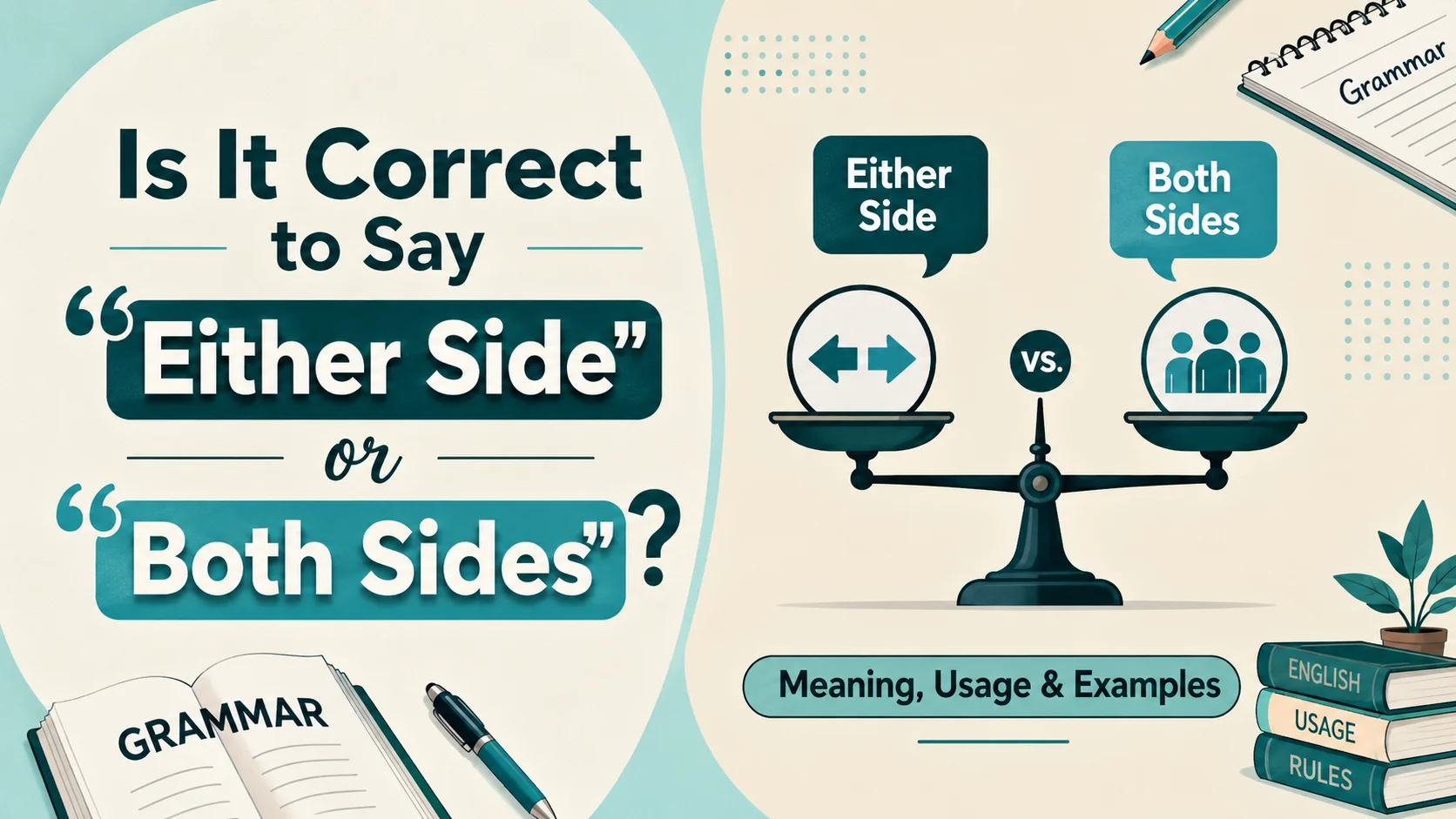
“Either Side” or “Both Sides” may look similar, but their meaning changes depending on whether you mean one choice or both options together. When learning American English, these expressions can cause confusion because they look almost identical. The key grammatical detail is the distinction between a single choice and two things considered together. Either side usually gives you a choice between two alternatives, while both sides include two sides together. This becomes easier to understand when you connect the expressions with real situations. For example, either side can describe physical locations, such as roads where you can sit on one side or the other. It gives you a choice, while both sides clearly include both locations.
Use either side when you’re choosing between two alternatives and only one option is involved at a time. For example, people can park on either side of a street, meaning they can choose one side but not both at the same time. The phrase can also refer to possible positions, places, or options. By contrast, both sides mean both are included together. This expression works well when two groups are being considered, especially in arguments or negotiations. If two sides were occupied, you would use both sides rather than either side. The difference becomes clearer when you ask whether you’re choosing between them or describing something that affects everyone or everything on the two sides.
These phrases can sometimes trip you up because English is packed with similar forms and subtle distinctions. You may find yourself scratching your head or getting tangled in the nuances of conversation and written text, particularly when you’re paused mid-sentence and unsure which expression to use. The rule is actually straightforward: either side refers to one out of two options, while both sides refer to both together. Either side suggests a choice, whereas both sides suggest something involving or affecting both. Once you understand this distinction, you can apply it naturally in a sentence. When referring to a park, street, physical location, or two viewpoints, consider the sentence’s intent before you decide which phrase fits best.
Quick Answer: “Either Side” or “Both Sides”?
Both “either side” and “both sides” are grammatically correct. The right expression depends on the meaning you want to convey.
Use “either side” when you mean one side or the other. You can also use it in certain constructions to mean each of two sides.
Use “both sides” when you specifically mean the two sides together.
| Expression | Meaning | Example |
| Either side | One side or the other; sometimes each of two sides | You can sit on either side of the table. |
| Both sides | The two sides together | Both sides agreed to the plan. |
Here’s an easy way to remember it:
- Either = one of two possibilities
- Both the two together
- Neither = not one and not the other
So, if someone says “Choose either side,” you choose one. If someone says “Consider both sides,” you consider the two sides.
What Does “Either Side” Mean?
The expression “either side” contains the word either, which can express more than one idea.
Most commonly, either refers to one of two choices or possibilities. It doesn’t identify which one because either option remains available.
For example:
- You can sit on either side of me.
- Either side can make the first move.
- You can enter through either side.
- Choose either side of the path.
- Either side may present its argument.
In each sentence, the speaker considers two possibilities.
Suppose a friend tells you, “You can sit on either side of me.” You have two possible positions. The speaker isn’t necessarily saying you should sit on both sides.
That’s the usual alternative meaning of either.
However, English has another important use. In expressions such as “on either side of the road,” the phrase can refer to each of the two sides.
For example:
Trees lined either side of the road.
Here, the natural interpretation is that trees lined the left side and the right side.
That doesn’t make either incorrect. It reflects another established use of the word.
Examples of “Either Side” in a Sentence
Consider these examples:
- You may choose either side.
- There are shops on either side of the street.
- She had a friend on either side of her.
- The entrance is accessible from either side.
- Either side can request a review.
The surrounding context determines the intended meaning.
In “You may choose either side,” either presents two alternatives.
In “There are shops on either side of the street,” it describes corresponding locations on the two sides.
That’s why you shouldn’t judge the meaning of either from the word alone.
What Does “Both Sides” Mean?
The meaning of both is more straightforward.
Both refers to two people, things, groups, or sides considered together.
For example:
- Both sides agreed to the proposal.
- Both sides of the road were crowded.
- Both sides presented strong arguments.
- Both sides of the paper contain information.
- Both sides benefited from the agreement.
In each case, the speaker includes the two sides.
Consider this sentence:
Both sides signed the agreement.
This tells you that the two parties signed it.
Now compare:
Either side can sign the agreement.
That sentence gives each party the possibility of signing. It doesn’t state that both parties actually signed.
That difference may seem tiny, but it can completely change the meaning.
Examples of “Both Sides” in a Sentence
Here are several natural examples:
- Both sides of the road need repairs.
- The mediator listened to both sides.
- Both sides accepted the final offer.
- The building has windows on both sides.
- Both sides of the argument deserve attention.
Notice the consistent idea: both include the pair.
When you want to make that inclusion unmistakable, both sides are usually the clearest choice.
Either Side vs. Both Sides: The Key Difference
The easiest distinction is choice versus inclusion.
Either side often presents two alternatives.
Both sides explicitly include the two sides.
| Point of comparison | Either side | Both sides |
| Basic idea | One or the other | The two together |
| Main function | Choice or distribution | Inclusion |
| Noun | Singular: side | Plural: sides |
| Common example | Choose either side. | Consider both sides. |
| Can you describe physical locations? | Yes | Yes |
| Can you describe two opposing groups? | Yes | Yes |
| Usually emphasizes both together? | No | Yes |
Consider these two sentences:
You can stand on either side.
People stood on both sides.
The first sentence gives you two possible locations.
The second sentence tells you that people occupied the two locations.
Here’s another comparison:
Either side may respond.
This means one side or the other may respond.
Both sides responded.
This means the two sides responded.
The grammatical difference is simple. The semantic difference is substantial.
When Are “Either Side” and “Both Sides” Interchangeable?
Sometimes, these expressions describe the same situation.
The clearest examples involve physical locations.
Compare:
Trees grew on either side of the road.
Trees grew on both sides of the road.
Both sentences can describe trees growing along the left and right sides of a road.
So, are they identical?
Not quite.
Either side can treat the two sides individually or as corresponding alternatives. Both sides explicitly state that the two sides are included.
This distinction becomes clearer when you change the verb.
Example 1: Choice
You can park on either side of the road.
This suggests that parking on one side or the other is possible.
Example 2: Existing situation
Cars were parked on both sides of the road.
This clearly says cars occupied the two sides.
Example 3: Descriptive construction
Tall trees stood on either side of the road.
This naturally describes trees standing along the two sides.
In physical descriptions, either side can therefore overlap with both sides.
Cases Where You Should Use “Both Sides”
Choose both sides when the two sides must clearly be included.
For example:
- Both sides signed the contract.
- Both sides accepted the decision.
- Both sides presented evidence.
- Both sides suffered financial losses.
- Both sides agreed to negotiate.
These sentences describe actions or conditions involving two parties.
Using either could make the meaning uncertain.
Cases Where “Either Side” Works Better
Use either side when the sentence involves alternatives.
For example:
- You can choose either side.
- Either side can withdraw from the discussion.
- You can enter from either side.
- Either side may request additional information.
- You may sit on either side of the table.
Here, the expression leaves two possibilities open.
Either, Neither, and Both: Understanding the Three-Way Contrast
A useful way to master either side and both sides is to compare either, neither, and both.
These three words create a simple logical pattern.
- Either = one of two
- Neither = not one and not the other
- Both = the two together
Imagine that two restaurants are available.
Either restaurant is fine.
You can choose Restaurant A or Restaurant B.
Neither restaurant is open.
Restaurant A isn’t open. Restaurant B isn’t open either.
Both restaurants are open.
Restaurant A and Restaurant B are open.
This pattern works with sides as well.
Either side is acceptable.
One of the two sides is acceptable.
Neither side is acceptable.
Neither option works.
Both sides are acceptable.
The two sides are acceptable.
Once you see the relationship, the grammar becomes much less mysterious.
Either vs. Both
Compare:
Either answer is correct.
This allows one of two answers.
Both answers are correct.
This says the two answers are correct.
The first sentence offers alternatives. The second confirms inclusion.
Either vs. Neither
These two often work as opposites.
Either option will work.
Neither option will work.
The first leaves two possibilities open. The second rejects both.
That makes either especially useful when you’re discussing decisions, alternatives, or choices.
Grammar Rules for “Either” and “Both”
The meaning matters, but grammar matters too.
When either directly modifies a singular countable noun, the noun normally remains singular.
Correct:
- either side
- either option
- either answer
- either road
- either choice
Incorrect:
- either sides
- either options
- either answers
- either roads
For example:
Either side is acceptable.
Here, side is singular.
With both, the noun is plural:
- both sides
- both options
- both answers
- both roads
- both choices
For example:
Both sides are acceptable.
The noun sides is plural, so the verb is plural as well.
“Either Side Is” vs. “Both Sides Are”
This is one of the most common grammar points to remember.
Either side is available.
Both sides are available.
Why?
Because either side is grammatically singular when it functions as the subject.
Both sides is grammatically plural.
So:
- Either side is
- Both sides are
Not:
- Either side are
- Both sides is
This small distinction can make your writing sound much more polished.
Common Mistakes With “Either Side” and “Both Sides”
Even experienced English learners sometimes mix these expressions.
Mistake 1: Using “Either Sides”
A common error looks like this:
There are trees on either sides of the road.
That’s incorrect.
Use:
There are trees on either side of the road.
Or:
There are trees on both sides of the road.
The expression on either side uses the singular noun side.
Mistake 2: Thinking “Either” Always Means One
This rule is useful but incomplete.
Consider:
Choose either road.
Here, either means one road or the other.
Now consider:
Houses stood on either side of the road.
Here, either side commonly refers to each of the two sides.
Context changes the interpretation.
Mistake 3: Using “Either” When You Mean “Both”
Suppose you’re discussing a disagreement.
The journalist interviewed either side of the dispute.
This may suggest that the journalist interviewed one side or the other.
If the journalist interviewed the two opposing groups, write:
The journalist interviewed both sides of the dispute.
That’s much clearer.
Mistake 4: Using “Both” for a Choice
Suppose someone asks you to choose one of two seats.
You can choose either side.
That’s appropriate.
But:
You can choose both sides.
Now you’ve changed the instruction. It suggests selecting both.
The wrong word can turn a simple choice into an entirely different instruction.
Conclusion
Understanding “Either Side” or “Both Sides” becomes much easier once you focus on the intended meaning. Use either side when you’re talking about one option out of two, especially when a choice is involved. Use both sides when you mean the two options, locations, or groups together. This simple distinction can help you avoid confusion and choose the right phrase with confidence in everyday American English.
FAQs
Q1. What does “either side” mean?
Either side means one of two possible sides or options. It usually suggests that you have a choice.
Q2. What does “both sides” mean?
Both sides means the two sides are included or considered together.
Q3. Is “either side” singular or plural?
Either refers to one of two options, so it normally takes a singular noun, such as “either side.”
Q4. Can I use “either side” for two locations?
Yes. You can use either side when referring to one of two possible physical locations.
Q5. Can “both sides” describe people?
Yes. Both sides can describe two groups of people, especially in arguments, discussions, or negotiations.
Q6. Does “either side” mean both sides?
No. Either side generally means one side or the other, while both sides means the two sides together.
Q7. Which phrase shows a choice?
Either side usually shows a choice between two alternatives.
Q8. Which phrase includes two sides together?
Both sides indicate that the two sides are included together.
Q9. Is “either side of the street” correct?
Yes. “You can park on either side of the street” means you can choose one of the two sides.
Q10. How can I remember the difference?
Remember this simple rule: either = one of two, while both = the two together. This makes the distinction much easier to apply.
About the Author