
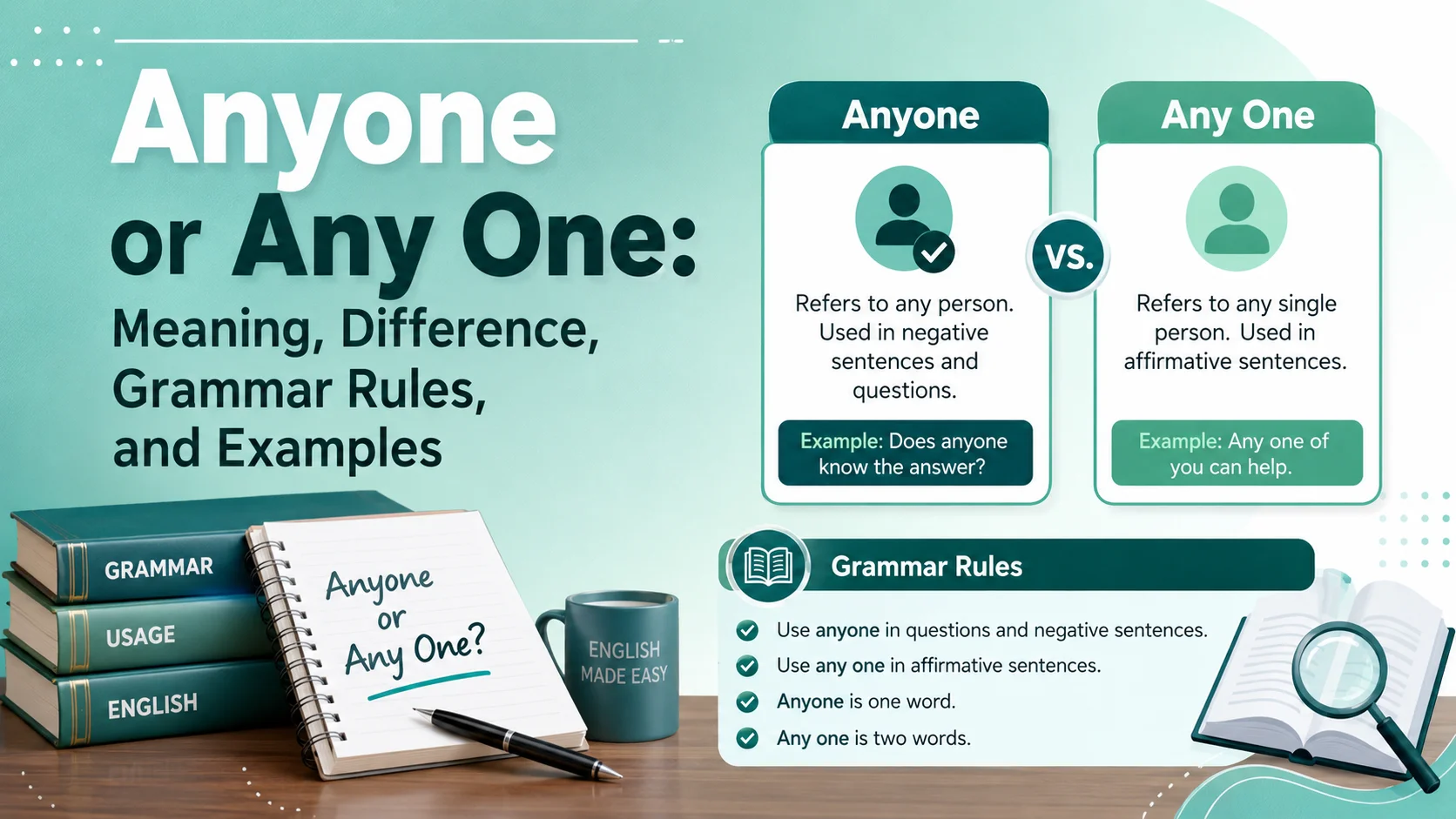
Anyone or Any One can look almost the same, but the meaning changes with the space. Anyone means any person or any person at all, while any one points to one person or thing from a particular group.
When you’re asking about people generally, anyone is the natural choice. For example, “Can anyone answer this question?” doesn’t focus on a person’s identity. The person may be unknown, and who responds isn’t important. This use is common in everyday English communication, especially in writing and speaking.
By contrast, any one highlights a single member, individual, or item from a group, set, or collection. For example, “Choose any one of these books” means you can select one single book from the offered collection. Understanding this distinction makes correct usage easier and helps you avoid commonly confused words in different contexts.
Quick Answer: Anyone or Any One?
Use anyone as one word when you mean any person.
Anyone can learn a new language.
Use any one as two words when you mean one person or thing from a group.
Any one of these books would be useful.
A quick test can help. If you can replace anyone with anybody, the one-word form is usually correct.
Can anyone help me?
Can anybody help me?
Both sentences have the same basic meaning.
For any one, think one from a group.
Choose any one of these three options.
Here, one represents a single option within a group.
| Form | Meaning | Example |
| Anyone | Any person | Anyone can apply. |
| Any one | One person or thing from a group | Any one of these options will work. |
The key isn’t the position of the words. It’s what the sentence is trying to say.
What Does “Anyone” Mean?
Anyone is an indefinite pronoun. It refers to an unspecified person or to any person in a particular situation.
For example:
Anyone can make a mistake.
The sentence doesn’t identify a particular person. It makes a general statement about people.
Other examples include:
- Anyone can join the discussion.
- Did anyone call earlier?
- I don’t know anyone here.
- Anyone with experience can apply.
- If anyone asks, give them this message.
In each example, anyone refers to a person.
Anyone Means “Any Person”
A useful way to remember anyone is to replace it mentally with any person.
Anyone can enter.
becomes:
Any person can enter.
The meaning remains clear.
That substitution doesn’t work with any one when the sentence refers to an individual member of a group.
Any one of these computers will work.
Here, one means one computer. The word anyone would incorrectly suggest a person.
Anyone in Questions
Anyone appears frequently in questions because questions often ask whether a person exists, is available, or has done something.
Examples include:
- Does anyone know the answer?
- Has anyone seen my phone?
- Did anyone call the office?
- Can anyone help me?
- Is anyone waiting outside?
Notice how the identity of the person isn’t important. The speaker simply wants to know whether any person fits the situation.
Anyone in Negative Sentences
You can also use anyone in negative sentences.
I didn’t tell anyone about the meeting.
Here, anyone means any person.
More examples:
- She hasn’t contacted anyone yet.
- We didn’t see anyone at the station.
- He doesn’t trust anyone easily.
- They never asked anyone for advice.
The negative meaning comes from words such as didn’t, hasn’t, doesn’t, and never. Anyone itself doesn’t mean “no person.”
What Does “Any One” Mean?
Any one contains two separate words: any + one.
In this construction, one represents a single member of a group.
Consider:
Choose any one of these desserts.
The sentence doesn’t mean “choose any person.” It means choose one dessert from the available desserts.
That distinction is the heart of the entire topic.
Any One Can Refer to People
Although anyone already refers to people, any one can also refer to people when the sentence focuses on a specific group.
Compare:
Anyone can answer the question.
This means any person is allowed to answer.
Now:
Any one of the students can answer the question.
This means one student from the particular group can answer.
The second sentence has a narrower focus.
Any One Can Refer to Things
This is another major difference.
Anyone refers to people. Any one can refer to people or things.
Examples:
- Any one of these chairs will work.
- Any one of these phones would be suitable.
- Any one of the three routes could get you there.
- Any one of these answers might be correct.
- Any one of the machines can perform the task.
The word one acts as a stand-in for the singular noun.
Anyone vs. Any One: The Main Difference
The clearest distinction is this:
Anyone = any person.
Any one = one person or thing from a group.
Think about a classroom. A teacher might say:
Anyone can answer the question.
The teacher is inviting any student to respond.
Now imagine the teacher points toward five students and says:
Any one of these students can answer the question.
The focus has changed. The teacher is referring to one student within a particular group.
| Anyone | Any One |
| One word | Two words |
| Means any person | Means one from a group |
| Refers to people | Can refer to people or things |
| Often replaceable with anybody | Often replaceable with any single one |
| Anyone can participate. | Any one of them can participate. |
This difference may seem small, but it can prevent awkward or incorrect sentences.
When to Use “Anyone”
“Anyone” is used to refer to any person without naming a specific individual, especially in questions, negatives, and general statements.
Use Anyone for Any Person
Use anyone when the identity of the person doesn’t matter.
Anyone can learn this skill.
Anyone with a valid ticket may enter.
Anyone interested in the position should apply.
The sentence remains broad because it doesn’t select one person from a defined group.
Use Anyone in Questions
Questions naturally use anyone when you’re asking about an unspecified person.
Does anyone have a pen?
Did anyone see what happened?
Can anyone explain this rule?
Has anyone finished the assignment?
These sentences could usually use anybody instead.
Does anybody have a pen?
The meaning remains essentially unchanged.
Use Anyone in Conditional Statements
Conditional sentences commonly use anyone.
If anyone calls, please take a message.
If anyone needs help, contact the support team.
If anyone asks about the schedule, show them the updated version.
The speaker isn’t choosing one specific person. The condition applies to any person who fits the situation.
When to Use “Any One”
“Any one” is used when you mean a single person or thing from a group, without specifying which one.
Use Any One for a Single Choice
When you want someone to select one item from several choices, use any one.
Choose any one of these colors.
Pick any one of the available seats.
Select any one of the three plans.
The word one makes the singular selection clear.
Use “Any One of” for a Group
The construction any one of + plural noun is especially common.
Examples include:
- Any one of the students could answer.
- Any one of these books would help.
- Any one of the candidates could win.
- Any one of these routes will work.
- Any one of the three answers may be correct.
The plural noun identifies the group. The word one identifies a single member.
Use Any One for Objects
If you’re talking about objects rather than people, any one is often the correct choice.
Any one of these laptops can handle the software.
Any one of these keys can open the cabinet.
Any one of these recipes would work.
Writing anyone in these sentences would create a different meaning because anyone normally refers to a person.
Why “Anyone of” Is Usually Incorrect
One of the most common errors is writing anyone of when the intended meaning is one from a group.
Incorrect:
❌ Anyone of these answers could be correct.
Correct:
✅ Any one of these answers could be correct.
Why does the second version work?
Because one represents a single answer from the larger group.
The same applies to people:
❌ Anyone of the players could win.
✅ Any one of the players could win.
However, don’t assume that every occurrence of anyone followed by of is automatically wrong. Context matters.
For example:
Anyone of importance should attend the meeting.
Here, of importance describes the people being discussed. The sentence doesn’t mean “one from a group.”
The important question is always: Does “one” represent a single member of a group?
If yes, write any one.
The “Anybody” Test
When you’re unsure about anyone or any one, try replacing the word with anybody.
For example:
Anyone can attend.
Replace anyone:
Anybody can attend.
The sentence still works naturally. Therefore, anyone is correct.
Try:
Any one of these chairs will work.
Replacing it with anybody produces:
❌ Anybody of these chairs will work.
That doesn’t make sense.
The test isn’t perfect in every unusual sentence, but it’s an excellent quick check for ordinary writing.
The “One From a Group” Test
The second test is even more direct.
Ask yourself:
Am I talking about one member or item from a particular group?
If yes, use any one.
Any one of the employees could answer the question.
There is a group of employees. One member of that group could answer.
Any one of these cars would be reliable.
There is a group of cars. One car could be selected.
You can often replace any one with any single one.
Any one of these options will work.
Any single one of these options will work.
If the meaning stays essentially the same, any one is probably the right choice.
Common Mistakes With Anyone and Any One
The most common mistakes with “anyone” and “any one” happen when writers confuse a general person with a specific individual from a group.
Writing “Any One” When You Mean “Any Person”
Incorrect:
❌ Any one can apply for the job.
Correct:
✅ Anyone can apply for the job.
The sentence refers to people generally.
Writing “Anyone” When You Mean One From a Group
Incorrect:
❌ Anyone of these products is suitable.
Correct:
✅ Any one of these products is suitable.
The sentence selects one product from a group.
Assuming Any One Refers Only to People
It doesn’t.
Any one of these computers will work.
Any one of these methods could solve the problem.
Any one of these restaurants would be a good choice.
The form works with both people and things.
Assuming the Forms Are Interchangeable
They aren’t.
Compare:
Anyone can enter the building.
with:
Any one of these doors can be opened.
The first refers to people. The second refers to one door from a group.
Anyone or Any One in Real-Life Writing
Understanding this difference becomes easier when you see how naturally it appears in practical situations.
Workplace Example
A manager might write:
Anyone with relevant experience can apply for the position.
This means any person who meets the requirement can apply.
After receiving applications, the manager might say:
Any one of the shortlisted candidates could be selected.
Now there is a specific group of candidates.
Classroom Example
A teacher might say:
Anyone can volunteer to answer the question.
Later, after several students volunteer:
Any one of these students can explain the answer.
The first sentence refers broadly to people. The second selects from a defined group.
Product Example
A store might advertise:
Anyone can purchase this product.
A customer choosing between models might say:
Any one of these models would suit my needs.
The context determines the correct form.
Anyone or Any One: A Practical Decision Guide
When the correct form doesn’t immediately jump out, use this checklist.
Ask: Do I mean “any person”?
If yes, write anyone.
Anyone can participate.
Ask: Do I mean “one from a group”?
If yes, write any one.
Any one of these participants can speak.
Try “anybody”
If anybody fits naturally, anyone is usually correct.
Did anyone call?
Did anybody call?
Try “any single one”
If that substitution works, any one is likely correct.
Any one of these answers could be right.
Any single one of these answers could be right.
Look at the meaning of “one”
If one represents an individual member of a group, keep it separate.
Any one of the three candidates could win.
Practice: Anyone or Any One?
Choose the correct form.
- _____ can learn this skill.
- Choose _____ of these three options.
- Did _____ call while I was away?
- _____ of these answers could be correct.
- I don’t know _____ at the event.
- _____ of the students could lead the project.
- If _____ asks, give them this message.
- You can select _____ of these files.
- Can _____ help me?
- _____ can make a mistake.
Answers
- Anyone — any person can learn it.
- Any one — one option is being selected.
- Anyone — the question concerns any person.
- Any one — one answer from a group is meant.
- Anyone — the sentence refers to any person.
- Any one — one student from a defined group is meant.
- Anyone — the sentence refers to any possible person.
- Any one — one file from a group is selected.
- Anyone — anybody would also work.
- Anyone — the statement applies to people generally.
Key Facts About Anyone and Any One
- Anyone is one word.
- Any one contains two words.
- Anyone means any person.
- Any one means one person or thing from a group.
- Anyone commonly works on questions and negative statements.
- Any one commonly appears in any one of + plural nouns.
- Anyone can usually be replaced with anybody.
- Any one can often be replaced with any single one.
- The two forms usually sound alike when spoken.
- The distinction becomes visible and important in writing.
- Any one can refer to people or objects.
- Anyone normally refers to people.
Conclusion
Understanding Anyone or Any One becomes easier when you focus on the meaning. Use anyone when you mean any person at all, especially when the person’s identity isn’t important. Use any one when you mean one person, thing, or individual from a particular group or collection. Remembering this simple distinction can help you choose the correct form in both writing and speaking.
FAQs
Q1. What is the difference between anyone and any one?
Anyone means any person at all, while any one means one person or thing from a particular group or set.
Q2. Is anyone one word?
Yes. Anyone is one word when it means any person without identifying a specific individual.
Q3. When should I use any one?
Use any one when you’re referring to a single person or thing from a group. For example, “You can choose any one of these options.”
Q4. Can anyone and any one be used interchangeably?
No. Although they sound similar, their meanings are different. Anyone refers generally to people, while any one identifies a single member of a group or set.
Q5. Which is correct: anyone or any one?
Both are correct, but the right choice depends on the meaning. Choose anyone for any person and any one for one particular person or thing from a group.
About the Author