
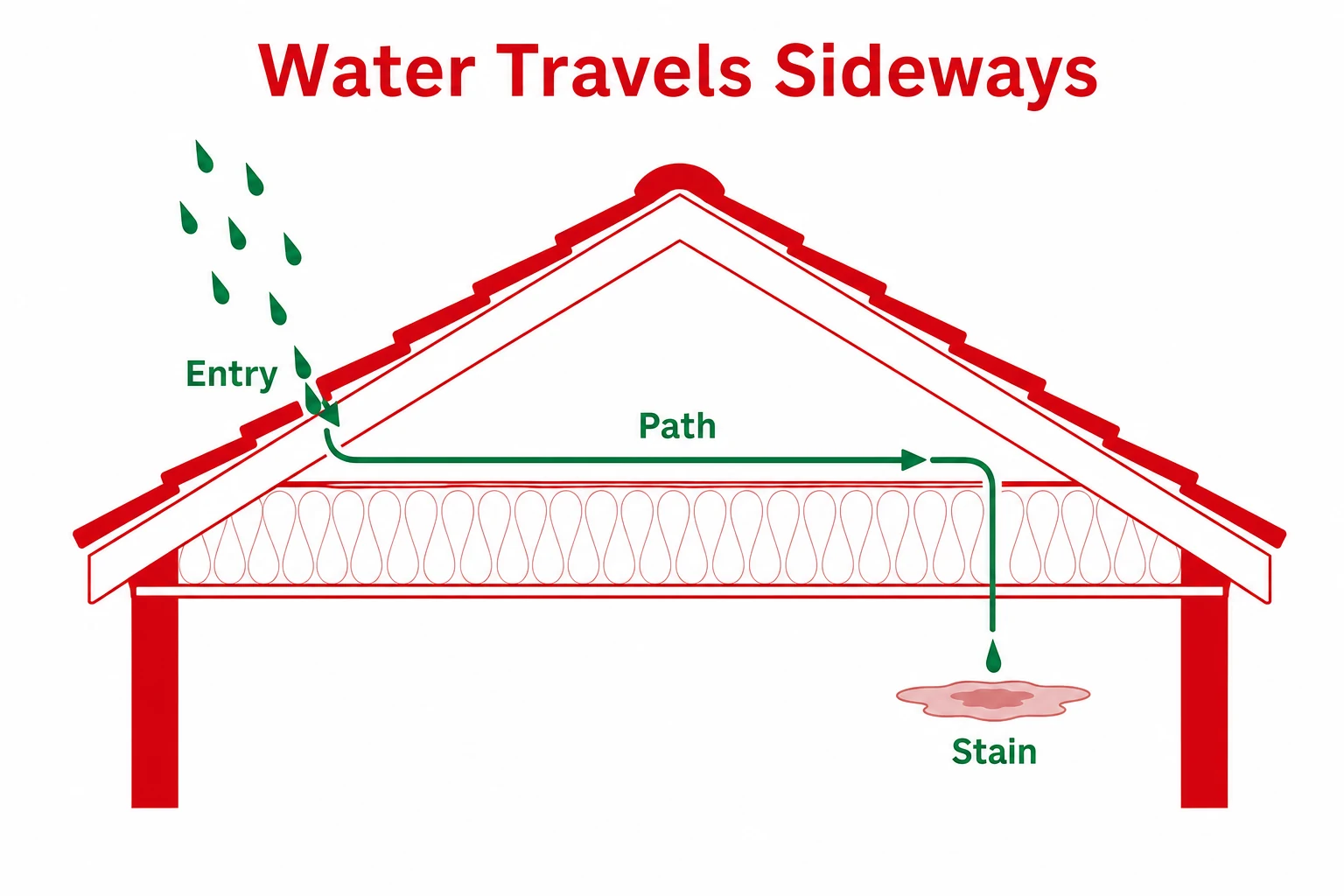
The first sign is often a faint brown ring on the ceiling. A homeowner puts a bucket underneath it, then looks up at the roof directly above the stain. There is nothing obvious: no missing shingle, no fallen branch, and no visible hole. The temptation is to assume the water must be coming through somewhere just above the wet patch.
But roof repair is rarely as simple as matching a ceiling stain to the same spot outdoors. Water follows slopes, seams, nails, and building materials before it finally becomes visible indoors. Homeowners considering Homey Roofing and Restoration may find it more useful to understand that journey than to guess which shingle needs replacing.
The path of a leak provides clues about its source. Reading those clues carefully can prevent repeat repairs, unnecessary work, and damage to ceilings or insulation that remains wet long after a storm ends.
Water Does Not Always Fall Straight Down
Imagine rain entering through a narrow opening beside a plumbing vent. It reaches the underside of the roof deck, then runs along the wood until it meets a rafter. From there, it may follow the framing toward a lower point. Only after reaching a gap or fastener does it drip onto the ceiling below.
The wet patch might appear several feet away from the opening. Roof slope and the direction of the framing can change that distance. Insulation may absorb some moisture first, delaying any visible sign in the living space.
This is why fixing an apparent problem directly above a stain can fail. The visible damage marks where water collected or escaped, not necessarily where it entered the building.
Flashing Can Be the Starting Point
Most broad roof surfaces are relatively straightforward: overlapping materials are arranged to shed water downward. The more complicated places are where the roof meets something else.
Chimneys and Sidewalls
A chimney interrupts the roof covering and requires several flashing details to keep water moving away from its edges. Similarly, a wall that rises alongside a sloped roof needs flashing integrated with the shingles and wall finish. If a connection opens or has been installed incorrectly, water may pass behind materials that look sound from the outside.
On the interior, the leak may show up around a window or at a ceiling corner rather than near the chimney itself. That apparent mismatch can lead to repeated patching in the wrong place.
Plumbing Vents and Skylights
Vent boots can crack or lose their seal around pipes. Skylights have perimeter flashing that must work with the roof covering. Neither opening should automatically be blamed for a nearby stain, but both deserve consideration when the water path leads toward them.
A careful roof repair investigation checks these transitions before assuming that the open field of shingles has failed.
A Ceiling Stain May Be Old Evidence
Not every discolored patch is an active leak. A previous water intrusion event may leave a mark even after the source has been fixed. Conversely, fresh moisture can enter a concealed cavity without immediately changing the ceiling’s appearance.
A homeowner can record when a mark first appears and whether it changes following rainfall. Taking photographs from the same safe indoor position can make changes easier to compare. Moisture meters used by trained inspectors may help locate damp materials, though readings need interpretation because building materials and conditions vary.
Paint over the stain only after the cause has been addressed and the affected area has dried. Otherwise, a neat finish can hide an ongoing problem without protecting the insulation and framing behind it.
Rain Direction Can Reveal More Than Rainfall Amount
Some leaks develop only during storms with strong wind. Rain that normally drains over a shingle or flashing edge may be pushed sideways or upward against a vulnerable joint. A gentle shower may not reproduce the same conditions.
Other problems appear after prolonged rainfall because water accumulates in a valley or finds a path through a slowly draining area. A leak that starts during snowmelt may involve yet another set of conditions.
Instead of reporting only that the ceiling leaked, note whether it happened during wind-driven rain, after many hours of precipitation, or as snow was melting. That history may help a professional narrow down likely entry points.
For a homeowner discussing recurring water intrusion with Homey Roofing and Restoration, those observations can be more useful than pointing to the stain alone. The inspection still needs physical evidence, but a clear timeline helps guide it.
Sometimes the Roof Is Not the Source at All
A stain below the attic does not prove that outdoor rain entered through the roof. Condensation can form when warm, humid indoor air reaches cold surfaces. A bathroom exhaust duct that terminates in the attic may add moisture to the space, especially when ventilation and air sealing are poor.
A leaking plumbing line or an air-conditioning condensate problem can create similar marks. The timing matters: a stain that grows when a bathroom is used, for example, deserves a different investigation from one that appears only after storms.
What the Attic Can Tell an Inspector
An inspection may reveal damp insulation, water tracks on wood, a disconnected vent duct, or a small opening around a penetration. A single wet board is not always enough to pinpoint the source. Water can travel across several surfaces, and stains may remain after materials dry.
Homeowners should not walk on exposed attic framing or reach near wet wiring. If attic access is awkward or the ceiling is sagging, leave the area to qualified professionals. Water near electrical fixtures or signs of structural distress requires prompt attention.
Why Repeated Patching Often Disappoints
A repair can stop one visible drip and still leave the underlying entry point untouched. Someone may apply sealant to a joint that appears suspicious, then assume the problem is solved because the next rainfall is light. Weeks later, a heavier storm produces the same stain.
Another common issue is treating sealant as the primary waterproofing method where properly integrated flashing is needed. Sealants can deteriorate and may not withstand the movement or water exposure of a poorly detailed connection.
Good roof repair starts with identifying the failed component and understanding why it failed. That may mean correcting a vent boot, rebuilding a flashing transition, replacing damaged shingles, or addressing an attic moisture problem rather than touching the roof covering at all.
The scope should match the finding. Homey Roofing and Restoration is one provider homeowners can evaluate, but the essential question for any professional is whether the proposed work actually interrupts the water’s entry route.
How to Prepare for a More Useful Inspection
Before an appointment, make a short record of the problem. Note the location of the stain, when it first appeared, the weather at the time, and whether it seems to spread. If it is safe, photograph the ceiling and any visible exterior concern from ground level. Keep records of previous repairs and what happened afterward.
During the inspection, ask the professional to explain the suspected entry point and the evidence linking it to the interior damage. Photos of flashing, penetrations, or deteriorated materials can make that explanation clearer. Ask whether wet insulation or other interior components also need attention.
Avoid climbing onto a wet roof or opening ceiling cavities yourself. Finding the source should not create a fall hazard or expose you to electrical risks.
Fix the Path, Not Just the Patch
A water stain identifies the place where a problem became visible. It does not draw a straight line to the opening in the roof. Understanding how water moves along decking, framing, and building connections helps explain why leaks can be so difficult to trace.
Successful roof repair addresses the entry point, checks for affected materials, and confirms that the proposed solution fits the evidence. When comparing an assessment from Homey Roofing and Restoration with other options, homeowners should look for that reasoning rather than a repair based solely on the location of the stain. The best outcome is not simply a dry-looking ceiling after the next shower, but a clearly identified problem that has been properly corrected.
About the Author