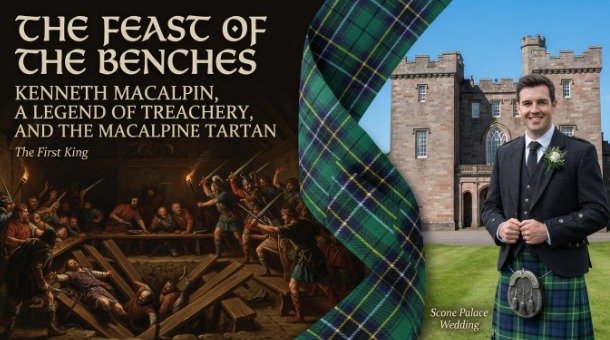
The story of the MacAlpine tartan begins with one of the oldest legends in Scottish history. Around the year 843 the Picts, who had ruled the north and east of Scotland for as long as anyone could remember, had been badly beaten by the Vikings and were weak. Kenneth, son of Alpin, king of the Scots of Dalriada in the west, saw his chance. He invited the Pictish nobility to a great feast to make peace between the two peoples.
The Picts came. They ate and drank. They sat on benches that had been set, on Kenneth’s orders, over pits dug in the floor of the hall, with the boards held in place by pins. At a signal, the pins were drawn. The benches collapsed, the Pictish lords fell into the pits, and the Scots killed them where they lay. With their leaders gone, the Pictish kingdom fell to Kenneth, who united it with his own and became the first King of Scots.
None of this is true. The tale first appears in the writings of Giraldus Cambrensis, a Welsh cleric of the twelfth century who had a low opinion of Scots, three hundred years after the event, and modern historians treat it as a fable. But it is one of the oldest and most persistent stories in Scottish history, and it is about a real man.
The first king
Cináed mac Ailpín, Kenneth son of Alpin, existed. He ruled the Picts from about 843 until his death in 858, and he is the first king from whom every later King of Scots, and every British monarch since, has claimed descent. How he came to rule is genuinely obscure. The Picts had been crippled by Viking attacks. Kenneth’s family may have had Pictish blood through marriage. There may have been a war. There may have been something like a takeover from within. The feast of the benches is what later ages invented to fill the gap, and it says more about the twelfth century than the ninth.
What Kenneth did once he was king is better attested. He moved the relics of St Columba from Iona, which the Vikings were raiding, to a new church at Dunkeld, on the Tay. He established his seat at Forteviot and his sacred centre at Scone, and it was at Scone that Scottish kings were made for the next five hundred years, seated on a block of stone. He died in 858 and was buried on Iona with the kings before him.
The chroniclers of the Middle Ages, who liked a clean beginning, made him the founder of the nation. So did the clans. A whole group of Highland families, the MacGregors, Grants, MacKinnons, MacNabs, MacQuarries, MacAulays and MacFies, claimed descent from him and called themselves Siol Alpin, the seed of Alpin. The MacGregors’ motto, ‘S rioghal mo dhream, royal is my race, means exactly that. And a small, scattered family called MacAlpine claimed the name itself.
A tartan for a name without a clan
Here the tartan archives are unusually blunt. The Siol Alpin, they say, quoting the great scholar D. C. Stewart, “belongs rather to mythology than to history.” The history of Clan MacAlpine, they add, is obscure. There was never a MacAlpine chief on record, never a MacAlpine castle, never a MacAlpine glen. There were only people with the name, mostly in Perthshire and Argyll, who believed they were the eldest branch of the oldest royal line in Europe and had nothing to prove it with but the name.
They got a tartan all the same, and it is a fine one. It was first published in W. & A. K. Johnston’s collection of 1906 and in Frank Adam’s great book on the clans in 1908. It is a green tartan of the hunting type, close to the Hunting MacLean, with broad bands of dark blue and black and fine lines of white and yellow. The archives note one unusual thing about it: the sett is asymmetric, repeating across the cloth without mirroring, which is rare among clan tartans and which the old society’s drawings got wrong.
Retailers offer MacAlpine tartan made to order as kilts, skirts, sashes, scarves and ties, or by the yard, in Modern and Ancient colours. It is a dark, dignified cloth, and it does not look like the tartan of a family that would drop its guests into a pit. Perhaps that is the point.
Scone Palace, a Saturday in April
Scone Palace, outside Perth, stands on the site of the old abbey where Kenneth’s successors were crowned, beside the Moot Hill where the Stone of Destiny sat until Edward I took it south in 1296. It is a private house, the seat of the Earls of Mansfield, and it takes weddings.
Rory MacAlpine is thirty-two, a civil engineer from Perth, and he is getting married there at three o’clock. He chose Scone, he says, for the obvious reason. If your name is MacAlpine and there is a place two miles from your house where the first King of Scots set up shop, you get married there.
The kilt was straightforward: the family tartan, eight yards, made to his measurements. The difficulty, as it is for most grooms, was the jacket. Highland dress has two, and a great many men get married in the wrong one.
The Prince Charlie is the evening jacket. It is short, black, cut away at the front to a point, with satin lapels and silver buttons, and it is worn over a low-cut three-button waistcoat with a wing-collar shirt and a bow tie. It is the Highland equivalent of a dinner jacket, and like a dinner jacket it is meant for after six. Worn at a three o’clock ceremony it looks, to anyone who knows, like a man who put on black tie for lunch.
The Argyll is the day jacket. It is longer, cut straight, with gauntlet cuffs and a plain or lightly decorated front, worn over a five-button waistcoat with an ordinary collar and a long tie. It is right for a daytime wedding, a christening, a graduation, and it will pass in the evening at all but the most formal dinners. It is the most versatile jacket in Highland dress, and the one most men should own first.
Rory found both, and the rest, at Scottish Kilt, whose jackets for kilts are described as the Argyll for daytime and weddings and the Prince Charlie for black-tie evening, each with its matching waistcoat, and offered alongside Irish styles, the Kilkenny and the Brian Boru, and a tweed vest for the country. He read that twice, thought about a wedding at three in the afternoon in April with the reception running into the night, and ordered the Argyll in charcoal, with the five-button waistcoat. Charcoal rather than black, because black against the dark green MacAlpine was a lot of darkness, and charcoal let the tartan breathe. He asked for antique silver buttons to match his sporran cantle and kilt pin. He also, on advice, ordered a plain black bow tie to keep in his sporran, since an Argyll worn with a bow tie after the meal will pass for evening dress at all but the stiffest of dinners, and nobody at Scone was going to check.
On the day, in the long gallery at Scone, with the Moot Hill through the windows, he stands in the green and blue of a family that may never have existed, under a charcoal jacket that is exactly right for the hour, and waits for his bride.
His best man, who is a MacGregor and therefore, by the old reckoning, a cousin, straightens his tie.
“Royal is my race,” says the best man.
“Don’t start.”
“I’m just saying. Kenneth. The pit. We’re the seed of Alpin, you and me. Your lot got the name, we got the motto.”
“Kenneth never dug a pit,” says Rory. “That was a Welshman three hundred years later who didn’t like us.”
“You’ve been reading.”
“I’m getting married two miles from the Stone of Destiny in a tartan called MacAlpine. Of course I’ve been reading. Is my collar straight?”
What the name carries
Kenneth MacAlpin was a real king who did something real, and the thing that is remembered about him is a lie told by an enemy three centuries later. That is the way of early history. The clans who took his name knew almost nothing about him and did not care; the name was the point. It said royal, and it said first.
The MacAlpine tartan is a quiet green cloth with a doubtful pedigree and an honest archive entry, and it looks very well on a groom at Scone in the right jacket. Whether or not the family goes back to the first King of Scots, it has been getting married in his front garden for a thousand years, and that is a claim of a kind.
About the Author