
During the first year of a baby’s life, few milestones are as meticulously tracked as their physical growth. From the very first weigh-in at the hospital to routine monthly checkups, parents are frequently presented with growth charts mapping their infant’s development. While it is thrilling to see those numbers climb, interpreting the jagged lines and statistical percentiles can often feel overwhelming. In today’s digital age, many families rely on trusted platforms like Genesis Parent Portal to centralize newborn checklists, feeding logs, and developmental guides. However, truly understanding your baby’s physical trajectory requires a foundational knowledge of how pediatricians use weight-for-length curves and growth percentiles during those critical early months.
Why Infants Are Measured Differently
When evaluating the physical development of older children, doctors use the standard Body Mass Index (BMI). However, for infants from birth up to 24 months, pediatricians utilize a different metric entirely: weight-for-length. Because babies cannot stand independently, they are measured lying down (length) rather than standing up (height).
More importantly, infant growth is exceptionally rapid and non-linear. A baby might experience a massive surge in weight during a cluster-feeding phase, followed by a sudden stretch in length a few weeks later. Measuring weight in strict relation to length provides a much more accurate picture of a baby’s overall nutritional status and physical proportions than evaluating weight based solely on their age.
The Gold Standard: WHO Growth Charts
For infants and toddlers up to two years of age, pediatric health authorities, including the World Health Organization (WHO), recommend using the WHO growth standards rather than CDC charts. The WHO charts were developed using data from healthy, breastfed infants across multiple continents, establishing a physiological baseline for optimal human growth.
These charts map several key indicators:
- Weight-for-age: How much a baby weighs compared to other babies of the exact same age.
- Length-for-age: How long a baby is compared to peers of the same age.
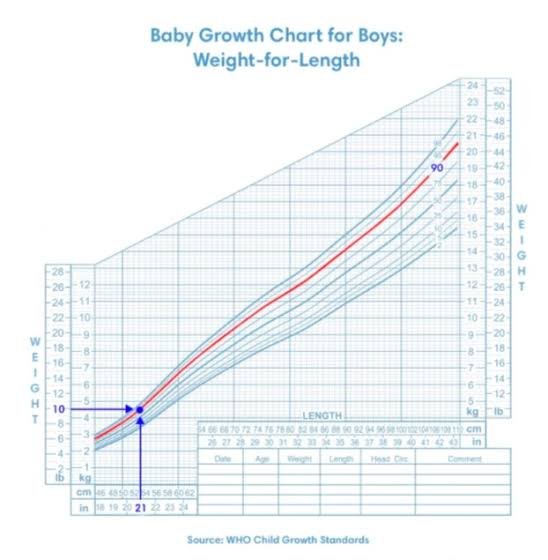
- Weight-for-length: How a baby’s weight corresponds to their specific body length, which is the most critical indicator of proportionate growth.
- Head circumference: To monitor healthy brain development.
Making Sense of Percentiles
When a pediatrician tells you that your infant is in the 60th percentile for weight-for-length, it means that out of 100 babies of the same length and sex, your baby weighs more than 60 of them and less than 40 of them.
A common misconception is that higher percentiles are “better” and lower percentiles represent a failure to thrive. In reality, a baby in the 15th percentile can be just as healthy as a baby in the 85th percentile. Pediatricians are rarely concerned with a single plot point on a graph. Instead, they are looking for a consistent trend. If a baby establishes a pattern along the 25th percentile and stays there, they are growing perfectly along their own genetic curve. A clinical concern usually only arises if a baby drastically drops across two or more major percentile lines (for example, falling from the 75th down to the 25th percentile) within a short timeframe.
Tracking Proportions at Home
Between scheduled wellness visits, it is completely normal for parents to wonder if their baby is gaining adequate weight, especially during nursing transitions, formula adjustments, or the introduction of solid foods.
While you should always rely on your pediatrician’s clinical scale for official records, parents can monitor interim trends at home. By gently measuring your baby’s length and weighing them on an infant scale, you can use a specialized baby BMI calculator to determine their current percentile. Checking these metrics occasionally can offer peace of mind and help you identify if a sudden change in feeding habits has meaningfully impacted their growth curve.
Focusing on the Big Picture
Growth charts are simply one tool in a pediatrician’s diagnostic toolkit. They do not measure a baby’s disposition, milestone acquisition, or overall vitality. A healthy baby is generally active, produces plenty of wet diapers, and follows their own unique developmental timeline. By understanding how weight-for-length percentiles work, parents can approach wellness visits with confidence, treating the numbers as a helpful guide rather than a definitive grade on their child’s health.
About the Author