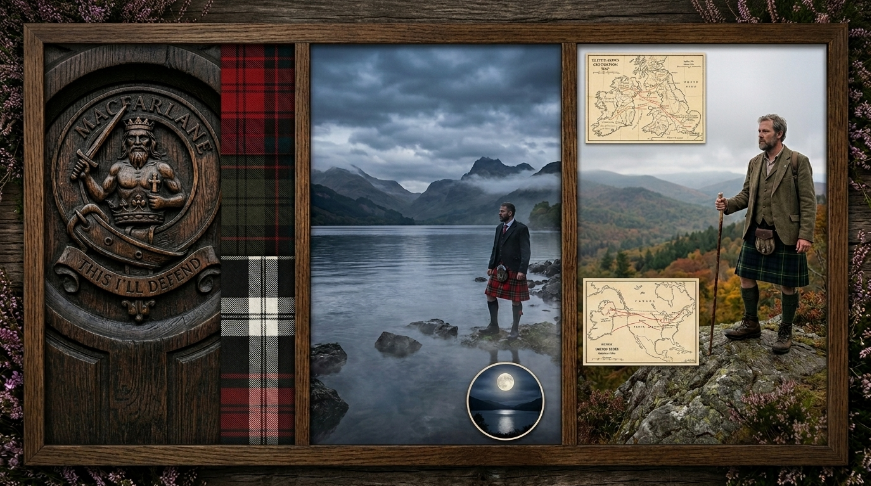
Every clan has a story; few have a nickname for the moon. For centuries across the Highlands, a full moon over Loch Lomond was known as “MacFarlane’s Lantern” — because when it rose, the MacFarlanes rode out, and somebody’s cattle changed ownership before dawn. It’s the rare piece of folklore that summarises an entire clan: fierce, nocturnal, unapologetically untamed, holding some of the most beautiful and most strategically awkward land in Scotland and defending it with a motto that says exactly one thing: This I’ll Defend.
Here is the full story of the clan, its striking red tartan, the suppression that scattered the name worldwide — and what a modern MacFarlane (or Macfarlan, or McFarland, or Millar) inherits with it.
Arrochar: a kingdom of mountains and narrows
The MacFarlane heartland is instantly recognisable to anyone who has driven Scotland’s west: Arrochar, at the head of Loch Long, and the western shore of Loch Lomond, beneath the jagged profile of Ben Arthur — the Cobbler. The clan descends from the ancient Earls of Lennox: the traditional line runs from Gilchrist, brother of a thirteenth-century earl, whose great-grandson Bartholomew — in Gaelic, Parlan — gave the family its name: MacPharlain, sons of Parlan. Few clan names have so clean an origin: one ancestor, one patronymic, seven centuries of it.
The land explains the reputation. Arrochar sits astride the narrow passes between the Lowlands and the western Highlands — country made for ambush, retreat, and the swift movement of other people’s livestock. The MacFarlanes became masters of exactly that economy. Cattle raiding was the Highland world’s rough sport and rougher business, and the clan practised it with such moonlit enthusiasm that the lantern nickname entered the language. They were, in the fullest sense, a fighting clan: their gathering cry, “Loch Sloy!,” named the small dark loch in their hills, and their pipers carried a war tune whose title translates, with magnificent honesty, as a promise to lift the cattle.
Loyal, dangerous, and eventually outlawed
For all the raiding, the MacFarlanes fought on the record’s grand stages. They stood in the national wars and paid heavily — a chief and many clansmen fell in the great battles of the sixteenth century — and they fought with distinction at Langside in 1568 against Mary, Queen of Scots, where tradition credits their ferocity with helping carry the day; the clan’s crest, a demi-savage brandishing a sword and pointing to a crown, is traditionally linked to that royal service.
But the same energies ran ungovernable at home. Feuds — most bitterly with the neighbouring Colquhouns — raids, and reprisals accumulated until the state ran out of patience. In the early seventeenth century the MacFarlanes were caught in the era’s harsh clan-suppression policies: legal pursuit, forfeitures, and — as with their fellow “unruly” neighbours — periods when bearing the name itself invited persecution. Families scattered, and many quietly took protective aliases; among the names tradition and the clan itself associate with dispersed MacFarlanes are MacFarland, McFarlin, MacPharlain, Parlane, MacNair, Weir, Miller/Millar, and others — which is why the modern sept list is long and why so many families with no obvious “Mac” discover a Loch Lomond ancestry underneath.
The chiefly line held Arrochar into the eighteenth century — producing, in a splendid reversal, Walter MacFarlane of that Ilk, one of Scotland’s greatest antiquarian scholars, whose manuscript collections remain foundational for Scottish genealogy — before debt forced the sale of the ancestral lands in 1784. The clan went chiefless for over two centuries, its people dispersing to Ireland, America, Canada, and beyond, until the line was formally re-established in modern times and a recognised chief restored — a rebirth the clan’s international societies had worked toward for generations.
The tartan: red as a warning
The MacFarlane tartan is one of the register’s boldest statements: a strong red ground crossed by deep blue-and-green bands, sharpened with fine white and yellow lines — high-contrast, unmistakable, and entirely in character for a clan that never once opted for camouflage. It’s among the more recognisable red setts in Highland dress, and it anchors a proper family of variants: the Hunting MacFarlane, on muted greens and blues for those who want the connection at conversational volume; the Black & White (mourning) sett, one of the most distinctive monochrome tartans recorded anywhere and a favourite of modern wearers precisely because almost nothing else looks like it; and ancient and weathered colourways that soften the red toward brick and rust for daily wear.
That spread makes MacFarlane an unusually wearable clan: the red for weddings, games, and the moments that deserve a lantern of their own; the hunting and monochrome setts for tailoring, skirts, scarves, and interiors. Few clans hand their descendants both a shout and a whisper.
Are you connected?
The front-door names are easy: MacFarlane, Macfarlane, McFarlane, McFarland, MacFarlan, McFarlin, Parlane and kindred spellings — the name consistently ranks among the more common Scottish surnames across the diaspora, with the McFarland form especially thick in Ulster and America, legacy of seventeenth-century dispersal through Ireland. The side doors matter just as much: the alias names above (Millar/Miller, MacNair, Weir, Griesck, MacCondy and more appear in the recognised lists) mean a Loch Lomond connection can hide under a thoroughly Lowland-sounding surname. The clan’s modern societies — active across North America, the UK, and Australasia — maintain the definitive sept rolls and run serious DNA projects that have already reconnected scattered alias-lines to the parent stem; for anyone with these names and a research itch, it’s one of the better-organised genealogical communities in the clan world.
For the pilgrimage: Arrochar and the Cobbler, the Loch Lomond western shore, the island strongholds the clan once kept on the loch, and Loch Sloy itself — the war cry you can stand beside.
Wearing the lantern today
Modern clan life runs on gatherings, games, weddings, and the quiet daily signals — and the MacFarlane setts serve all of it. The full red kilt is as commanding as Highland dress gets; the hunting and black-and-white variants slide into contemporary wardrobes without ceremony; and the pattern family extends across everything from sashes to ties to throws. Specialist weavers keep all of it accessible — a Highland-wear house like Scottish Kilt Shop produces the MacFarlane setts to order across kilts, skirts, and accessories, which means a clan society dinner or a family wedding can put the whole line back under the lantern without anyone raiding so much as a fabric store.
The lantern goes abroad: Ulster, Appalachia, and the scattered clan
What suppression started, economics finished — and the result is that the MacFarlane story’s second half happens mostly outside Scotland. The seventeenth-century dispersal pushed families across the North Channel into Ulster, where the McFarland spelling took root so firmly that it now outnumbers the parent form in much of the world; from there, the great eighteenth-century Ulster-Scots migrations carried the name into Pennsylvania and down the wagon roads into the Appalachian backcountry, where McFarlands settled the valleys of Virginia, the Carolinas, and Tennessee in numbers that place the name deep in the founding stock of the American upland South. Canada drew its own share — Ontario and the Maritimes fill with the name through the nineteenth century — and Australia and New Zealand completed the map.
Two features make the MacFarlane diaspora unusual to research. First, the alias problem cuts both ways: some emigrant lines left under cover-names (the Millers, Weirs, and MacNairs of the sept lists) and only rediscovered the connection through modern records and DNA — meaning the clan’s true global footprint exceeds even the surname counts. Second, the clan’s two-century interregnum without a chief meant the diaspora didn’t just preserve the identity; it ran it. The international clan societies — organising gatherings, maintaining the sept rolls, funding the genealogical and DNA projects — were the institution during the chiefless years, and the eventual restoration of the line owed much to that scattered persistence. It’s a fitting inversion: a clan once outlawed at home was kept alive by the descendants of the people the outlawing scattered.
For researchers, the practical route mirrors the history — search all spellings, expect an Ulster chapter in American lines, test the male line against the clan DNA project, and treat any Miller or Weir in the tree near Loch Lomond dates as a lead rather than a coincidence.
What the name carries
Seven centuries on, the MacFarlane inheritance distils to three artifacts: a mountain — the Cobbler standing over land the clan defended past all prudence; a motto — the five most economical words in Scottish heraldry, This I’ll Defend; and a moon — the only clan in Scotland whose name attached itself to something in the sky. Plenty of families inherit castles. Not many inherit a lantern that rises, free of charge, thirteen times a year, everywhere on earth their descendants ended up. When it does, you know what it used to mean — and whose it still is. Seven centuries of MacFarlanes have looked up at the same lantern from Arrochar to Appalachia; wearing the red sett under it is simply the family answering back.