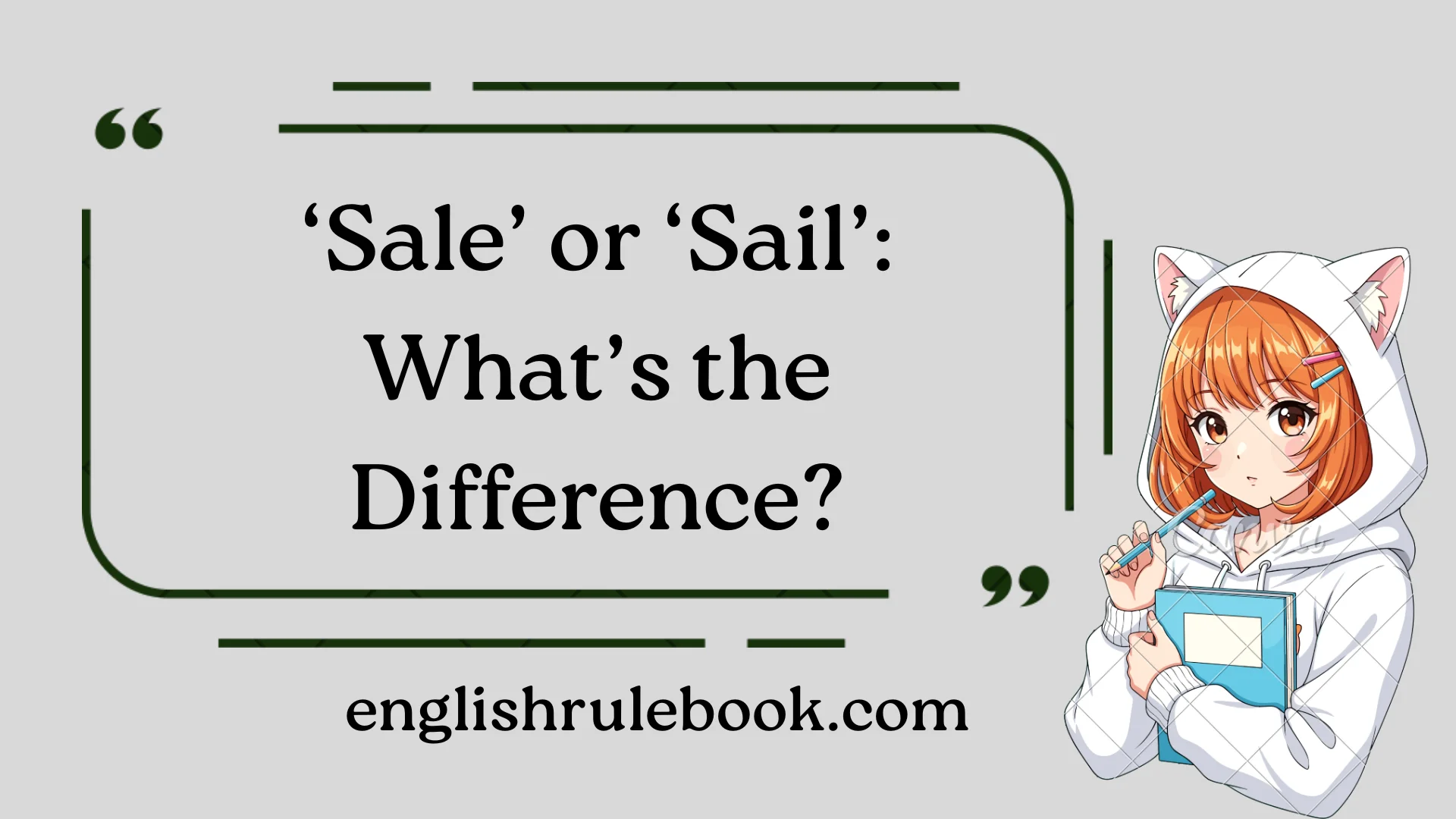
If you’re learning ‘Sale’ or ‘Sail’: What’s the Difference?, knowing these English words is important. They sound exactly the same because they are homophones with identical pronunciation, but their spelling, meanings, and uses are completely different. This guide offers simple, friendly, and practical explanations with examples, grammar, and real-life usage to help beginners, writers, and fluent speakers avoid a common mistake and maintain a professional tone.
To understand the difference, focus on the context. A sale connects to shopping, commerce, buying, selling, sales, stores, items, prices, discounts, products, services, money, and transactions. A sail, on the other hand, belongs to boats, ships, water, wind, sea, lake, oceans, travel, adventure, and movement. Many people pause, start wondering, and become confused when a sentence could describe a deal or a sailing journey. Choosing the correct word keeps your ideas accurate, natural, and free from unnecessary confusion.
From my own writing experience, I have seen how the wrong word can change an entire message. A strong memory system, regular practice, and avoiding errors help build confidence over time. Lets break the fog around these classic words and follow the paths that diverge into different stories. Even if you have felt alone, stopped mid-sentence, or spent time thinking about what, why, how, when, where, and which word to use, the good news is that your understanding improves with every attempt. In the end, this small choice can turn a messy note into a clear masterpiece and make your writing far more meaningful and confident.
Quick Answer: Sale vs. Sail
If you want the fast answer, here it is:
| Word | Meaning | Example |
| Sale | Selling products or discounted shopping | The shoes are on sale. |
| Sail | A boat’s fabric or traveling by water | We sail every summer. |
The easiest way to remember it
- Sale = shopping or selling
- Sail = boats, wind, and water
Think of it this way:
Sale helps you save money. Sail helps boats move.
Simple. Yet powerful.
What Does “Sale” Mean?
The word sale relates to selling something. Most often, you’ll see it connected to shopping, business transactions, or discounts.
In grammar, sale is primarily a noun. It names an event, process, or exchange.
Definition of Sale
Sale means:
- The exchange of goods or services for money
- A special event where items sell at discounted prices
People use this word daily in retail, real estate, e-commerce, and finance.
For example:
- The house is for sale.
- The company completed the sale last month.
- Everything is half price during the winter sale.
Notice something important here: sale never refers to boats or water.
Common Uses of “Sale”
The word appears in two major situations.
Sale as a Transaction
Sometimes, sale refers to the act of selling something.
Examples:
- The sale of the company took months.
- Their home sale closed last week.
- The business reported strong sales this quarter.
Here, the focus sits on an exchange of ownership.
For example, if someone sells a car for $10,000, that transaction becomes a sale.
Sale as a Discount Event
This is the meaning most people know.
Retail stores constantly advertise:
- Holiday sales
- Flash sales
- Clearance sales
- Black Friday sales
- End-of-season sales
Examples:
- The electronics store is having a huge sale.
- We bought furniture during a weekend sale.
- That jacket went on sale yesterday.
A quick distinction matters here:
“On sale” can mean either:
- Available to buy
- Available at a discount
Context tells you which meaning applies.
Example:
The laptop is on sale for $699.
That sentence suggests a discount.
Common Phrases With “Sale”
You’ll see sale in many everyday expressions.
| Phrase | Meaning |
| For sale | Available to purchase |
| On sale | Being sold or discounted |
| Final sale | Cannot be returned |
| Garage sale | Secondhand household sale |
| Clearance sale | Discounted leftover stock |
Examples in sentences:
- Their old house is for sale.
- The boots are finally on sale.
- Be careful. It’s a final sale item.
Grammar Note: Is Sale a Noun or Verb?
Here’s a rule many people forget:
Sale is almost always a noun.
Incorrect:
❌ They want to sale the house.
Correct:
✅ They want to sell the house.
This mistake happens because sale and sell look related.
Think of it this way:
| Word | Part of Speech |
| Sale | Noun |
| Sell | Verb |
You make a sale, but you sell something.
That tiny difference matters.
What Does “Sail” Mean?
Now let’s switch from shopping malls to oceans.
The word sail connects to boats, ships, water travel, and wind.
Unlike sale, sail works as both a noun and a verb.
Definition of Sail
Sail can mean:
- A piece of fabric attached to a boat that catches wind
- The act of traveling by boat
Examples:
- The boat’s sail ripped.
- We love to sail on weekends.
One word. Two uses.
Sail as a Noun
When used as a noun, sail refers to the large fabric structure on a boat.
Boats use sails to catch wind and move across water.
Example sentences:
- The captain repaired the damaged sail.
- Strong winds filled the sail.
- The boat lowered its sail before docking.
Historically, sails changed transportation forever.
Before engines existed, ships crossed oceans entirely through wind power. Ancient civilizations depended on sails for trade, exploration, and survival.
Without sails, global commerce would have looked very different.
Sail as a Verb
As a verb, sail means moving across water in a boat.
Examples:
- We sail every summer.
- They sailed across the Atlantic.
- He learned to sail at age ten.
You can also use sail figuratively.
Example:
She sailed through the exam.
In this sentence, sail means moving through something smoothly and easily.
Common Phrases With “Sail”
English uses many expressions built around sailing.
| Phrase | Meaning |
| Set sail | Begin a voyage |
| Smooth sailing | Easy progress |
| Sail away | Leave by boat |
| Sail through | Finish something easily |
Examples:
- They set sail at sunrise.
- After the rough start, it was smooth sailing.
- He sailed through the interview.
These idioms appear frequently in everyday speech.
Sale vs. Sail: Side-by-Side Comparison
Sometimes the fastest way to understand a confusing word pair is through comparison.
Here’s a simple breakdown.
| Feature | Sale | Sail |
| Meaning | Selling or discounts | Boating or wind movement |
| Category | Shopping/business | Water travel |
| Part of Speech | Noun | Noun and verb |
| Associated Words | Store, money, retail | Boat, sea, wind |
| Example | The dress is on sale. | We sail every July. |
The Key Difference
The difference comes down to context.
Ask yourself:
Am I talking about buying or selling?
If yes, choose sale.
Am I talking about boats, wind, or water?
If yes, choose sail.
That quick question solves the confusion almost every time.
Why Do People Confuse Sale and Sail?
Here’s the real reason:
They sound identical.
Linguists call words like this homophones.
What Are Homophones?
Homophones are words that:
- Sound the same
- Have different spellings
- Mean different things
Examples include:
| Word Pair | Meaning Difference |
| There / Their | Place vs ownership |
| To / Too | Direction vs excess |
| Flour / Flower | Baking ingredient vs plant |
| Sale / Sail | Shopping vs boats |
Because sale and sail share the same pronunciation—/seɪl/—many writers accidentally switch them.
Common Mistakes People Make
Let’s look at mistakes that happen often.
Incorrect:
❌ The store has a huge sail.
Correct:
✅ The store has a huge sale.
Incorrect:
❌ We went on a sale around the lake.
Correct:
✅ We went on a sail around the lake.
Incorrect:
❌ Their yacht lowered its sale.
Correct:
✅ Their yacht lowered its sail.
One misplaced letter completely changes the meaning.
How to Remember the Difference Between Sale and Sail
Memory tricks work because they create quick mental shortcuts.
Here are the best ones.
Sale = Savings
Both words start with “Sa.”
When you think of sale, picture:
- Discounts
- Coupons
- Shopping bags
- Saving money
Example reminder:
A sale saves cash.
Easy to remember.
Sail = Sea
Notice the shared “S” sound.
When you see sail, think:
- Sea
- Ship
- Sailing
- Storms
Visualize a sailboat moving across the ocean.
That image sticks.
Quick Mnemonic
Try this:
Sale means spending. Sail means sea travel.
Simple memory tools often work best.
Examples of Sale and Sail in Sentences
Sometimes repetition builds confidence.
Here are practical examples.
Sentences Using “Sale”
- The furniture sale ends Friday.
- Their house went up for sale.
- We found great deals during the summer sale.
- The online sale attracted thousands of buyers.
- She bought shoes that were on sale.
Sentences Using “Sail”
- We plan to sail across the bay.
- The wind pushed the sail forward.
- They learned how to sail during vacation.
- The captain adjusted the sail.
- We watched boats sail into the harbor.
Compare the Difference
Look closely.
Sale example:
The jacket is on sale.
This sentence talks about shopping.
Sail example:
We sail every weekend.
This sentence talks about boating.
Same sound. Totally different meaning.
Real-Life Case Study: One Letter Can Change Everything
A small spelling mistake can confuse readers fast.
Imagine a local business posting this message online:
“Massive furniture sail this weekend!”
People might laugh. Others may think it’s a typo. Some could even question the company’s professionalism.
Now compare:
“Massive furniture sale this weekend!”
Clear. Professional. Easy to understand.
That tiny spelling choice changes credibility.
This matters even more in:
- Marketing
- Business writing
- Academic work
- Professional emails
- Product listings
Words shape trust.
Common Expressions Using “Sale”
Here are phrases you’ll encounter often.
For Sale
Means available to purchase.
Example:
- The building is for sale.
On Sale
Means discounted or available to buy.
Example:
- These shoes are on sale.
Final Sale
Means returns are not allowed.
Example:
- Jewelry marked final sale cannot be refunded.
Clearance Sale
A store reduces prices to remove old inventory.
Example:
- The store held a major clearance sale.
Common Expressions Using “Sail”
Set Sail
Means begin a journey by boat.
Example:
- The crew set sail at dawn.
Smooth Sailing
Means things are going well.
Example:
- After fixing the software issue, it was smooth sailing.
Sail Through
Means completing something easily.
Example:
- She sailed through the exam.
These expressions appear frequently in books, movies, and conversation.
Sale or Sail Quiz
Ready to test yourself?
Choose the correct word.
Question One
The clothing store is having a huge _____.
Answer:
✅ Sale
Question Two
They hope to _____ around the island tomorrow.
Answer:
✅ Sail
Question Three
The boat’s _____ ripped in strong winds.
Answer:
✅ Sail
Question Four
The house is officially _____.
Answer:
✅ For sale
Question Five
We watched ships _____ into the harbor.
Answer:
✅ Sail
If you got them right, you already understand the difference.
Common Homophones Similar to Sale and Sail
English contains many confusing word pairs.
Here are a few worth knowing.
There, Their, and They’re
| Word | Meaning |
| There | A place |
| Their | Possession |
| They’re | They are |
Example:
- Put the bags over there.
- That is their car.
- They’re coming soon.
To, Too, and Two
| Word | Meaning |
| To | Direction |
| Too | Also |
| Two | Number |
Example:
- I’m going to the store.
- I want ice cream too.
- She bought two books.
Brake and Break
| Word | Meaning |
| Brake | Stops movement |
| Break | Damage or pause |
Allowed and Aloud
| Word | Meaning |
| Allowed | Permitted |
| Aloud | Spoken out loud |
Learning these patterns makes English easier.
Read More: Is It Correct to Say, “You Are Very Welcome”?
Why Correct Word Choice Matters
Some people think spelling mistakes don’t matter much.
In reality, they shape how others see your writing.
Correct usage helps you:
- Sound more professional
- Avoid misunderstandings
- Build trust
- Improve clarity
- Write with confidence
Even one letter changes meaning.
Think about these examples:
“Everything is on sail.”
vs.
“Everything is on sale.”
One sounds polished. The other sounds accidental.
Small details matter.
FAQs
Is it “sale” or “sail” at a store?
The correct word is sale.
Example:
The bookstore is having a weekend sale.
Is it “sale” or “sail” on a boat?
The correct word is sail.
Example:
The wind filled the sail.
Why do sale and sail sound the same?
Because they are homophones.
English contains many words with identical pronunciation but different spellings and meanings.
Can sail be used as a verb?
Yes.
Example:
We sail every summer.
Is sale a verb?
No.
Sale is a noun.
The verb form is sell.
Example:
- Correct: We sell books.
- Incorrect: We sale books.
What is the easiest way to remember the difference?
Use this shortcut:
Sale = savings
Sail = sea
It works surprisingly well.
Conclusion
Understanding ‘Sale’ or ‘Sail’: What’s the Difference? becomes much easier when you focus on meaning and context rather than sound. Although these English words have the same pronunciation and are homophones, their uses belong to completely different areas. A sale relates to shopping, commerce, selling, money, and transactions, while a sail connects to boats, water, wind, travel, and adventure. With a little practice, a good memory trick, and attention to spelling, you can avoid mistakes, build confidence, and use each word correctly every time. The more you learn and apply these rules in daily writing and speech, the more natural, accurate, and professional your communication will become.
About the Author