
Game Online
The idea of building a game and sharing it with actual players used to imply a timeline measured in months, sometimes years. You would spend weeks learning your tools, more weeks building something functional, additional time polishing it enough to feel confident releasing it, and then navigate a separate distribution process that often required its own technical knowledge and infrastructure. By the time your game reached anyone, the version you had originally imagined had been through so many compromises and revisions that the distance between the original idea and the finished product felt enormous.
That timeline has compressed dramatically. The combination of browser-based creation platforms, AI-assisted development tools, and integrated publishing infrastructure means that a focused creator with a clear idea can genuinely build a game online and put it in front of real players within a single day. Not a prototype, not a proof of concept, but an actual playable game that someone else can open, enjoy, and share with their own network.
This is not a marketing language. It is a practical reality that more creators are discovering every week, and understanding exactly how it works, what it requires, and what to realistically expect from a one-day build process is more useful than simply being told it is possible.
Why One Day Is Actually a Realistic Target Now
Skepticism about the one-day game development claim is reasonable, because for most of gaming history it would have been an exaggeration. Understanding why it is now genuinely achievable requires looking at what has changed in the tools and platforms available to independent creators.
The first change is the elimination of the environment setup phase. Traditional game development required installing and configuring a development environment before writing a single line of logic or placing a single game element. Depending on the tools involved, this setup process could consume hours or even days for creators encountering the tools for the first time. Browser-based game maker online platforms eliminate this entirely. You open a tab and you are already in the creation environment, with no installation, configuration, or compatibility troubleshooting standing between you and starting work.
The second change is the availability of pre-built components. Modern game creation platforms come with libraries of ready-to-use mechanics, behaviors, visual assets, and interaction systems that creators can assemble and configure rather than building from scratch. A physics system that would have taken an experienced developer days to implement properly is available as a configurable component that takes minutes to set up. This compression of implementation time is what makes ambitious one-day projects achievable rather than aspirational.
The third change is integrated publishing. In traditional development, finishing a game and releasing a game were two separate processes, each with its own complexity. Browser-based platforms that include publishing functionality collapse those two phases into one. When your game is ready, you press publish and it is live. No separate hosting to configure, no distribution platform to navigate, no technical deployment process to manage. The game goes from your creation environment to a live URL that anyone can visit within moments.
Planning Your One-Day Game Build
The difference between a one-day game project that finishes and one that stalls halfway through is almost always in the planning that happens before any building begins. Creators who sit down with a vague idea and start building tend to hit decision paralysis at critical moments when they should be executing. Creators who spend 30 to 60 minutes defining exactly what they are building before touching any tools tend to move through the build phase with a clarity that keeps momentum going throughout the day.
Effective one-day game planning comes down to answering four questions before you start:
What is the single core mechanic? Every good game has one thing it is fundamentally about. Running and avoiding obstacles. Matching patterns. Navigating a space. Shooting targets. Building structures. That core mechanic is the center of your game, and everything else either supports it or is unnecessary for a one-day build. Identify it clearly and commit to it before starting.
What does winning and losing look like? A game without clear success and failure states is not really a game. It is an interactive experience, which is fine, but if you want to build something that feels complete in one day, defining the win and loss conditions early gives your design something concrete to work toward.
What is the minimum content required to make it feel like a real game? One level, five levels, or an endless mode. Three enemy types or one. A single environment or multiple. Scope decisions made before building starts prevent the scope from expanding uncontrollably during the build and pushing completion past your one-day target.
What will make a player want to try one more session? Every game that holds players beyond a single attempt has something that motivates return. A score to beat, a progression to continue, a mechanic that produces different outcomes each time. Identify your retention hook before building and design toward it from the beginning rather than trying to add it at the end.
Drone Attack: What Skill-Based Design Looks Like in Practice
Playing well-designed games before building your own is one of the most efficient ways to develop the design intuition that separates good games from forgettable ones. Drone Attack on Astrocade offers a particularly clean example of how a specific, focused skill challenge can carry an entire game experience when it is implemented with genuine care.
The game puts you in full control of a drone navigating through a detailed neighborhood environment. The movement system is the game. Mastering how the drone responds to your inputs, understanding its momentum and handling characteristics, and developing the spatial awareness to navigate through a three-dimensional environment without losing control is the entire skill challenge and it turns out to be more than enough to build a compelling experience around.
What Drone Attack captures well is the genuine fascination that drone piloting holds for a growing number of people. There is something inherently satisfying about aerial navigation, the combination of freedom of movement in three dimensions, the skill required to translate that freedom into precise control, and the perspective on familiar environments that elevation provides. The game translates that real-world appeal into a low-stakes browser experience where the consequence of losing control is a reset rather than a damaged piece of expensive equipment. The neighborhood environment gives the exploration component genuine visual interest, making the experience feel like discovery as much as skill development. For creators thinking about what makes a focused, single-mechanic game work, Drone Attack is worth studying alongside playing.
Choosing the Right Platform to Build and Publish in One Day
The platform you choose for a one-day game build matters more than it does for longer projects because the overhead of learning a complex tool is a much larger proportion of your total available time. A platform that takes four hours to learn before you can start building effectively has consumed half your day before you have placed a single game element.
The right platform for a one-day build combines three qualities: a learning curve measurable in minutes rather than hours, enough capability to produce the type of game you want to make, and integrated publishing that makes your game accessible to players the moment you decide it is ready.
A genuine no-code game maker that operates in the browser meets all three criteria for most game types. The visual interface is immediately navigable without prior experience, the component libraries cover the mechanics needed for most arcade, platformer, and casual game concepts, and publishing is built into the same environment where you build.
AI game maker platforms add a fourth quality that is particularly valuable under time constraints: the ability to generate assets, behaviors, and content from descriptions rather than building everything manually. When you have one day to go from idea to published game, AI generation of visual assets alone can save hours that would otherwise go toward sourcing, creating, or configuring graphics.
The combination of no-code visual building and AI asset generation is what makes the one-day timeline genuinely achievable for a solo creator building their first or second game, rather than being reserved for experienced developers who have already internalized enough knowledge to move quickly through conventional tools.
The Build Process: What a One-Day Game Development Session Actually Looks Like
Understanding the realistic shape of a one-day build session helps set expectations that keep the process productive rather than frustrating. The day does not flow evenly. Some phases move faster than expected and others slower, and knowing which is which prevents you from making poor time allocation decisions in the moment.
The morning phase, roughly the first two to three hours, should be entirely focused on getting the core mechanic working and feeling right. Nothing else matters at this stage. Not the visual polish, not the menus, not the progression system, not the sound. Just the core loop: the thing the player does and the response the game gives. If that loop does not feel satisfying by the end of the morning, the rest of the day spent adding content around it will not save the game. If it does feel satisfying, everything added on top of it has a strong foundation to build from.
The midday phase is for content and structure. Add the levels, enemies, obstacles, or progression systems that make the core mechanic into a complete game experience. Make decisions quickly and test them immediately. If something does not add to the experience within the first few minutes of testing, cut it and move on rather than spending time trying to make it work.
The afternoon phase is for polish and preparation to publish. This is when visual refinements, audio, menus, and the small details that make a game feel finished rather than functional get addressed. Keep this phase bounded. Polish can expand to fill any amount of time available, and it needs a defined end point to prevent it from consuming time that should go toward actually publishing.
Create Game Content That Feels Complete Without Being Exhaustive
One of the most important mindset shifts for one-day game development is separating completeness from exhaustiveness. A complete game has everything a player needs to have a full experience. An exhaustive game has every feature, every content piece, and every refinement the creator could imagine. Exhaustive games take months. Complete games can be built in a day.
For a one-day project, completeness means the player can open the game, understand what to do, engage with the core mechanic, reach some form of conclusion or loop point, and walk away feeling like they experienced something with a beginning, middle, and end. That is achievable in a day. Everything beyond that is version two.
Making games with this constrained-completeness mindset also produces something that many longer development projects fail to achieve: a clear value proposition. When you cannot add every feature you can imagine, you are forced to identify which features actually matter to the experience and which ones you wanted to include more for your own satisfaction than for the player’s benefit. That forced prioritization is design clarity, and it makes one-day games that ship often better focused than longer projects that kept adding things until the core experience got buried.
Sharing Your Game Effectively After Publishing
Publishing your game is the moment the one-day project crosses from personal achievement into public reality, but publishing and sharing are two different things. A published game with no distribution strategy reaches nobody, and reaching nobody means getting none of the feedback that makes building the next game better than building this one.
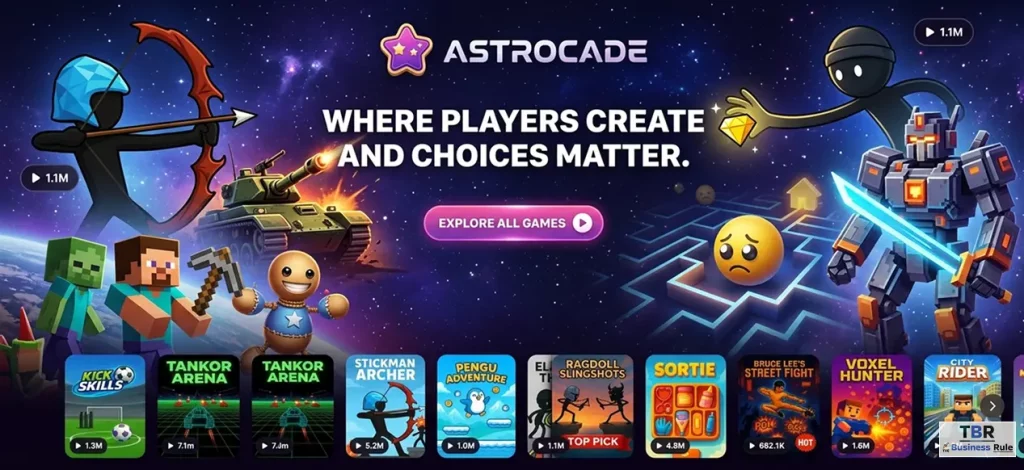
Effective sharing for a browser game built on a platform like Astrocade starts with the platform’s own community. Players already using the platform are the most accessible first audience because they are already in the habit of discovering and trying new games in that environment. Making sure your game is properly tagged, titled, and described so the platform’s discovery systems can surface it to relevant players is the minimum baseline for distribution.
Beyond the platform, sharing the direct URL across personal networks is the most straightforward next step. Gaming communities on Reddit, Discord servers focused on indie games or browser gaming, and social media accounts where you have any existing presence are all viable distribution channels that cost nothing beyond the time to post.
The key message when sharing a game you built in one day is not the timeline. Most players do not care how long a game took to make. They care whether it is fun. Lead with what the experience is like, not with the fact that you made it quickly. The one-day timeline is impressive context for other creators. For players, it is irrelevant compared to whether clicking the link is worth their time.
What Comes After Your First Published Game
The most valuable thing a one-day game project produces is not the game itself. It is the complete experience of taking something from idea to published reality and understanding every step of that process from the inside. That understanding is what makes the second game faster, the third game better, and the fourth game the one where your genuine creative voice starts to come through clearly.
Create a game once and you learn what the process actually involves versus what you imagined it would involve. You discover which parts of development you find energizing and which parts you find draining. You see how real players interact with your work in ways that surprise you, both positively and through the problems they find that you never noticed. You get feedback that is worth more than any amount of pre-development research or planning.
The creators who grow fastest in this space are not the ones with the most natural talent or the most technical knowledge. They are the ones who publish consistently, gather feedback honestly, and apply what they learn without getting attached to any single project as their defining work. One day to build, one click to publish, one round of real feedback, and then straight into the next one. That cycle, repeated consistently, is how genuine creative development in game creation actually works.
Conclusion
The ability to build a game online and share it with real players in a single day is one of the more remarkable things that has become practically achievable for independent creators in recent years. The tools exist, the platforms are ready, and the only thing standing between a good game idea and a published game that people are actually playing is a focused day of creative work and the decision to press publish when the day is done. Start with a clear concept, keep the scope honest, build the core mechanic until it feels right, add enough content to make it complete, and share it before you talk yourself into waiting for one more round of polish. The world can see your game today. That is worth acting on.
About the Author