
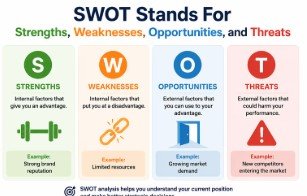
Traditional SWOT has been around for a long time and is a useful tool for teams to work through the usual S/W/O/T. The problem with the traditional model in today’s world is that it’s simply not sufficient. We now have SWOT 2.0 which is the next generation of the model and incorporates competitive intelligence to give you a far more precise and accurate view of the local market.
Whether you’re a startup, a mid-sized company or an analyst putting together some strategy recommendations, an understanding of SWOT 2.0 can go a long way to improving your decision making.
What is SWOT 2.0 and why does it matter?
Standard SWOT is pretty much an internal, static exercise. You’ve got your own team listing off your own attributes and making judgements about the market based on what they know generally. The end result is typically a very superficial view of the market which doesn’t take into account the actual behaviour of your local competitors, the actual shifts in regional demand or the actual market data.
SWOT 2.0 takes each of the quadrants and expands them by adding in competitive intelligence. That’s done by employing structured data collection, competitive benchmarking, customer feedback analysis and local market research to populate each section with real, specific and actionable intelligence.
For example rather than just saying “excellent customer service” as a strength you’d have SWOT 2.0 asking you how your customer service actually compares to the top three competitors in the area. That kind of precision is what changes the way the strategy is actually built.
Applying Competitive Intelligence to Each Quadrant
Strengths of Benchmarking
In SWOT 2.0 the strengths aren’t assessed in a vacuum. They are assessed against your direct competitors. Gather data on your price, your product quality, your delivery speed, your online reviews and your brand in your particular city/region. That way you can see which of your strengths are actually distinctive and which are just the norm.
Weaknesses Identified Through Customer Intelligence
Customer reviews, social media mentions and churn data all point to the gaps in your offering that your own internal teams will tend to either ignore or downplay. Tools such as sentiment analysis and NPS tracking can be used to actually map out where you’re falling short in comparison to the local competition. That’s a lot more honest than an internal assessment.
Opportunities Tied to Local Demand Signals
Identifying opportunities in SWOT 2.0 is all about looking at local search trends, looking at what the customer is actually asking for and what the customer needs, and looking at the gaps in your competitor’s offering. A good example would be if you had a number of competitors in your city who simply don’t have a good mobile ordering option at all. That’s a very tangible, real opportunity, based on actual data rather than some nebulous notion of “digital growth”.
Threats Backed by Real Competitor Monitoring
Threats in the traditional SWOT are generally very broad and rather generic. SWOT 2.0 requires you to be actively tracking your competition. You need to be watching for new entrants, price changes, marketing campaigns and product launches in your local market. That way your threat assessment is actually relevant, specific and up to date.
Building the Right Skills to Execute SWOT 2.0
SWOT 2.0 isn’t just a thinking exercise. It requires real skills in data collection, data analysis and data interpretation. The business analyst is absolutely central to the effective execution of the SWOT 2.0 framework. They are the ones who collect the competitive data, organise it and then turn it into actual strategic recommendations.
If you’re looking to develop these capabilities in a professional way then a Business Analyst course in Hyderabad is a very good place to start. Hyderabad has a burgeoning ecosystem of business analysts and training institutes that go into competitive analysis, data tools and the various frameworks in相当 some depth. A proper course will give you the methodology to actually apply SWOT 2.0 in a business context.
Integrating SWOT 2.0 Into Regular Strategy Cycles
One of the biggest mistakes that organisations make is to treat SWOT as a one off exercise. Local markets are in a constant state of flux. The competition moves on, the economy changes, consumer preferences shift. SWOT 2.0 is a living framework and is intended to be updated on a quarterly or semi-annual basis.
Build a simple intelligence system: assign ownership of competitor tracking, set up alerts for industry news in your region and then schedule regular review meetings to go through each quadrant. That way your strategy work becomes an ongoing process rather than an annual exercise.
Conclusion
SWOT 2.0 takes the old SWOT and makes it actually useful for competitive strategy in the local market. It does this by replacing the usual assumptions with actual data and the usual internal opinions with insights that are benchmarked against the market. It’s a far more useful tool as a result.
For those who want to be in a position to lead this type of analytical work, a Business Analyst course in Hyderabad can give you the skills and the frameworks to actually apply competitive intelligence. The businesses that are investing in structured analysis today are the ones that are best placed to adapt and grow in the very competitive local markets that we’re all operating in.
About the Author