Have you ever stayed calm through a long series of annoying problems only to suddenly snap over something small? Maybe your internet failed again, your coffee spilled, or someone made one more careless mistake. To outsiders, your reaction looked dramatic. Yet to you, it felt completely justified.
That moment is exactly what “the last straw” means.
People use this phrase every day in conversations, workplaces, relationships, and even movies. Still, many people misunderstand it. Some use it too early. Others confuse it with ordinary frustration.
In reality, the last straw idiom carries a deeper meaning. It describes a breaking point after patience has slowly worn thin.
This guide explains everything you need to know about the last straw meaning, including its origin, correct usage, examples, sentence patterns, common mistakes, and how native speakers actually use it.
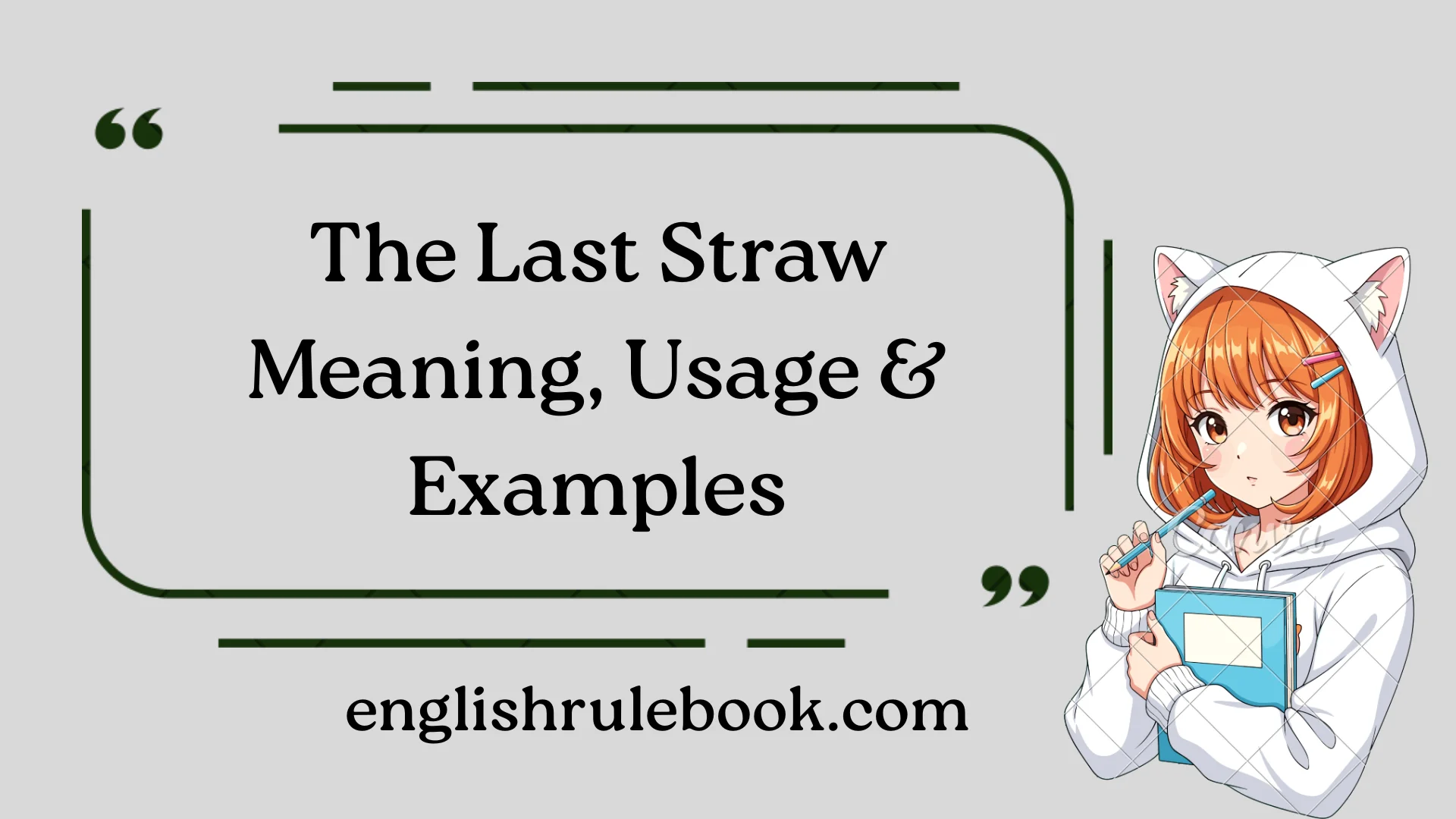
What Does “The Last Straw” Mean?
“The last straw” refers to the final small problem or frustrating event that causes someone to lose patience after many previous difficulties.
The key idea here is accumulation.
The final event usually isn’t huge. In fact, it may seem tiny on its own. What makes it powerful is everything that happened before it.
Simple Definition of “The Last Straw”
In plain English, the last straw means reaching your emotional limit.
You have already tolerated:
- Stress
- Problems
- Mistakes
- Frustration
- Disappointment
Then one more thing happens.
Suddenly, you cannot handle it anymore.
A Quick Example
Imagine this situation:
You wake up late.
Then traffic slows your commute.
Your boss criticizes your work unfairly.
After that, your laptop crashes.
Finally, someone steals your lunch from the office fridge.
That stolen lunch becomes the last straw.
The lunch itself seems minor. Yet after everything else, it pushes you over the edge.
Simple rule to remember: The last straw is never the first problem. It is the final problem.
The Real Meaning Behind “The Last Straw”
Many people think the phrase simply means anger.
It doesn’t.
Instead, it reflects accumulated emotional pressure.
Think of frustration like water filling a glass.
At first, everything feels manageable.
Then stress builds.
The glass gets fuller.
Eventually, one final drop makes it overflow.
That overflow moment becomes the last straw.
Why This Expression Feels So Relatable
People love this phrase because it explains something very human.
Most emotional reactions happen gradually.
You rarely quit a job because of one email.
You rarely end a friendship because of one late reply.
Usually, many disappointments build up first.
Then something small happens.
Suddenly, you think:
“That’s it. I’ve had enough.”
That feeling is the heart of the last straw idiom.
The Origin of “The Last Straw”
The phrase comes from a much older proverb:
“The straw that broke the camel’s back.”
This proverb describes an overloaded camel carrying straw.
Each piece of straw adds weight.
One extra straw eventually breaks the camel’s back.
Interestingly, the final straw itself is not heavy.
The camel collapses because of the total burden.
That metaphor perfectly explains human frustration.
Historical Background
The longer proverb dates back hundreds of years and became common in English literature during the 17th and 18th centuries.
Over time, English speakers shortened the phrase to simply:
“The last straw.”
Today, the shorter version appears more often in:
- Everyday conversations
- TV shows
- Social media posts
- Workplace discussions
- Books and articles
Why the Phrase Became Popular
People prefer shorter expressions.
Instead of saying:
“That was the straw that broke the camel’s back.”
Most people simply say:
“That was the last straw.”
It sounds quicker and more natural.
The Last Straw Meaning in Everyday Life
You will hear this expression in many situations.
Usually, it appears when someone reaches a breaking point.
Here are the most common real-life situations.
| Situation | Example of the Last Straw |
| Work | Another unfair deadline |
| Relationships | Repeated broken promises |
| Parenting | Constant disrespect |
| School | One more failed group project |
| Customer Service | Another rude interaction |
| Finances | An unexpected expense |
The phrase works because everyone experiences emotional overload.
How to Use “The Last Straw” Correctly
Understanding the meaning matters.
Using the phrase naturally matters even more.
Here are the most common sentence structures.
Pattern: “That Was the Last Straw”
This is the most common format.
Examples
- When my manager blamed me again, that was the last straw.
- The broken air conditioner was the last straw for us.
- Her lying became the last straw.
This structure sounds conversational and natural.
Pattern: “The Last Straw Came When…”
This version sounds more descriptive.
Examples
- The last straw came when they cut my salary.
- The last straw came when he forgot my birthday again.
- The last straw came when the company ignored employee complaints.
Use this structure when telling a story.
Pattern: “It Was the Last Straw for Me”
This format sounds personal.
Examples
- Being ignored in meetings was the last straw for me.
- The constant delays became the last straw for us.
This version works especially well in emotional situations.
When You Should Use “The Last Straw”
You should use the phrase when frustration builds over time.
Workplace Frustration
Work environments often create perfect “last straw” moments.
Examples include:
- Constant overtime
- Poor communication
- Unfair criticism
- Toxic leadership
- Missed promotions
Example
You tolerate long hours for months.
Then your boss cancels your vacation.
That becomes the last straw.
Relationship Problems
Relationships often involve emotional buildup.
A single mistake rarely destroys trust.
Repeated behavior causes problems.
Common examples include:
- Broken promises
- Dishonesty
- Lack of effort
- Constant arguments
Example
Someone forgets important dates repeatedly.
Then they ignore your anniversary.
That becomes the last straw.
School or College Stress
Students often use this phrase.
Examples include:
- Group projects gone wrong
- Heavy workloads
- Teacher conflicts
- Poor grades despite effort
Example
You study all night.
Then your assignment disappears due to a tech error.
That feels like the last straw.
When You Should NOT Use “The Last Straw”
Many English learners misuse this idiom.
Here are situations where it sounds unnatural.
Don’t Use It for a First Problem
Incorrect:
“My internet stopped once. It was the last straw.”
Why?
Because no emotional buildup exists.
Correct:
“My internet failed all week. Today’s outage was the last straw.”
Don’t Use It in Positive Situations
Incorrect:
“Winning the lottery was the last straw.”
The phrase carries a negative emotional tone.
It almost always relates to frustration.
Don’t Use It Randomly
The phrase needs context.
Without previous struggles, it sounds confusing.
Real-Life Examples of “The Last Straw”
Examples make everything easier to understand.
Here are realistic situations.
At Work
Scenario: Your boss keeps adding tasks without appreciation.
“When they asked me to work the weekend again, that was the last straw.”
In Relationships
Scenario: Your partner repeatedly cancels plans.
“He forgot our dinner reservation again. That was the last straw.”
Family Situations
Scenario: Constant household mess.
“I cleaned the kitchen every day. Seeing dirty dishes again was the last straw.”
Financial Problems
Scenario: Bills keep piling up.
“The surprise repair bill was the last straw.”
Customer Service Problems
Scenario: Terrible service repeatedly.
“Waiting another hour for support was the last straw.”
25 Everyday Examples of “The Last Straw” in Sentences
Personal Life Examples
- The broken washing machine was the last straw.
- Missing the bus again became the last straw.
- Another sleepless night felt like the last straw.
- The loud neighbors were the last straw for me.
- Losing my wallet was the last straw.
Workplace Examples
- Another unpaid overtime shift was the last straw.
- Being ignored during meetings became the last straw.
- The surprise deadline was the last straw.
Relationship Examples
- The forgotten anniversary was the last straw.
- Constant excuses became the last straw.
- Another broken promise was the last straw.
School Examples
- The failed group project was the last straw.
- Getting blamed unfairly became the last straw.
Funny Examples
- When the pizza arrived cold, it was the last straw.
- My phone battery dying at 1% was the last straw.
- The broken coffee machine was absolutely the last straw.
Short Dialogue Examples Using “The Last Straw”
Workplace Conversation
Sarah: Why did Jake quit?
Mark: Honestly, management kept overloading him.
Sarah: So what happened?
Mark: They canceled his vacation. That was the last straw.
Relationship Conversation
Emma: Are you still upset?
Ryan: I tried being patient.
Emma: What changed?
Ryan: Forgetting my birthday was the last straw.
Friendship Example
Lena: Why aren’t you talking anymore?
Chris: He kept canceling plans.
Lena: Really?
Chris: Yeah. Last night was the last straw.
Is “The Last Straw” Positive or Negative?
The phrase is almost always negative.
It describes emotions like:
- Frustration
- Anger
- Emotional exhaustion
- Disappointment
- Stress
Emotional Meaning
Think of it as emotional overflow.
People often say it right before making a major decision:
- Quitting a job
- Ending a relationship
- Filing a complaint
- Walking away
Similar Idioms and Expressions
English has many similar phrases.
Still, each carries slightly different meaning.
| Phrase | Meaning | Best Use |
| The last straw | Final frustration | Emotional overload |
| Breaking point | Emotional limit | Stress situations |
| Fed up | Tired of something | Everyday speech |
| Enough is enough | Refusing more problems | Firm boundaries |
| At the end of my rope | Exhausted | Emotional strain |
Example Comparison
The last straw:
Missing another deadline was the last straw.
Fed up:
I’m fed up with the delays.
Breaking point:
I finally reached my breaking point.
Small difference. Big impact.
“The Last Straw” vs “The Straw That Broke the Camel’s Back”
Many people wonder if these phrases are different.
Short answer:
They mean almost the same thing.
Main Difference
| Phrase | Tone | Common Usage |
| The last straw | Casual | Daily conversation |
| The straw that broke the camel’s back | Traditional | Writing or storytelling |
Example
Casual speech:
That missed payment was the last straw.
Traditional wording:
That missed payment was the straw that broke the camel’s back.
Most native speakers prefer the shorter version.
Common Mistakes People Make
Using It Too Soon
The phrase requires repeated problems.
Without buildup, the meaning fails.
Forgetting the Emotional Context
The phrase implies emotional pressure.
Random annoyance isn’t enough.
Using It for Positive Events
This sounds unnatural.
The idiom almost always reflects frustration.
Overusing It
Save the phrase for serious moments.
If everything becomes “the last straw,” it loses meaning.
How Native English Speakers Actually Use “The Last Straw”
Native speakers often use shortened, casual versions.
Here are examples:
Casual Conversation
“That was honestly the last straw.”
“I’m done. That was the last straw.”
Workplace Talk
“Management cutting benefits was the last straw.”
Relationships
“Ignoring me again was the last straw.”
Social Media Examples
People often post things like:
“Flight delayed for six hours. Lost luggage too. This is the last straw.”
Short.
Emotional.
Easy to understand.
Read More: The Audience Is or Are? A Clear Guide to Collective Nouns in English
Grammar Tips and Phrase Variations
You can change the phrase slightly without changing meaning.
Common Variations
- That was the last straw.
- It was the last straw for me.
- The final mistake became the last straw.
- That turned out to be the last straw.
- The last straw came when they ignored me.
Verb Tense Examples
Past tense
It was the last straw.
Present tense
This feels like the last straw.
Future possibility
One more delay might be the last straw.
Why “The Last Straw” Matters in Communication
This idiom helps explain emotions clearly.
Instead of saying:
“I suddenly got angry.”
You explain deeper context.
For example:
“Months of pressure built up. Missing the deadline was the last straw.”
That sentence tells a story.
It explains cause and emotion together.
Communication becomes stronger.
Quick Facts About “The Last Straw”
| Fact | Detail |
| Idiom Type | English expression |
| Emotional Tone | Negative |
| Meaning | Final frustration after many problems |
| Origin | “The straw that broke the camel’s back” |
| Common Use | Work, relationships, stress |
| Formality | Mostly informal |
FAQs
What does “the last straw” mean?
It means the final problem or frustration that causes someone to lose patience after many previous difficulties.
Where does “the last straw” come from?
It comes from the proverb:
“The straw that broke the camel’s back.”
The idea is simple: even something small can cause collapse when too much pressure already exists.
Is “the last straw” formal or informal?
It is mostly informal, though people still use it in professional writing and workplace discussions.
Can you use “the last straw” in writing?
Yes.
You can use it in:
- Blogs
- Stories
- Emails
- Workplace communication
- Articles
It works best when describing emotional buildup.
What is another way to say “the last straw”?
You could say:
- Breaking point
- Fed up
- Enough is enough
- At the end of my rope
Each phrase has slightly different meaning.
Is “the last straw” always negative?
Almost always, yes.
The phrase usually describes frustration, disappointment, or emotional exhaustion.
Final Thoughts
The phrase “the last straw” may sound simple, yet it captures a very human experience.
People rarely explode over one tiny problem.
Usually, stress piles up quietly.
Disappointment grows.
Patience weakens.
Then something small happens and suddenly everything changes.
That final moment becomes the last straw.
Once you understand the meaning, you will start noticing this expression everywhere. You will hear it in conversations, TV shows, workplaces, friendships, and relationships.
More importantly, you will know exactly how to use it correctly.
And next time life throws one more problem your way, you might catch yourself saying:
“Okay… that was the last straw.”
About the Author