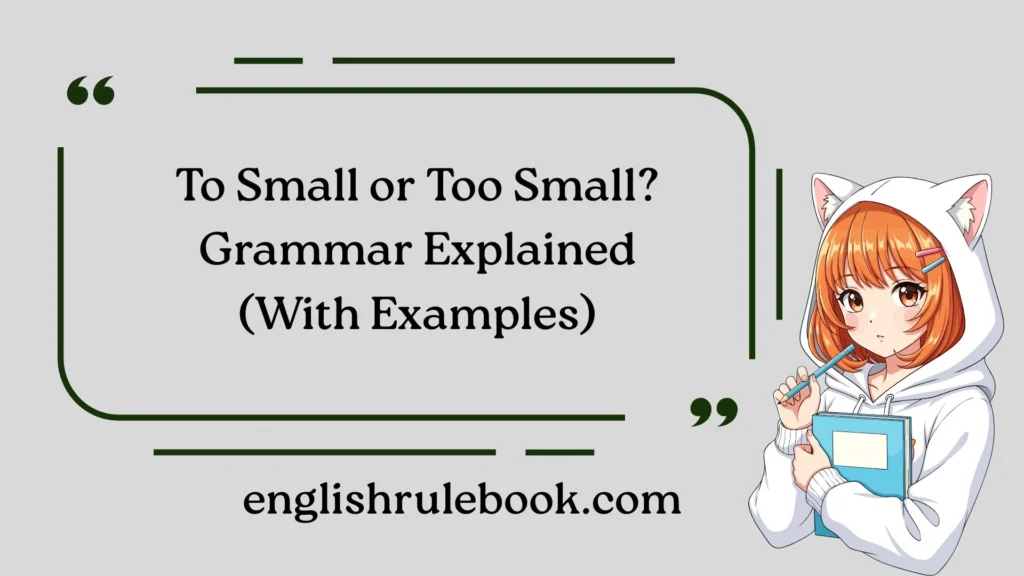
In the hierarchy of tricky English things, nothing drives grammar sticklers mad like confusing to and too, making To Small or Too Small? a very common problem to see these words confused, abused, or misused not just on YouTube comments or Reddit. People seem to mix these two funny, little words all over the place, and something like this can happen to anyone, leaving us scratching heads while trying to craft the perfect sentence, tangled in a web of grammatical dilemmas, because English grammar, with its plethora of rules and exceptions, doesn’t make life easier, and the confusion between “to small” and “too small” can lead to embarrassing errors.
Understanding the Core Difference Between ‘To’ and ‘Too’
Before diving into examples, let’s clarify the main difference:
| Word | Definition | Example |
| To | Preposition indicating direction, purpose, or recipient | “I am going to the store.” |
| Too | Adverb indicating excess or addition | “The shoes are too small.” |
Memory Tip:
- To → Think of it as a path or direction.
- Too → Think of it as more than enough or also.
Once you internalize this, spotting errors becomes almost automatic.
The Many Roles of ‘To’ in English
The word “to” is versatile and appears in several contexts:
- Directional preposition: Indicates movement or destination.
Example: “I walked to the park yesterday.” - Expressing purpose: Shows intent or reason.
Example: “This letter is to thank you for your help.” - Part of infinitive verbs: Combines with verbs to indicate action.
Example: “I want to learn French.” - Giving or receiving something: Shows transfer.
Example: “I gave the book to Sarah.”
Common Error:
- Writing “I went too the store” is incorrect. You need to for direction, not too.
Also Read This: Breath vs. Breathe: Understanding the Difference and Using Them Correctly
The Power of ‘Too’: Emphasizing Excess or Addition
The word “too” communicates one of two things:
- Excessive degree
Example: “This shirt is too small for me.” - Also / in addition
Example: “I want to come too.”
Tip: Context is everything. If you’re expressing more than desired, you likely need too. If you’re showing direction, purpose, or recipient, it’s to.
Table: ‘Too’ in Different Contexts
| Usage | Meaning | Example |
| Excessive | More than enough | “The room was too hot.” |
| Addition | Also / as well | “She wants to join too.” |
Notice how subtle the meaning shift is. Small mistakes here can confuse readers or change your intended message.
Homophones in English: Why ‘To’ and ‘Too’ Trip Us Up
English has many homophones—words that sound the same but have different spellings and meanings. “To” and “too” are classic examples.
- Phonetic similarity: Both sound like /tuː/ in most accents.
- Visual difference: One has an extra o, and that o often signals “excess” or “also.”
Other tricky homophones include:
- There vs. Their vs. They’re
- Your vs. You’re
Understanding homophones helps you read carefully and choose the right word.
Spotting Common Misuses of ‘To’ and ‘Too’
Here are some examples from real-world writing and social media:
| Incorrect | Correct | Explanation |
| “The shirt is to small.” | “The shirt is too small.” | Use too for excess, not to. |
| “I want to come too.” | “I want to come too.” | Correct for addition. |
| “Give it too him.” | “Give it to him.” | Direction/recipient requires to. |
Pro Tip: When in doubt, ask: Am I showing excess or addition? → too; Am I indicating direction, purpose, or recipient? → to.
Correct Usage: ‘Too Small’ in Context
Using “too small” correctly emphasizes that something is bigger than desired or inadequate.
Examples:
- “These gloves are too small for my hands.”
- “The apartment was too small for their family.”
- “The font is too small to read comfortably.”
Notice how switching too to to changes the meaning entirely and makes the sentence grammatically incorrect.
Emphasizing Excess Effectively with ‘Too’
You can strengthen your sentences by combining too with modifiers:
- Far too small: Stronger emphasis
Example: “The suitcase is far too small to fit everything.” - Way too small: Casual, conversational
Example: “This cake pan is way too small for the recipe.”
These intensifiers make your language more expressive while keeping it correct.
Practical Sentences You Can Use Today
Here’s a list of everyday scenarios where too small or too can appear:
- Shopping: “These jeans are too small.”
- School/Work: “The font on the report is too small to read.”
- Food: “This bowl is too small for the salad.”
- Technology: “The phone screen is too small for gaming.”
Encourage readers to write similar sentences with too to internalize the rule.
Visualizing Grammar: When ‘Small’ Just Isn’t Enough
Visual aids can help you remember the difference:
- Small: Acceptable size
- Adequate: Just right
- Too Small: Not enough, excessive limitation
Using visual cues reinforces learning, especially for visual learners.
Guidelines to Choose the Right Word: ‘To’ vs ‘Too’
Here’s a quick decision checklist:
- Are you indicating direction, purpose, or recipient? → Use to
- Are you expressing excess or addition? → Use too
- Unsure? Substitute “also” or “more than enough” and see if it fits → if yes, it’s too
| Rule | Quick Check | Example |
| Direction/Recipient | Can you replace it with “toward” or “for”? | “I sent it to my friend.” |
| Excess | Can you replace it with “more than enough”? | “The bag is too heavy.” |
| Addition | Can you replace it with “also”? | “I want to come too.” |
FAQs
Q1: What is the difference between “to small” and “too small”?
“To small” is incorrect and usually misused, while “too small” is correct and means something is excessively little or insufficient.
Q2: Can “to” and “too” be used interchangeably?
No. “To” is a preposition used for direction, motion, or position, while “too” is an adverb indicating excessiveness or addition.
Q3: Why do people often confuse them?
It’s very common because both words sound the same, making it tricky even for native speakers and English learners.
Q4: How can I avoid mistakes with “to” and “too”?
Always remember the rule: use to for direction or action, and too when you mean more than needed, excessively, or additionally.
Q5: Are there tips for spotting errors in writing?
Check the context carefully, read aloud, and practice using phrases like “too small”, “to the store”, or “this shirt is too small for me”.
Conclusion
Understanding “to small” vs “too small” is essential for clear, effective communication. By following the rules, checking context, and practicing, you can avoid common mistakes, build confidence, and express ideas correctly. Remember, even small errors can lead to confusion, but with attention, anyone can master these tricky, little words.