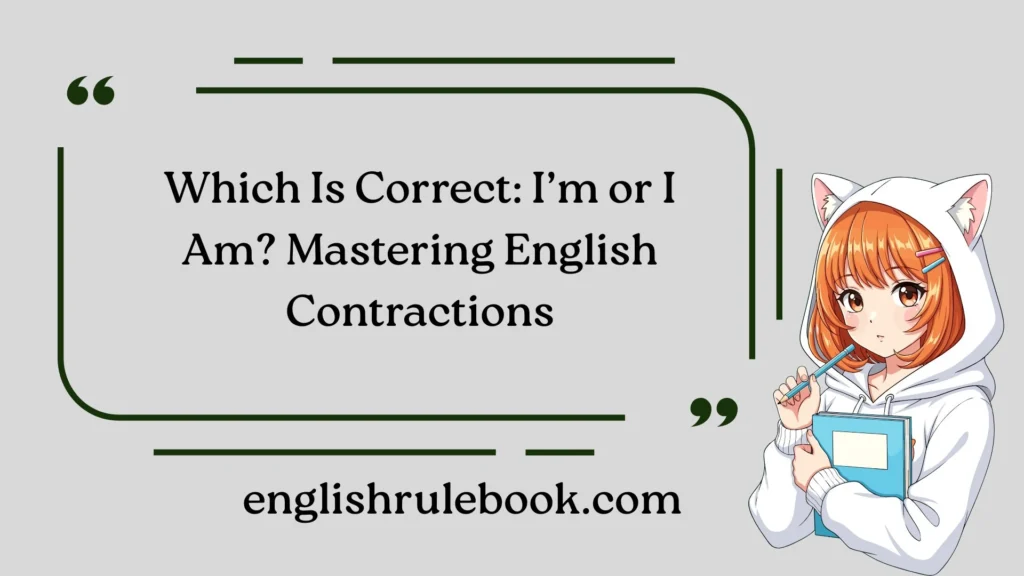
Sometimes, we use contractions in writing to make things quicker and easier to understand. Which Is Correct: I’m or I Am? is a question many people ask, because I’m is a contraction of I am, making speech sound more casual, friendly, and natural, while I am can feel formal or professional, especially in job interviews or when talking to a friend. Knowing when to use each form can make your speech sound polished and professional, as there’s more to these two phrases than meets the eye.
I am is usually preferred when you want to emphasize something formal or important, for example, saying I am qualified for a position. On the other hand, I’m works well in a casual setting, like going to the store or chatting with a friend. The main difference lies in tone, setting, and the nuances of English language, which can change the meaning or impact of a sentence in subtle ways. Right now, only a closer look can show how each choice serves different purposes, and sometimes, you need to proceed accurately to provide content that fits all these rules.
Understanding the Basics: “I’m” vs. “I Am”
At its core, “I’m” is a contraction of “I am”. Contractions combine two words, usually shortening them and adding an apostrophe, making speech and writing smoother and faster.
- I am – full, formal form
- I’m – contracted, informal form
Examples:
| Full Form | Contraction | Usage |
| I am happy to help you. | I’m happy to help you. | Formal vs. casual |
| I am confident in my abilities. | I’m confident in my abilities. | Formal emphasis vs. conversational tone |
Historically, contractions like “I’m” became common in English to speed up speech and reduce monotony. Writers like Jane Austen frequently used contractions in letters and novels, showing their longstanding role in natural English.
The Role of Context in Choosing the Right Form
Context determines whether “I’m” or “I am” is appropriate. Written and spoken English are not interchangeable. The key factors are:
- Tone: Friendly, conversational, or professional.
- Setting: Text messages, social media, emails, academic writing.
- Audience: Friends, colleagues, professors, or a general readership.
Example 1:
- “I’m thrilled to join this project!” → casual, friendly, appropriate for colleagues or emails.
Example 2:
- “I am confident that this report meets the highest standards.” → formal, authoritative, appropriate for academic or professional writing.
In short, contractions lean casual, full forms lean formal.
When to Use “I’m” in Casual Conversation
“I’m” is widely used in everyday speech because it sounds natural and approachable. It’s perfect for:
- Talking with friends or family:
- “I’m going to the store, want to come?”
- Text messages and chat apps:
- “I’m so tired after work today.”
- Dialogue in writing:
- “I’m not sure that’s a good idea,” she said.
The key is rhythm. Contractions keep your speech and writing flowing naturally. Using “I am” repeatedly in conversation may sound robotic or overly formal.
Tip: Reading your sentences aloud helps determine if “I’m” feels natural.
The Importance of “I Am” in Formal Writing
“I am” carries weight and clarity, making it indispensable in professional, academic, and official contexts.
Situations for “I am”:
- Academic essays and research papers
- Professional emails or letters
- Job applications and cover letters
- Official documents
Example:
- “I am confident that my research contributes new insights to the field.”
Notice how the sentence feels stronger and more deliberate than:
- “I’m confident that my research contributes new insights.”
Using “I am” avoids ambiguity and signals seriousness, which is crucial in professional environments.
Also Read This: A Dish Fit for the Gods – Meaning, Usage & Examples
Audience-Based Decision Making
Choosing between “I’m” and “I am” often depends on your audience’s expectations. Misjudging this can alter the impact of your message.
Checklist to guide your choice:
| Audience | Preferred Form | Reason |
| Friends/Family | I’m | Casual, friendly |
| Colleagues | I’m/I am | Depends on tone and formality |
| Professors/Academic | I am | Formal, authoritative |
| Clients/Executives | I am | Professional, clear |
Example:
- Casual email: “I’m looking forward to our meeting tomorrow.”
- Professional email: “I am looking forward to our discussion tomorrow.”
Tip: When in doubt, lean toward “I am” for writing; it’s safer and more professional.
Contractions in American English: Deep Dive
American English favors contractions in informal settings because they mimic natural speech patterns. Beyond “I’m”, understanding other contractions helps you avoid mistakes.
Common contractions:
- don’t → do not
- it’s → it is / it has
- we’re → we are
- you’re → you are
Rules and tips:
- Never use contractions in overly formal documents, like legal contracts.
- Be consistent—don’t mix contractions and full forms randomly.
- Apostrophes are crucial—“its” vs. “it’s” changes meaning entirely.
Contractions aren’t sloppy—they’re strategic tools to convey tone and readability.
Common Mistakes and How to Avoid Them
Even seasoned writers occasionally misuse “I’m” and “I am.” Here are the most frequent errors:
- Misplacing the apostrophe:
- ❌ “Im happy” → ✅ “I’m happy”
- Using “am” without a subject:
- ❌ “Am going to the store” → ✅ “I am going to the store”
- Inconsistent usage in one piece of writing:
- ❌ “I’m confident in my work. I am also aware of its flaws.” → Better: pick one style for consistency.
Tip: A quick read-aloud check often catches awkward or incorrect usage.
Perceptions of Formality
“I am” vs. “I’m” signals formality and confidence:
- “I am” → authoritative, serious, confident
- “I’m” → casual, approachable, conversational
Example:
- Formal presentation: “I am committed to achieving these results.”
- Informal discussion: “I’m excited to try this out!”
Readers and listeners subconsciously react to these cues. Choosing the right form can improve your credibility and engagement.
Practical Applications
Knowing when to use “I’m” or “I am” is one thing; applying it effectively is another.
In formal letters and documents:
- “I am writing to express my interest in the position.”
- “I am pleased to submit this report for your review.”
In casual messages or dialogue:
- “I’m going to grab some coffee, want one?”
- “I’m so glad you could make it!”
Quick reference checklist:
- Speaking casually? → I’m
- Writing professionally? → I am
- Emphasizing a statement? → I am
- Texting a friend? → I’m
Summary and Best Practices
Let’s recap the key points:
- “I’m” is for casual, conversational tone.
- “I am” is for formal, professional, or emphatic usage.
- Context and audience are your guides.
- Consistency matters; don’t mix forms randomly.
- Reading aloud helps ensure natural flow.
Reference Table:
| Form | Usage | Tone | Example |
| I’m | Casual conversation, texts, dialogue | Friendly, approachable | I’m happy to help you. |
| I am | Formal writing, official documents, emphasis | Serious, professional | I am confident in my abilities. |
By following these rules, you’ll write and speak with confidence, clarity, and the right level of formality.
Bonus Tip: Practice Quiz
Choose the correct form in each sentence:
- ___ going to the store later.
- ___ confident that our team can succeed.
- ___ so excited to see you!
- ___ pleased to submit this report today.
Answers: 1. I’m | 2. I am | 3. I’m | 4. I am
Using “I’m” vs. “I am” correctly isn’t just grammar—it’s about tone, clarity, and connection. Master this subtle skill, and your writing and speaking will feel natural, polished, and engaging.
FAQs
Q1: When should I use “I’m” instead of “I am”?
You should use I’m in casual conversations, writing, or talking to a friend. It makes your speech sound friendly, natural, and quick.
Q2: Is “I am” always formal?
Not always, but I am is usually preferred when you want to emphasize something formal or important, like during a job interview.
Q3: Can I mix “I’m” and “I am” in everyday speech?
Yes, many people use them interchangeably, but knowing when to use each form helps your speech sound polished and professional.
Q4: What is the main difference between “I’m” and “I am”?
The main difference lies in tone, setting, and the nuances of English language, which can change the meaning or impact of a sentence.
Conclusion
Choosing between I’m and I am depends on tone, setting, and purpose. I’m is casual and friendly, while I am is formal, emphasized, and professional. Knowing when to use each form makes your speech sound natural, polished, and clear. By observing these rules, you can proceed accurately in writing and conversations, ensuring your English language skills are precise and effective.