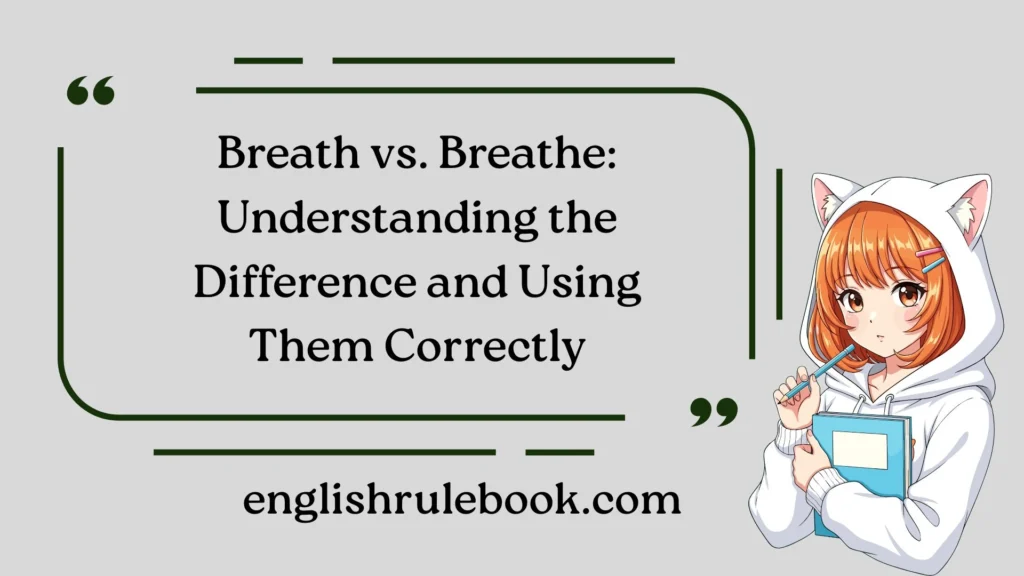
Breath vs. Breathe: What’s the Difference? One of the most difficult things in English is to confuse breath and breathe, as their spellings are almost identical yet their meanings and roles in a sentence are different. Breath is a noun that refers to the air taken into or expelled from the lungs, while breathe is a verb that describes the action of drawing air into the lungs and then expelling it. Understanding these differences is essential for clear and accurate communication, helping you use each word correctly in the context it is used. For example, “Take a deep breath” versus “Remember to breathe deeply.”
Over the years, I’ve learned that paying close attention to pronunciation and sentence structure makes a huge difference. Breath ends with a short, sharp sound, while breathe ends with a soft ‘z’. That small -e is a game-changer when trying to master English. Getting the hang of this can feel like a walk in the park on easy days, or a steep hike up a hill. Remember, distinguish each word, think about the action it represents, and you’ll make the right choice every time. Let’s get started and trust that with practice, using these words will become second nature.
Understanding the Basics of Breath vs Breathe
Before diving into grammar rules and idioms, let’s clarify what each word actually means.
- Breath (noun): A single act of inhaling or exhaling air. It can also refer to air in general or a metaphorical sense like relief or calmness.
- Breathe (verb): The action of inhaling and exhaling air; to take or release a breath.
Pronunciation
| Word | Pronunciation | Part of Speech | Example |
| Breath | /brɛθ/ | Noun | I took a deep breath before speaking. |
| Breathe | /briːð/ | Verb | Remember to breathe deeply during meditation. |
Memory Tip: If the word represents an action, it usually ends in -e: breathe. If it’s a thing, like air or the act itself, it’s breath without the “e.”
Breath as a Noun
Meaning and Usage
“Breath” is tangible and abstract. You can feel it when you inhale, see it on a cold day, or use it metaphorically. Examples:
- Literal: He gasped for breath after running up the stairs.
- Metaphorical: Taking a moment of breath can help reduce stress.
Common Mistakes
Many confuse “breath” with “breathe” because of similar pronunciation. Writing “I need to breathe air” instead of “I need a breath of air” is a frequent mistake.
Idioms and Phrases Using Breath
- Hold your breath – wait anxiously or in suspense.
- A breath of fresh air – something refreshing or new.
- Take one’s last breath – to die.
- Catch your breath – to rest and recover.
Example Sentences:
- She waited, holding her breath, for the results.
- The new teacher was truly a breath of fresh air in the school.
Also Read This: Don’t Rain on My Parade – Meaning, Origin, Usage, Psychology, and Real-Life Examples
Breathe as a Verb
Definition and Action
“Breathe” describes the action of inhaling and exhaling. It’s not a thing, but something you do.
- Example: It’s important to breathe slowly during yoga.
Conjugation of Breathe
| Tense | Example Sentence |
| Present | I breathe deeply every morning. |
| Past | He breathed heavily after the workout. |
| Continuous | She is breathing steadily now. |
| Imperative | Breathe in, then out. |
Figurative Usage
- Breathe life into – to invigorate or revitalize.
- Breathe easy – to relax after worry or stress.
Example Sentences:
- The coach breathed life into the team with her inspiring speech.
- After submitting the exam, I could finally breathe easy.
Common Errors
- Mistaking breathe for breath in writing.
- Mispronunciation: forgetting the long “ee” sound in “breathe.”
Grammar Focus: Nouns vs Verbs
Understanding why “breath” and “breathe” differ hinges on grammar fundamentals.
Key Differences
| Feature | Breath | Breathe |
| Part of speech | Noun | Verb |
| Represents | Thing, air, inhalation/exhalation | Action of inhaling/exhaling |
| Example | I took a breath | I need to breathe |
Sentence Structures
- Noun usage: The doctor monitored his breath.
- Verb usage: The doctor told him to breathe slowly.
Tip: If you can replace the word with “air” or “inhalation,” it’s probably breath. If it’s an action, it’s breathe.
The Biological Connection
Understanding the biological process of breathing can help you remember usage.
How We Breathe
- Inhalation: Air enters the lungs through the nose or mouth.
- Oxygen exchange: Oxygen passes into the bloodstream via alveoli.
- Exhalation: Carbon dioxide exits the body.
Breath as a Sign of Life
- Humans can survive minutes without breath.
- Regular breathing maintains oxygen levels, supporting brain and organ function.
Fun Fact: The average adult takes 12–20 breaths per minute, amounting to roughly 20,000 breaths per day.
Linking Language to Biology
- Breath is the tangible unit of air.
- Breathe is the act sustaining life.
Understanding this can cement the difference in your mind.
Common Confusions and Errors
Even experienced writers make mistakes. Here are some typical pitfalls:
- Incorrect: I need to breath.
- Correct: I need to breathe.
- Incorrect: Take a deep breathe.
- Correct: Take a deep breath.
Tricky Homophones
- English learners often mix breath and breathe with words like breadth (width) due to similar spelling.
Tips to Remember
- Breathe = action → verb → do it
- Breath = thing → noun → hold it
- Visualization: imagine breath as a visible puff of air and breathe as the act of moving it.
Idioms, Expressions, and Figurative Language
Both words feature heavily in idiomatic expressions.
Breath Idioms
- Short of breath: out of air; exhausted
- Take someone’s breath away: astonish or surprise
Breathe Idioms
- Breathe down someone’s neck: watch someone closely
- Breathe new life into: rejuvenate or improve
Example Sentences:
- The magician’s trick took my breath away.
- The manager breathed new life into the failing project.
Practical Exercises and Memory Aids
Mini-Quiz
Fill in the blanks:
- Remember to ______ deeply before the test. (breathe / breath)
- She paused to catch her ______. (breathe / breath)
- The movie’s ending took my ______ away. (breathe / breath)
Answers: 1. breathe, 2. breath, 3. breath
Visualization Tricks
- Imagine breath as a balloon you hold.
- Imagine breathe as blowing air into the balloon.
Sentence Practice
- I paused for a breath before answering.
- You should breathe slowly to calm yourself.
- A cold wind hit me, giving me a breath of fresh air.
FAQs
Q1: What is the main difference between breath and breathe?
Breath is a noun that refers to the air taken into or expelled from the lungs, while breathe is a verb that describes the action of inhaling or exhaling air.
Q2: How do I know when to use breath or breathe?
Think about the context: if it’s about the thing itself, use breath; if it’s about the action, use breathe. Paying close attention to sentence structure helps.
Q3: Why does breathe have an -e at the end?
The -e at the end of breathe distinguishes it as a verb and affects its pronunciation, ending with a soft ‘z’ sound compared to breath’s short, sharp sound.
Q4: Can breath and breathe be confusing because they look similar?
Yes, their spellings are nearly identical, and they are pronounced differently, which can confuse learners. Understanding the roles in a sentence helps you use them correctly.
Q5: Any tips to remember the difference?
Remember that breath is the air, and breathe is the action. Take a deep breath, then breathe deeply, and practice using them in sentences.
Conclusion
Mastering the difference between breath and breathe is essential for clear communication. By distinguishing each word, paying close attention to pronunciation, sentence structure, and context, you’ll make the right choice every time. With practice, using these words correctly becomes natural, and understanding this difference can be a real game-changer in English.